

5.4 Tandem Suzuki Coupling/Macrolactonisation
A tandem reaction has been devised allowing a direct access to various resorcylic
lactones, a class of natural products possessing various alkoxy groups on the aryl
moieties. The tandem Suzuki coupling/macrolactonisation sequence was applied to
183 and 184 to furnish, after hydrogenation, graphislactone D, 185 (Scheme 69)
[98, 99].
5.5 Ring Enlargement
5.5.1 Thermal [2+2]-Cycloaddition/Electrocyclic Ring Opening
α,β-Unsaturated caprolactone 189 has been prepared from 2-methoxy-tetrahydrofuran 186 and 1-(trisisopropylsilyloxy)alkyne 187. The reaction, performed
at 0
C in CH 2 Cl 2 , required a Lewis acid activation (e.g. BF 3 ∙OEt 2 ). In a
mechanistic point of view, the oxocarbenium 186
0 was generated in situ; the
resulting trifluoro(alkoxyborate) reacted with the silyoxyalkyne to deliver
ynolate 187
0 . A stepwise reaction between these two highly reactive species led
to an oxetenium intermediate 188 which immediately underwent an electrocyclic
OH
H
OAc
O
HO 2 C
H
O
O
AcO
O
180
Cl
Cl
Cl
Cl
O
1)
Et 3 N, Ph-Me
0 °C to rt
2) DMAP, rt
179
88%
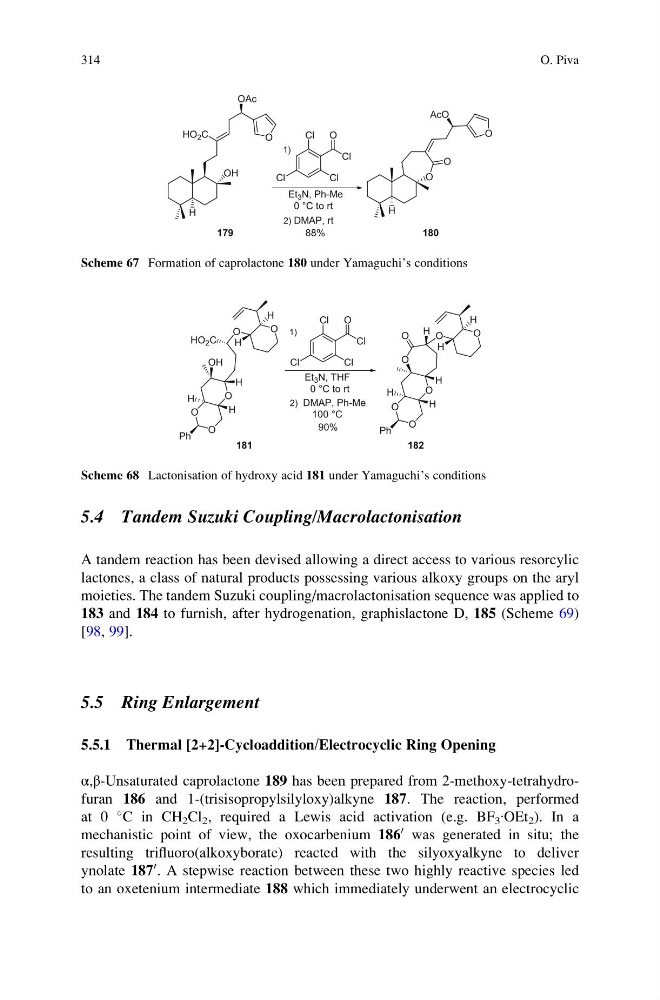
Scheme 67 Formation of caprolactone 180 under Yamaguchi’s conditions
Cl
Cl
Cl
Cl
O
1)
Et 3 N, THF
0 °C to rt
2) DMAP, Ph-Me
100 °C
O
OH
O
O
Ph
HO 2 C
O
O
H
H
O
O
O
O
Ph
O
H
H
H
H
O
O
H
H
H
182
181
90%
H
H
Scheme 68 Lactonisation of hydroxy acid 181 under Yamaguchi’s conditions
314
O. Piva
A tandem reaction has been devised allowing a direct access to various resorcylic
lactones, a class of natural products possessing various alkoxy groups on the aryl
moieties. The tandem Suzuki coupling/macrolactonisation sequence was applied to
183 and 184 to furnish, after hydrogenation, graphislactone D, 185 (Scheme 69)
[98, 99].
5.5 Ring Enlargement
5.5.1 Thermal [2+2]-Cycloaddition/Electrocyclic Ring Opening
α,β-Unsaturated caprolactone 189 has been prepared from 2-methoxy-tetrahydrofuran 186 and 1-(trisisopropylsilyloxy)alkyne 187. The reaction, performed
at 0
C in CH 2 Cl 2 , required a Lewis acid activation (e.g. BF 3 ∙OEt 2 ). In a
mechanistic point of view, the oxocarbenium 186
0 was generated in situ; the
resulting trifluoro(alkoxyborate) reacted with the silyoxyalkyne to deliver
ynolate 187
0 . A stepwise reaction between these two highly reactive species led
to an oxetenium intermediate 188 which immediately underwent an electrocyclic
OH
H
OAc
O
HO 2 C
H
O
O
AcO
O
180
Cl
Cl
Cl
Cl
O
1)
Et 3 N, Ph-Me
0 °C to rt
2) DMAP, rt
179
88%
Scheme 67 Formation of caprolactone 180 under Yamaguchi’s conditions
Cl
Cl
Cl
Cl
O
1)
Et 3 N, THF
0 °C to rt
2) DMAP, Ph-Me
100 °C
O
OH
O
O
Ph
HO 2 C
O
O
H
H
O
O
O
O
Ph
O
H
H
H
H
O
O
H
H
H
182
181
90%
H
H
Scheme 68 Lactonisation of hydroxy acid 181 under Yamaguchi’s conditions
314
O. Piva