

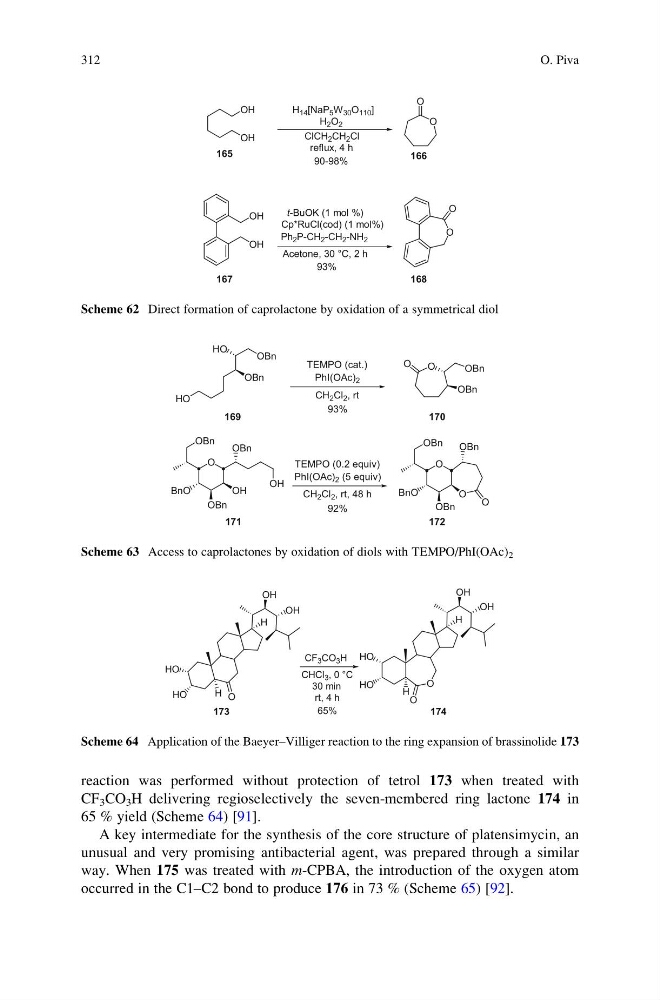
reaction was performed without protection of tetrol 173 when treated with
CF 3 CO 3 H delivering regioselectively the seven-membered ring lactone 174 in
65 % yield (Scheme 64) [91].
A key intermediate for the synthesis of the core structure of platensimycin, an
unusual and very promising antibacterial agent, was prepared through a similar
way. When 175 was treated with m-CPBA, the introduction of the oxygen atom
occurred in the C1–C2 bond to produce 176 in 73 % (Scheme 65) [92].
OH
OH
O
O
H 14 [NaP 5 W 30 O 110 ]
H 2 O 2
90-98%
OH
OH
O
O
168
t-BuOK (1 mol %)
Acetone, 30 °C, 2 h
Cp*RuCl(cod) (1 mol%)
Ph 2 P-CH 2 -CH 2 -NH 2
165
166
167
ClCH 2 CH 2 Cl
reflux, 4 h
93%
Scheme 62 Direct formation of caprolactone by oxidation of a symmetrical diol
OBn
OBn
HO
HO
O
O
OBn
OBn
170
TEMPO (cat.)
PhI(OAc) 2
CH 2 Cl 2 , rt
O
OBn
OH
OBn
BnO
OBn
TEMPO (0.2 equiv)
PhI(OAc) 2 (5 equiv)
CH 2 Cl 2 , rt, 48 h
OH
O
OBn
BnO
OBn
O
OBn
O
172
169
171
93%
92%
Scheme 63 Access to caprolactones by oxidation of diols with TEMPO/PhI(OAc) 2
HO
HO
O
H
OH
OH
H
CF 3 CO 3 H
CHCl 3 , 0 °C
30 min
rt, 4 h
173
OH
OH
H
O
HO
HO
O
174
65%
H
Scheme 64 Application of the Baeyer–Villiger reaction to the ring expansion of brassinolide 173
312
O. Piva
CF 3 CO 3 H delivering regioselectively the seven-membered ring lactone 174 in
65 % yield (Scheme 64) [91].
A key intermediate for the synthesis of the core structure of platensimycin, an
unusual and very promising antibacterial agent, was prepared through a similar
way. When 175 was treated with m-CPBA, the introduction of the oxygen atom
occurred in the C1–C2 bond to produce 176 in 73 % (Scheme 65) [92].
OH
OH
O
O
H 14 [NaP 5 W 30 O 110 ]
H 2 O 2
90-98%
OH
OH
O
O
168
t-BuOK (1 mol %)
Acetone, 30 °C, 2 h
Cp*RuCl(cod) (1 mol%)
Ph 2 P-CH 2 -CH 2 -NH 2
165
166
167
ClCH 2 CH 2 Cl
reflux, 4 h
93%
Scheme 62 Direct formation of caprolactone by oxidation of a symmetrical diol
OBn
OBn
HO
HO
O
O
OBn
OBn
170
TEMPO (cat.)
PhI(OAc) 2
CH 2 Cl 2 , rt
O
OBn
OH
OBn
BnO
OBn
TEMPO (0.2 equiv)
PhI(OAc) 2 (5 equiv)
CH 2 Cl 2 , rt, 48 h
OH
O
OBn
BnO
OBn
O
OBn
O
172
169
171
93%
92%
Scheme 63 Access to caprolactones by oxidation of diols with TEMPO/PhI(OAc) 2
HO
HO
O
H
OH
OH
H
CF 3 CO 3 H
CHCl 3 , 0 °C
30 min
rt, 4 h
173
OH
OH
H
O
HO
HO
O
174
65%
H
Scheme 64 Application of the Baeyer–Villiger reaction to the ring expansion of brassinolide 173
312
O. Piva