

5 Access to Seven-Membered Ring Lactones
A large number of methods are to the disposal of chemists to achieve the synthesis
of medium-sized lactones. Some of them, applied to the synthesis of caprolactones,
are depicted vide infra.
5.1 Oxidative Processes
5.1.1 Oxidation of Diols/Lactols and Lactonisation
The oxidation of 1,6-hexanediol is a very important chemical process, as it gives a
short access to caprolactone, a major compound in polymer chemistry. This has
been done by using a wide panel of oxidising reagents. Eco-friendly methods
combining hydrogen peroxide and heteropolyacid catalysts are very appealing for
this purpose [86]. Noteworthy also is the ruthenium-catalysed aerobic oxidation of
diols which requires highly diluted conditions to prevent extensive oligomerisation
[87]. Another oxidative lactonisation based on hydrogen transfer, catalysed by
ruthenium salts (1 mol%) in acetone, has also been tested. While the reaction was
inefficient with linear hexan-1,6-diol, introduction of a rigid biphenyl backbone led,
nearly quantitatively, to the expected lactone (Scheme 62) [88].
Access to functionalised lactones by selective oxidation of unsymmetrical diols
has also been considered. In the context of the total synthesis of (À)-brevenal,
a complex natural product possessing five oxygenated fused rings, the selective
oxidation of the primary alcohol in 169 followed by a lactonisation and a subsequent
oxidation furnished in a one-pot process, the expected lactone 170 [89]. While
primary alcohols react more rapidly than secondary ones, the overall yield is usually
excellent, as demonstrated by the conversion of 171–172 in the course of the total
synthesis of the even more challenging maitotoxin (Scheme 63) [90].
5.1.2 Baeyer–Villiger Reaction
The ring enlargement of cyclohexanones has been considered to prepare homobrassinolides which possess potential neuroprotective activities. Of interest, the
O
O
S
O
S
hn (Hanovia lamp)
Ph-Me, 70 °C, 2 h
O
OTIPS
1)
2) TBAF (3 equiv)
THF, 45 °C, 8 h
TMS
O
O
O
H
H
O
OH
H
164
163
58%
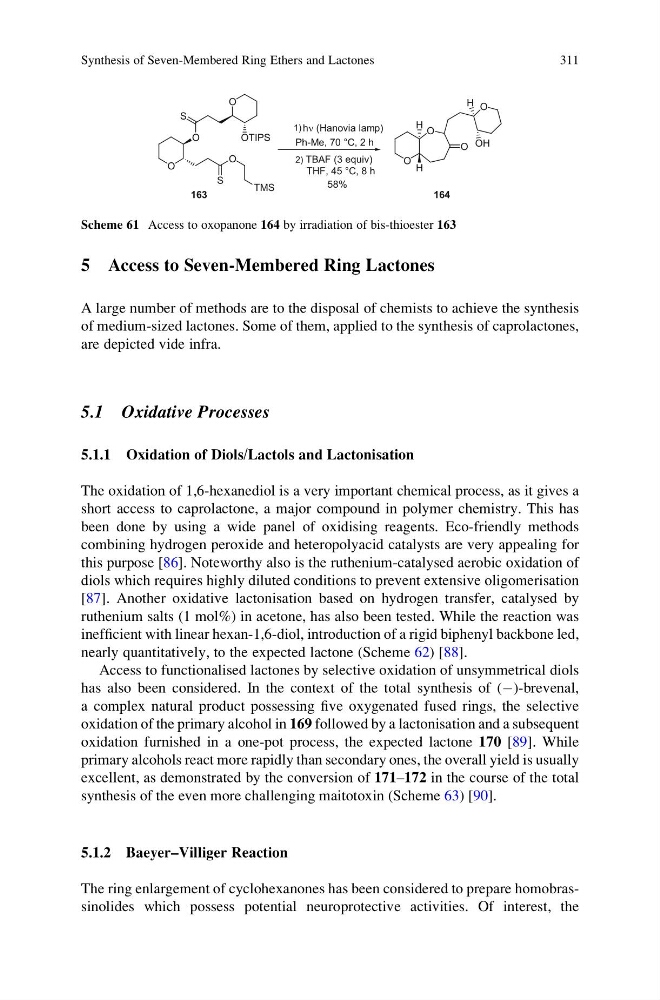
Scheme 61 Access to oxopanone 164 by irradiation of bis-thioester 163
Synthesis of Seven-Membered Ring Ethers and Lactones
311
A large number of methods are to the disposal of chemists to achieve the synthesis
of medium-sized lactones. Some of them, applied to the synthesis of caprolactones,
are depicted vide infra.
5.1 Oxidative Processes
5.1.1 Oxidation of Diols/Lactols and Lactonisation
The oxidation of 1,6-hexanediol is a very important chemical process, as it gives a
short access to caprolactone, a major compound in polymer chemistry. This has
been done by using a wide panel of oxidising reagents. Eco-friendly methods
combining hydrogen peroxide and heteropolyacid catalysts are very appealing for
this purpose [86]. Noteworthy also is the ruthenium-catalysed aerobic oxidation of
diols which requires highly diluted conditions to prevent extensive oligomerisation
[87]. Another oxidative lactonisation based on hydrogen transfer, catalysed by
ruthenium salts (1 mol%) in acetone, has also been tested. While the reaction was
inefficient with linear hexan-1,6-diol, introduction of a rigid biphenyl backbone led,
nearly quantitatively, to the expected lactone (Scheme 62) [88].
Access to functionalised lactones by selective oxidation of unsymmetrical diols
has also been considered. In the context of the total synthesis of (À)-brevenal,
a complex natural product possessing five oxygenated fused rings, the selective
oxidation of the primary alcohol in 169 followed by a lactonisation and a subsequent
oxidation furnished in a one-pot process, the expected lactone 170 [89]. While
primary alcohols react more rapidly than secondary ones, the overall yield is usually
excellent, as demonstrated by the conversion of 171–172 in the course of the total
synthesis of the even more challenging maitotoxin (Scheme 63) [90].
5.1.2 Baeyer–Villiger Reaction
The ring enlargement of cyclohexanones has been considered to prepare homobrassinolides which possess potential neuroprotective activities. Of interest, the
O
O
S
O
S
hn (Hanovia lamp)
Ph-Me, 70 °C, 2 h
O
OTIPS
1)
2) TBAF (3 equiv)
THF, 45 °C, 8 h
TMS
O
O
O
H
H
O
OH
H
164
163
58%
Scheme 61 Access to oxopanone 164 by irradiation of bis-thioester 163
Synthesis of Seven-Membered Ring Ethers and Lactones
311