

protective group fixed on the nucleophilic species plays a crucial role on the
regioselectivity of the reaction. The work of Alcaide and Almendros
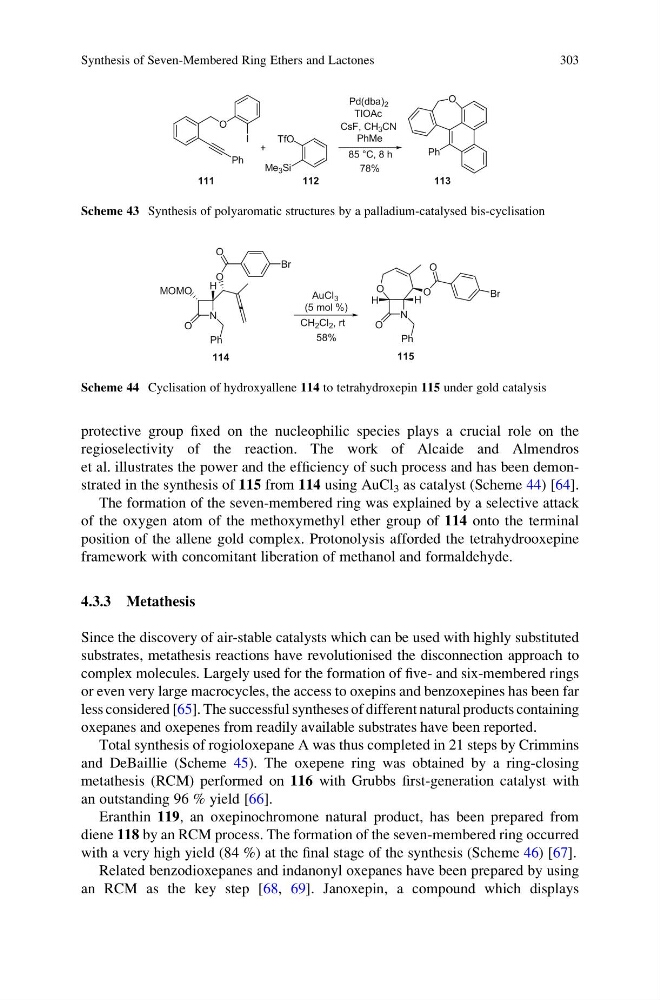
et al. illustrates the power and the efficiency of such process and has been demonstrated in the synthesis of 115 from 114 using AuCl 3 as catalyst (Scheme 44) [64].
The formation of the seven-membered ring was explained by a selective attack
of the oxygen atom of the methoxymethyl ether group of 114 onto the terminal
position of the allene gold complex. Protonolysis afforded the tetrahydrooxepine
framework with concomitant liberation of methanol and formaldehyde.
4.3.3 Metathesis
Since the discovery of air-stable catalysts which can be used with highly substituted
substrates, metathesis reactions have revolutionised the disconnection approach to
complex molecules. Largely used for the formation of five- and six-membered rings
or even very large macrocycles, the access to oxepins and benzoxepines has been far
less considered [65]. The successful syntheses of different natural products containing
oxepanes and oxepenes from readily available substrates have been reported.
Total synthesis of rogioloxepane A was thus completed in 21 steps by Crimmins
and DeBaillie (Scheme 45). The oxepene ring was obtained by a ring-closing
metathesis (RCM) performed on 116 with Grubbs first-generation catalyst with
an outstanding 96 % yield [66].
Eranthin 119, an oxepinochromone natural product, has been prepared from
diene 118 by an RCM process. The formation of the seven-membered ring occurred
with a very high yield (84 %) at the final stage of the synthesis (Scheme 46) [67].
Related benzodioxepanes and indanonyl oxepanes have been prepared by using
an RCM as the key step [68, 69]. Janoxepin, a compound which displays
N
O
MOMO
O
Ph
H
N
O
Ph
O
O
H
H
115
O
O
AuCl 3
(5 mol %)
CH 2 Cl 2 , rt
114
Br
Br
58%
Scheme 44 Cyclisation of hydroxyallene 114 to tetrahydroxepin 115 under gold catalysis
Ph
O
I
TfO
Me 3 Si
+
Pd(dba) 2
TlOAc
CsF, CH 3 CN
PhMe
85 °C, 8 h
78%
111
112
113
O
Ph
Scheme 43 Synthesis of polyaromatic structures by a palladium-catalysed bis-cyclisation
Synthesis of Seven-Membered Ring Ethers and Lactones
303
regioselectivity of the reaction. The work of Alcaide and Almendros
et al. illustrates the power and the efficiency of such process and has been demonstrated in the synthesis of 115 from 114 using AuCl 3 as catalyst (Scheme 44) [64].
The formation of the seven-membered ring was explained by a selective attack
of the oxygen atom of the methoxymethyl ether group of 114 onto the terminal
position of the allene gold complex. Protonolysis afforded the tetrahydrooxepine
framework with concomitant liberation of methanol and formaldehyde.
4.3.3 Metathesis
Since the discovery of air-stable catalysts which can be used with highly substituted
substrates, metathesis reactions have revolutionised the disconnection approach to
complex molecules. Largely used for the formation of five- and six-membered rings
or even very large macrocycles, the access to oxepins and benzoxepines has been far
less considered [65]. The successful syntheses of different natural products containing
oxepanes and oxepenes from readily available substrates have been reported.
Total synthesis of rogioloxepane A was thus completed in 21 steps by Crimmins
and DeBaillie (Scheme 45). The oxepene ring was obtained by a ring-closing
metathesis (RCM) performed on 116 with Grubbs first-generation catalyst with
an outstanding 96 % yield [66].
Eranthin 119, an oxepinochromone natural product, has been prepared from
diene 118 by an RCM process. The formation of the seven-membered ring occurred
with a very high yield (84 %) at the final stage of the synthesis (Scheme 46) [67].
Related benzodioxepanes and indanonyl oxepanes have been prepared by using
an RCM as the key step [68, 69]. Janoxepin, a compound which displays
N
O
MOMO
O
Ph
H
N
O
Ph
O
O
H
H
115
O
O
AuCl 3
(5 mol %)
CH 2 Cl 2 , rt
114
Br
Br
58%
Scheme 44 Cyclisation of hydroxyallene 114 to tetrahydroxepin 115 under gold catalysis
Ph
O
I
TfO
Me 3 Si
+
Pd(dba) 2
TlOAc
CsF, CH 3 CN
PhMe
85 °C, 8 h
78%
111
112
113
O
Ph
Scheme 43 Synthesis of polyaromatic structures by a palladium-catalysed bis-cyclisation
Synthesis of Seven-Membered Ring Ethers and Lactones
303