

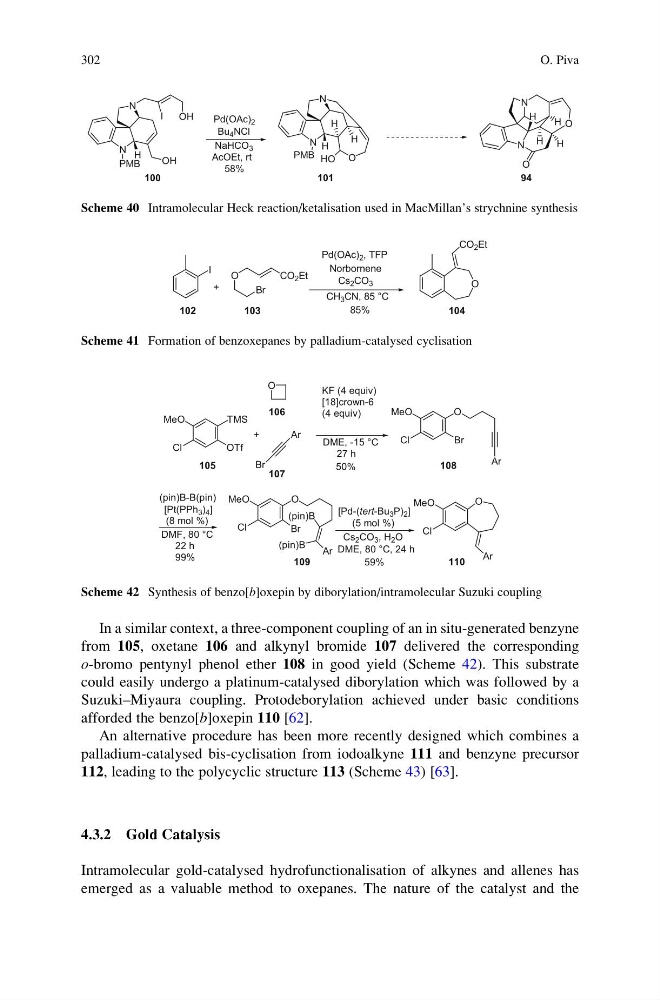
In a similar context, a three-component coupling of an in situ-generated benzyne
from 105, oxetane 106 and alkynyl bromide 107 delivered the corresponding
o-bromo pentynyl phenol ether 108 in good yield (Scheme 42). This substrate
could easily undergo a platinum-catalysed diborylation which was followed by a
Suzuki–Miyaura coupling. Protodeborylation achieved under basic conditions
afforded the benzo[b]oxepin 110 [62].
An alternative procedure has been more recently designed which combines a
palladium-catalysed bis-cyclisation from iodoalkyne 111 and benzyne precursor
112, leading to the polycyclic structure 113 (Scheme 43) [63].
4.3.2 Gold Catalysis
Intramolecular gold-catalysed hydrofunctionalisation of alkynes and allenes has
emerged as a valuable method to oxepanes. The nature of the catalyst and the
N
N
PMB
O
HO
101
H
H
H
Pd(OAc) 2
Bu 4 NCl
NaHCO 3
AcOEt, rt
N
N
PMB
OH
I
OH
H
100
58%
94
N
O
H
H
N
H
O
H
Scheme 40 Intramolecular Heck reaction/ketalisation used in MacMillan’s strychnine synthesis
I
Br
CO 2 Et
O
O
CO 2 Et
104
Pd(OAc) 2 , TFP
Norbornene
Cs 2 CO 3
CH 3 CN, 85 °C
+
85%
102
103
Scheme 41 Formation of benzoxepanes by palladium-catalysed cyclisation
TMS
OTf
MeO
Cl
O
Br
O
Br
MeO
Cl
Ar
O
Br
MeO
Cl
O
Ar
MeO
Cl
+
Ar
108
109
110
107
105
106
KF (4 equiv)
[18]crown-6
(4 equiv)
DME, -15 °C
27 h
50%
(pin)B-B(pin)
(8 mol %)
[Pt(PPh 3 ) 4 ]
DMF, 80 °C
22 h
99%
[Pd-(tert-Bu 3 P) 2 ]
(pin)B
Ar
(pin)B
(5 mol %)
DME, 80 °C, 24 h
Cs 2 CO 3 , H 2 O
59%
Scheme 42 Synthesis of benzo[b]oxepin by diborylation/intramolecular Suzuki coupling
302
O. Piva
from 105, oxetane 106 and alkynyl bromide 107 delivered the corresponding
o-bromo pentynyl phenol ether 108 in good yield (Scheme 42). This substrate
could easily undergo a platinum-catalysed diborylation which was followed by a
Suzuki–Miyaura coupling. Protodeborylation achieved under basic conditions
afforded the benzo[b]oxepin 110 [62].
An alternative procedure has been more recently designed which combines a
palladium-catalysed bis-cyclisation from iodoalkyne 111 and benzyne precursor
112, leading to the polycyclic structure 113 (Scheme 43) [63].
4.3.2 Gold Catalysis
Intramolecular gold-catalysed hydrofunctionalisation of alkynes and allenes has
emerged as a valuable method to oxepanes. The nature of the catalyst and the
N
N
PMB
O
HO
101
H
H
H
Pd(OAc) 2
Bu 4 NCl
NaHCO 3
AcOEt, rt
N
N
PMB
OH
I
OH
H
100
58%
94
N
O
H
H
N
H
O
H
Scheme 40 Intramolecular Heck reaction/ketalisation used in MacMillan’s strychnine synthesis
I
Br
CO 2 Et
O
O
CO 2 Et
104
Pd(OAc) 2 , TFP
Norbornene
Cs 2 CO 3
CH 3 CN, 85 °C
+
85%
102
103
Scheme 41 Formation of benzoxepanes by palladium-catalysed cyclisation
TMS
OTf
MeO
Cl
O
Br
O
Br
MeO
Cl
Ar
O
Br
MeO
Cl
O
Ar
MeO
Cl
+
Ar
108
109
110
107
105
106
KF (4 equiv)
[18]crown-6
(4 equiv)
DME, -15 °C
27 h
50%
(pin)B-B(pin)
(8 mol %)
[Pt(PPh 3 ) 4 ]
DMF, 80 °C
22 h
99%
[Pd-(tert-Bu 3 P) 2 ]
(pin)B
Ar
(pin)B
(5 mol %)
DME, 80 °C, 24 h
Cs 2 CO 3 , H 2 O
59%
Scheme 42 Synthesis of benzo[b]oxepin by diborylation/intramolecular Suzuki coupling
302
O. Piva