

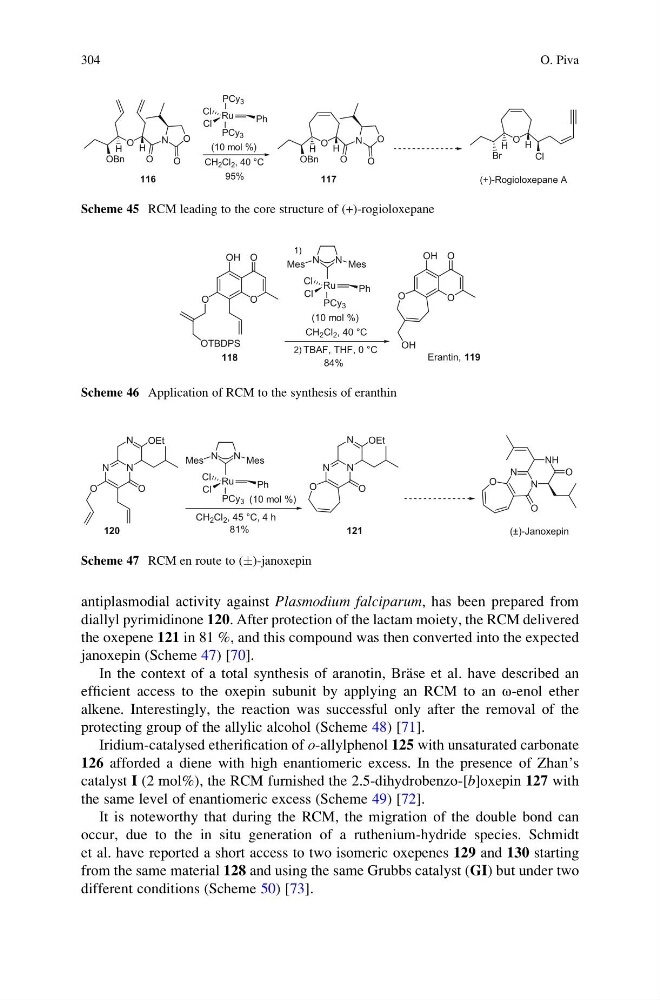
antiplasmodial activity against Plasmodium falciparum, has been prepared from
diallyl pyrimidinone 120. After protection of the lactam moiety, the RCM delivered
the oxepene 121 in 81 %, and this compound was then converted into the expected
janoxepin (Scheme 47) [70].
In the context of a total synthesis of aranotin, Bra ¨se et al. have described an
efficient access to the oxepin subunit by applying an RCM to an ω-enol ether
alkene. Interestingly, the reaction was successful only after the removal of the
protecting group of the allylic alcohol (Scheme 48) [71].
Iridium-catalysed etherification of o-allylphenol 125 with unsaturated carbonate
126 afforded a diene with high enantiomeric excess. In the presence of Zhan’s
catalyst I (2 mol%), the RCM furnished the 2.5-dihydrobenzo-[b]oxepin 127 with
the same level of enantiomeric excess (Scheme 49) [72].
It is noteworthy that during the RCM, the migration of the double bond can
occur, due to the in situ generation of a ruthenium-hydride species. Schmidt
et al. have reported a short access to two isomeric oxepenes 129 and 130 starting
from the same material 128 and using the same Grubbs catalyst (GI) but under two
different conditions (Scheme 50) [73].
O
N
O
O
O
OBn
H
H
Ru
Ph
PCy 3
PCy 3
Cl
Cl
CH 2 Cl 2 , 40 °C
(10 mol %)
O
N
O
O
O
OBn
H
H
116
117
95%
O
Cl
Br
H
H
(+)-Rogioloxepane A
Scheme 45 RCM leading to the core structure of (+)-rogioloxepane
Ru
Ph
PCy 3
Cl
Cl
CH 2 Cl 2 , 40 °C
(10 mol %)
N
N
Mes
Mes
O
O
OH
O
O
O
OH
O
OH
1)
2) TBAF, THF, 0 °C
Erantin, 119
OTBDPS
118
84%
Scheme 46 Application of RCM to the synthesis of eranthin
N
N
N
OEt
O
O
121
Ru
Ph
PCy 3
Cl
Cl
CH 2 Cl 2 , 45 °C, 4 h
(10 mol %)
N
N
Mes
Mes
N
N
N
OEt
O
O
120
81%
N
N
NH
O
O
(±)-Janoxepin
O
Scheme 47 RCM en route to (Æ)-janoxepin
304
O. Piva
diallyl pyrimidinone 120. After protection of the lactam moiety, the RCM delivered
the oxepene 121 in 81 %, and this compound was then converted into the expected
janoxepin (Scheme 47) [70].
In the context of a total synthesis of aranotin, Bra ¨se et al. have described an
efficient access to the oxepin subunit by applying an RCM to an ω-enol ether
alkene. Interestingly, the reaction was successful only after the removal of the
protecting group of the allylic alcohol (Scheme 48) [71].
Iridium-catalysed etherification of o-allylphenol 125 with unsaturated carbonate
126 afforded a diene with high enantiomeric excess. In the presence of Zhan’s
catalyst I (2 mol%), the RCM furnished the 2.5-dihydrobenzo-[b]oxepin 127 with
the same level of enantiomeric excess (Scheme 49) [72].
It is noteworthy that during the RCM, the migration of the double bond can
occur, due to the in situ generation of a ruthenium-hydride species. Schmidt
et al. have reported a short access to two isomeric oxepenes 129 and 130 starting
from the same material 128 and using the same Grubbs catalyst (GI) but under two
different conditions (Scheme 50) [73].
O
N
O
O
O
OBn
H
H
Ru
Ph
PCy 3
PCy 3
Cl
Cl
CH 2 Cl 2 , 40 °C
(10 mol %)
O
N
O
O
O
OBn
H
H
116
117
95%
O
Cl
Br
H
H
(+)-Rogioloxepane A
Scheme 45 RCM leading to the core structure of (+)-rogioloxepane
Ru
Ph
PCy 3
Cl
Cl
CH 2 Cl 2 , 40 °C
(10 mol %)
N
N
Mes
Mes
O
O
OH
O
O
O
OH
O
OH
1)
2) TBAF, THF, 0 °C
Erantin, 119
OTBDPS
118
84%
Scheme 46 Application of RCM to the synthesis of eranthin
N
N
N
OEt
O
O
121
Ru
Ph
PCy 3
Cl
Cl
CH 2 Cl 2 , 45 °C, 4 h
(10 mol %)
N
N
Mes
Mes
N
N
N
OEt
O
O
120
81%
N
N
NH
O
O
(±)-Janoxepin
O
Scheme 47 RCM en route to (Æ)-janoxepin
304
O. Piva