

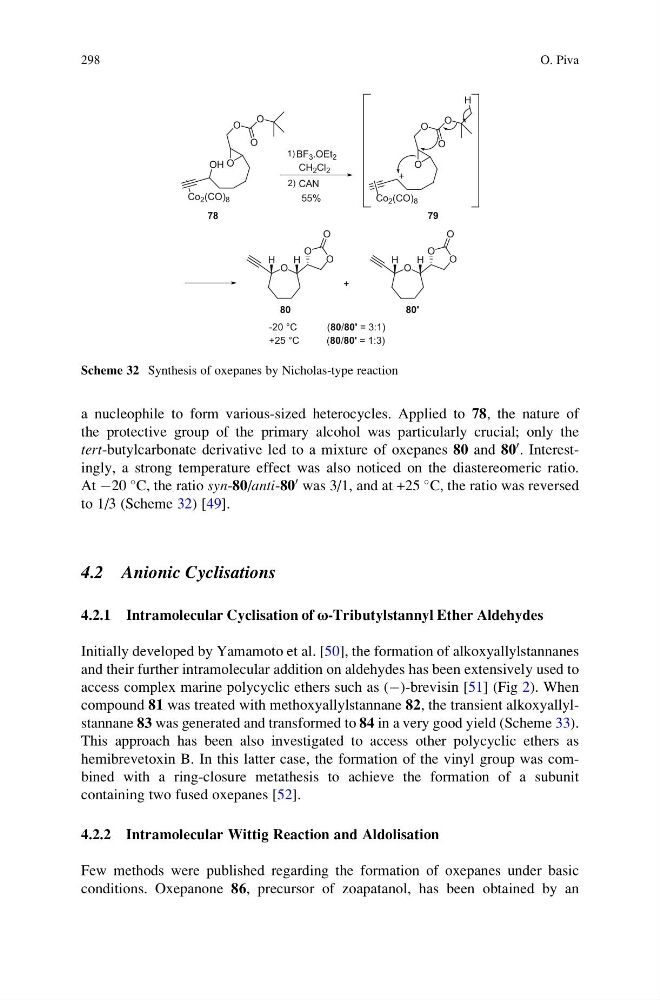
a nucleophile to form various-sized heterocycles. Applied to 78, the nature of
the protective group of the primary alcohol was particularly crucial; only the
tert-butylcarbonate derivative led to a mixture of oxepanes 80 and 80
0 . Interestingly, a strong temperature effect was also noticed on the diastereomeric ratio.
At À20
C, the ratio syn-80/anti-80
0 was 3/1, and at +25
C, the ratio was reversed
to 1/3 (Scheme 32) [49].
4.2 Anionic Cyclisations
4.2.1 Intramolecular Cyclisation of ω-Tributylstannyl Ether Aldehydes
Initially developed by Yamamoto et al. [50], the formation of alkoxyallylstannanes
and their further intramolecular addition on aldehydes has been extensively used to
access complex marine polycyclic ethers such as (À)-brevisin [51] (Fig 2). When
compound 81 was treated with methoxyallylstannane 82, the transient alkoxyallylstannane 83 was generated and transformed to 84 in a very good yield (Scheme 33).
This approach has been also investigated to access other polycyclic ethers as
hemibrevetoxin B. In this latter case, the formation of the vinyl group was combined with a ring-closure metathesis to achieve the formation of a subunit
containing two fused oxepanes [52].
4.2.2 Intramolecular Wittig Reaction and Aldolisation
Few methods were published regarding the formation of oxepanes under basic
conditions. Oxepanone 86, precursor of zoapatanol, has been obtained by an
Co 2 (CO) 8
BF 3 .OEt 2
CH 2 Cl 2
Co 2 (CO) 8
O
O
O
O
H
O
H
O
O
O
H
O
H
O
O
O
H
1)
2) CAN
-20 °C
(80/80' = 3:1)
+25 °C
(80/80' = 1:3)
78
55%
79
80
80'
+
O
O
O
O
OH
Scheme 32 Synthesis of oxepanes by Nicholas-type reaction
298
O. Piva
the protective group of the primary alcohol was particularly crucial; only the
tert-butylcarbonate derivative led to a mixture of oxepanes 80 and 80
0 . Interestingly, a strong temperature effect was also noticed on the diastereomeric ratio.
At À20
C, the ratio syn-80/anti-80
0 was 3/1, and at +25
C, the ratio was reversed
to 1/3 (Scheme 32) [49].
4.2 Anionic Cyclisations
4.2.1 Intramolecular Cyclisation of ω-Tributylstannyl Ether Aldehydes
Initially developed by Yamamoto et al. [50], the formation of alkoxyallylstannanes
and their further intramolecular addition on aldehydes has been extensively used to
access complex marine polycyclic ethers such as (À)-brevisin [51] (Fig 2). When
compound 81 was treated with methoxyallylstannane 82, the transient alkoxyallylstannane 83 was generated and transformed to 84 in a very good yield (Scheme 33).
This approach has been also investigated to access other polycyclic ethers as
hemibrevetoxin B. In this latter case, the formation of the vinyl group was combined with a ring-closure metathesis to achieve the formation of a subunit
containing two fused oxepanes [52].
4.2.2 Intramolecular Wittig Reaction and Aldolisation
Few methods were published regarding the formation of oxepanes under basic
conditions. Oxepanone 86, precursor of zoapatanol, has been obtained by an
Co 2 (CO) 8
BF 3 .OEt 2
CH 2 Cl 2
Co 2 (CO) 8
O
O
O
O
H
O
H
O
O
O
H
O
H
O
O
O
H
1)
2) CAN
-20 °C
(80/80' = 3:1)
+25 °C
(80/80' = 1:3)
78
55%
79
80
80'
+
O
O
O
O
OH
Scheme 32 Synthesis of oxepanes by Nicholas-type reaction
298
O. Piva