

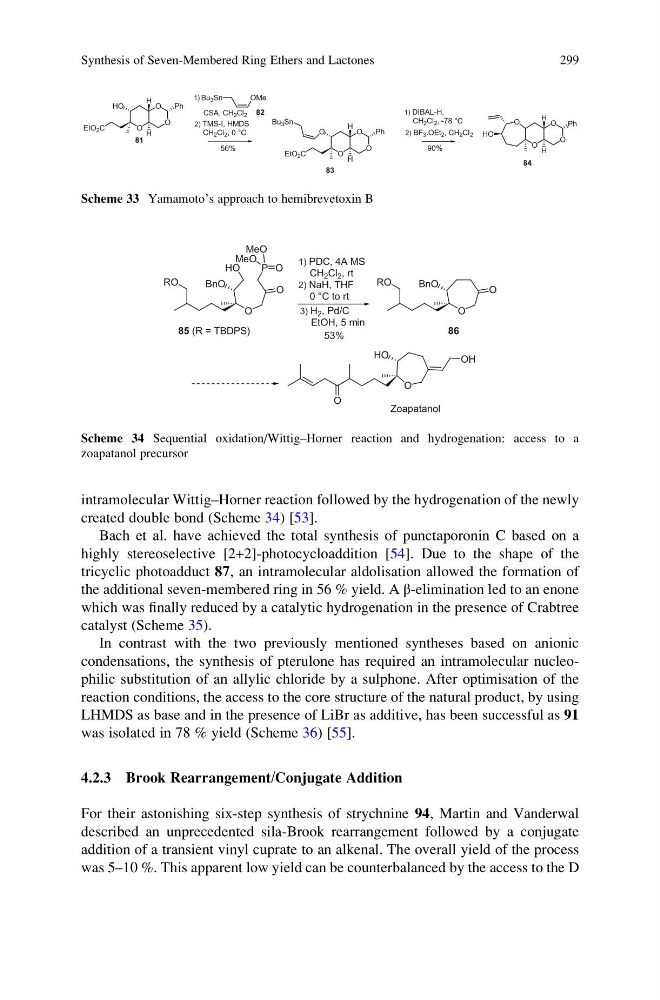
intramolecular Wittig–Horner reaction followed by the hydrogenation of the newly
created double bond (Scheme 34) [53].
Bach et al. have achieved the total synthesis of punctaporonin C based on a
highly stereoselective [2+2]-photocycloaddition [54]. Due to the shape of the
tricyclic photoadduct 87, an intramolecular aldolisation allowed the formation of
the additional seven-membered ring in 56 % yield. A β-elimination led to an enone
which was finally reduced by a catalytic hydrogenation in the presence of Crabtree
catalyst (Scheme 35).
In contrast with the two previously mentioned syntheses based on anionic
condensations, the synthesis of pterulone has required an intramolecular nucleophilic substitution of an allylic chloride by a sulphone. After optimisation of the
reaction conditions, the access to the core structure of the natural product, by using
LHMDS as base and in the presence of LiBr as additive, has been successful as 91
was isolated in 78 % yield (Scheme 36) [55].
4.2.3 Brook Rearrangement/Conjugate Addition
For their astonishing six-step synthesis of strychnine 94, Martin and Vanderwal
described an unprecedented sila-Brook rearrangement followed by a conjugate
addition of a transient vinyl cuprate to an alkenal. The overall yield of the process
was 5–10 %. This apparent low yield can be counterbalanced by the access to the D
O
O
O
P h
H
H
HO
EtO 2 C
81
O
O
O
P h
H
H
O
EtO 2 C
Bu 3 Sn
83
56%
OMe
Bu 3 Sn
CSA, CH 2 Cl 2
1)
2) TMS-I, HMDS
CH 2 Cl 2 , 0 °C
82
1) DIBAL-H,
CH 2 Cl 2 , -78 °C
2) BF 3 .OEt 2 , CH 2 Cl 2
O
O
O Ph
H
H
O
HO
84
90%
Scheme 33 Yamamoto’s approach to hemibrevetoxin B
O
O
P O
MeO
MeO
HO
BnO
1) PDC, 4A MS
CH 2 Cl 2 , rt
2) NaH, THF
0 °C to rt
RO
85 (R = TBDPS)
3) H 2 , Pd/C
EtOH, 5 min
O
O
BnO
RO
86
53%
O
OH
HO
O
Zoapatanol
Scheme 34 Sequential oxidation/Wittig–Horner reaction and hydrogenation: access to a
zoapatanol precursor
Synthesis of Seven-Membered Ring Ethers and Lactones
299
created double bond (Scheme 34) [53].
Bach et al. have achieved the total synthesis of punctaporonin C based on a
highly stereoselective [2+2]-photocycloaddition [54]. Due to the shape of the
tricyclic photoadduct 87, an intramolecular aldolisation allowed the formation of
the additional seven-membered ring in 56 % yield. A β-elimination led to an enone
which was finally reduced by a catalytic hydrogenation in the presence of Crabtree
catalyst (Scheme 35).
In contrast with the two previously mentioned syntheses based on anionic
condensations, the synthesis of pterulone has required an intramolecular nucleophilic substitution of an allylic chloride by a sulphone. After optimisation of the
reaction conditions, the access to the core structure of the natural product, by using
LHMDS as base and in the presence of LiBr as additive, has been successful as 91
was isolated in 78 % yield (Scheme 36) [55].
4.2.3 Brook Rearrangement/Conjugate Addition
For their astonishing six-step synthesis of strychnine 94, Martin and Vanderwal
described an unprecedented sila-Brook rearrangement followed by a conjugate
addition of a transient vinyl cuprate to an alkenal. The overall yield of the process
was 5–10 %. This apparent low yield can be counterbalanced by the access to the D
O
O
O
P h
H
H
HO
EtO 2 C
81
O
O
O
P h
H
H
O
EtO 2 C
Bu 3 Sn
83
56%
OMe
Bu 3 Sn
CSA, CH 2 Cl 2
1)
2) TMS-I, HMDS
CH 2 Cl 2 , 0 °C
82
1) DIBAL-H,
CH 2 Cl 2 , -78 °C
2) BF 3 .OEt 2 , CH 2 Cl 2
O
O
O Ph
H
H
O
HO
84
90%
Scheme 33 Yamamoto’s approach to hemibrevetoxin B
O
O
P O
MeO
MeO
HO
BnO
1) PDC, 4A MS
CH 2 Cl 2 , rt
2) NaH, THF
0 °C to rt
RO
85 (R = TBDPS)
3) H 2 , Pd/C
EtOH, 5 min
O
O
BnO
RO
86
53%
O
OH
HO
O
Zoapatanol
Scheme 34 Sequential oxidation/Wittig–Horner reaction and hydrogenation: access to a
zoapatanol precursor
Synthesis of Seven-Membered Ring Ethers and Lactones
299