

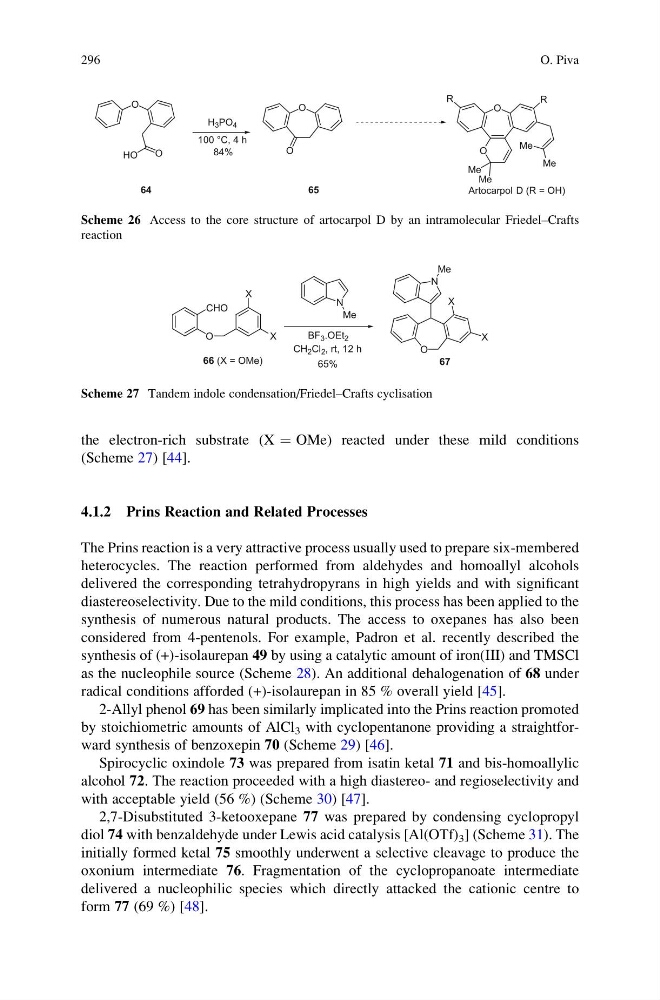
the electron-rich substrate (X ¼ OMe) reacted under these mild conditions
(Scheme 27) [44].
4.1.2 Prins Reaction and Related Processes
The Prins reaction is a very attractive process usually used to prepare six-membered
heterocycles. The reaction performed from aldehydes and homoallyl alcohols
delivered the corresponding tetrahydropyrans in high yields and with significant
diastereoselectivity. Due to the mild conditions, this process has been applied to the
synthesis of numerous natural products. The access to oxepanes has also been
considered from 4-pentenols. For example, Padron et al. recently described the
synthesis of (+)-isolaurepan 49 by using a catalytic amount of iron(III) and TMSCl
as the nucleophile source (Scheme 28). An additional dehalogenation of 68 under
radical conditions afforded (+)-isolaurepan in 85 % overall yield [45].
2-Allyl phenol 69 has been similarly implicated into the Prins reaction promoted
by stoichiometric amounts of AlCl 3 with cyclopentanone providing a straightforward synthesis of benzoxepin 70 (Scheme 29) [46].
Spirocyclic oxindole 73 was prepared from isatin ketal 71 and bis-homoallylic
alcohol 72. The reaction proceeded with a high diastereo- and regioselectivity and
with acceptable yield (56 %) (Scheme 30) [47].
2,7-Disubstituted 3-ketooxepane 77 was prepared by condensing cyclopropyl
diol 74 with benzaldehyde under Lewis acid catalysis [Al(OTf) 3 ] (Scheme 31). The
initially formed ketal 75 smoothly underwent a selective cleavage to produce the
oxonium intermediate 76. Fragmentation of the cyclopropanoate intermediate
delivered a nucleophilic species which directly attacked the cationic centre to
form 77 (69 %) [48].
O
HO
O
O
O
H 3 PO 4
100 °C, 4 h
65
84%
O
O
Me
Me
Artocarpol D (R = OH)
Me
Me
R
R
64
Scheme 26 Access to the core structure of artocarpol D by an intramolecular Friedel–Crafts
reaction
CHO
O
X
X
N
Me
BF 3 .OEt 2
66 (X = OMe)
O
X
X
N
Me
67
CH 2 Cl 2 , rt, 12 h
65%
Scheme 27 Tandem indole condensation/Friedel–Crafts cyclisation
296
O. Piva
(Scheme 27) [44].
4.1.2 Prins Reaction and Related Processes
The Prins reaction is a very attractive process usually used to prepare six-membered
heterocycles. The reaction performed from aldehydes and homoallyl alcohols
delivered the corresponding tetrahydropyrans in high yields and with significant
diastereoselectivity. Due to the mild conditions, this process has been applied to the
synthesis of numerous natural products. The access to oxepanes has also been
considered from 4-pentenols. For example, Padron et al. recently described the
synthesis of (+)-isolaurepan 49 by using a catalytic amount of iron(III) and TMSCl
as the nucleophile source (Scheme 28). An additional dehalogenation of 68 under
radical conditions afforded (+)-isolaurepan in 85 % overall yield [45].
2-Allyl phenol 69 has been similarly implicated into the Prins reaction promoted
by stoichiometric amounts of AlCl 3 with cyclopentanone providing a straightforward synthesis of benzoxepin 70 (Scheme 29) [46].
Spirocyclic oxindole 73 was prepared from isatin ketal 71 and bis-homoallylic
alcohol 72. The reaction proceeded with a high diastereo- and regioselectivity and
with acceptable yield (56 %) (Scheme 30) [47].
2,7-Disubstituted 3-ketooxepane 77 was prepared by condensing cyclopropyl
diol 74 with benzaldehyde under Lewis acid catalysis [Al(OTf) 3 ] (Scheme 31). The
initially formed ketal 75 smoothly underwent a selective cleavage to produce the
oxonium intermediate 76. Fragmentation of the cyclopropanoate intermediate
delivered a nucleophilic species which directly attacked the cationic centre to
form 77 (69 %) [48].
O
HO
O
O
O
H 3 PO 4
100 °C, 4 h
65
84%
O
O
Me
Me
Artocarpol D (R = OH)
Me
Me
R
R
64
Scheme 26 Access to the core structure of artocarpol D by an intramolecular Friedel–Crafts
reaction
CHO
O
X
X
N
Me
BF 3 .OEt 2
66 (X = OMe)
O
X
X
N
Me
67
CH 2 Cl 2 , rt, 12 h
65%
Scheme 27 Tandem indole condensation/Friedel–Crafts cyclisation
296
O. Piva