

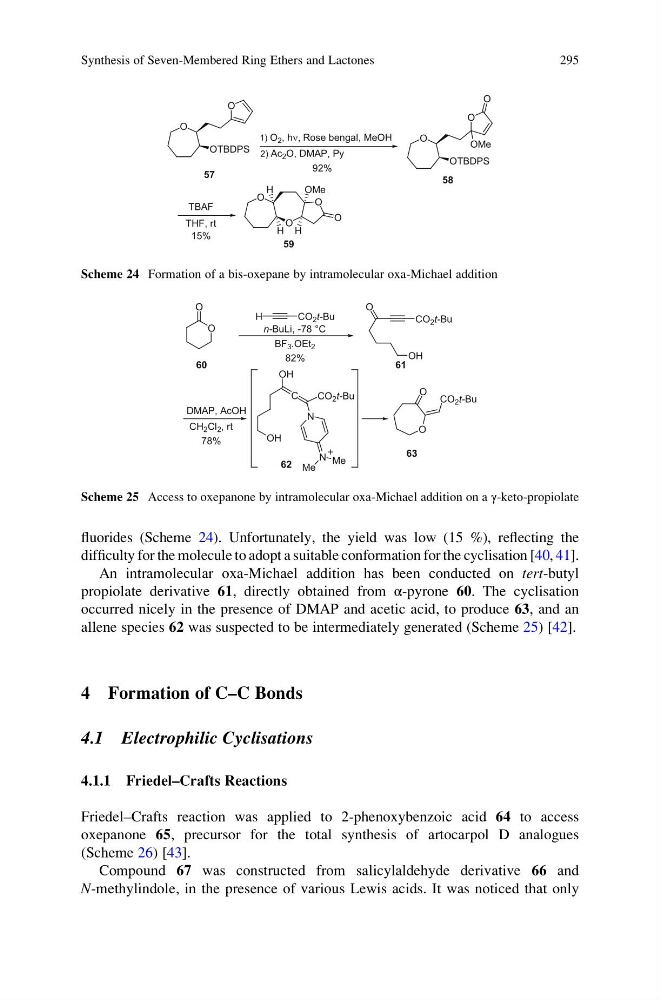
fluorides (Scheme 24). Unfortunately, the yield was low (15 %), reflecting the
difficulty for the molecule to adopt a suitable conformation for the cyclisation [40, 41].
An intramolecular oxa-Michael addition has been conducted on tert-butyl
propiolate derivative 61, directly obtained from α-pyrone 60. The cyclisation
occurred nicely in the presence of DMAP and acetic acid, to produce 63, and an
allene species 62 was suspected to be intermediately generated (Scheme 25) [42].
4 Formation of C–C Bonds
4.1 Electrophilic Cyclisations
4.1.1 Friedel–Crafts Reactions
Friedel–Crafts reaction was applied to 2-phenoxybenzoic acid 64 to access
oxepanone 65, precursor for the total synthesis of artocarpol D analogues
(Scheme 26) [43].
Compound 67 was constructed from salicylaldehyde derivative 66 and
N-methylindole, in the presence of various Lewis acids. It was noticed that only
O
O
H
C O 2 t-Bu
n-BuLi, -78 °C
BF 3 .OEt 2
O
CO 2 t-Bu
OH
CH 2 Cl 2 , rt
O
C
OH
CO 2 t-Bu
N
OH
N
Me
Me
O
CO 2 t-Bu
61
63
62
60
82%
78%
DMAP, AcOH
Scheme 25 Access to oxepanone by intramolecular oxa-Michael addition on a γ-keto-propiolate
O
OTBDPS
O
1) O 2 , hn, Rose bengal, MeOH
2) Ac 2 O, DMAP, Py
O
OTBDPS
O
O
58
O
O
O
O
H
H
OMe
H
OMe
59
TBAF
THF, rt
57
92%
15%
Scheme 24 Formation of a bis-oxepane by intramolecular oxa-Michael addition
Synthesis of Seven-Membered Ring Ethers and Lactones
295
difficulty for the molecule to adopt a suitable conformation for the cyclisation [40, 41].
An intramolecular oxa-Michael addition has been conducted on tert-butyl
propiolate derivative 61, directly obtained from α-pyrone 60. The cyclisation
occurred nicely in the presence of DMAP and acetic acid, to produce 63, and an
allene species 62 was suspected to be intermediately generated (Scheme 25) [42].
4 Formation of C–C Bonds
4.1 Electrophilic Cyclisations
4.1.1 Friedel–Crafts Reactions
Friedel–Crafts reaction was applied to 2-phenoxybenzoic acid 64 to access
oxepanone 65, precursor for the total synthesis of artocarpol D analogues
(Scheme 26) [43].
Compound 67 was constructed from salicylaldehyde derivative 66 and
N-methylindole, in the presence of various Lewis acids. It was noticed that only
O
O
H
C O 2 t-Bu
n-BuLi, -78 °C
BF 3 .OEt 2
O
CO 2 t-Bu
OH
CH 2 Cl 2 , rt
O
C
OH
CO 2 t-Bu
N
OH
N
Me
Me
O
CO 2 t-Bu
61
63
62
60
82%
78%
DMAP, AcOH
Scheme 25 Access to oxepanone by intramolecular oxa-Michael addition on a γ-keto-propiolate
O
OTBDPS
O
1) O 2 , hn, Rose bengal, MeOH
2) Ac 2 O, DMAP, Py
O
OTBDPS
O
O
58
O
O
O
O
H
H
OMe
H
OMe
59
TBAF
THF, rt
57
92%
15%
Scheme 24 Formation of a bis-oxepane by intramolecular oxa-Michael addition
Synthesis of Seven-Membered Ring Ethers and Lactones
295