

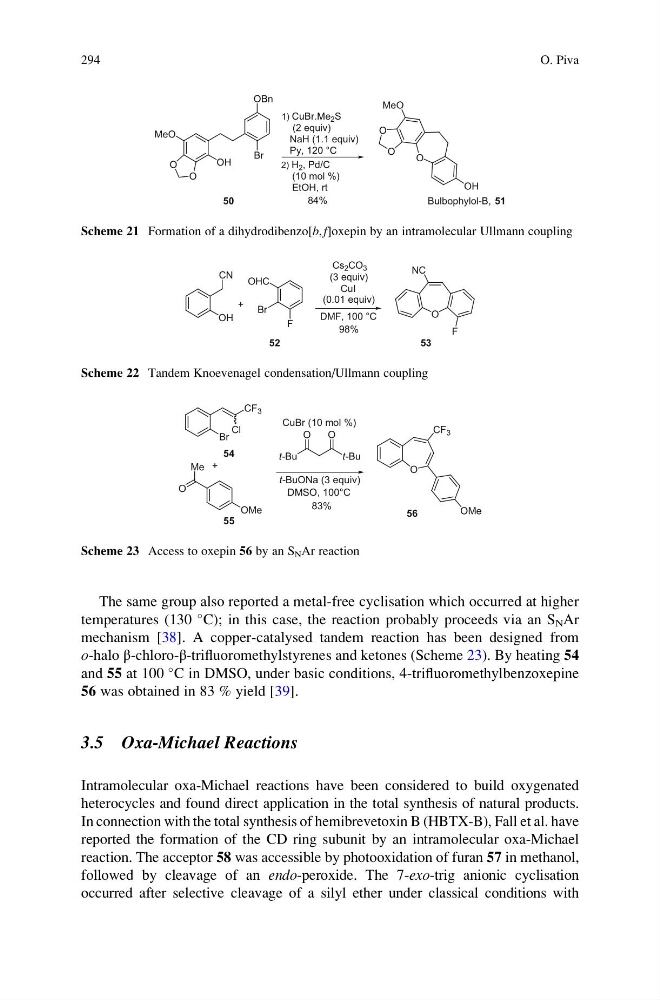
The same group also reported a metal-free cyclisation which occurred at higher
temperatures (130
C); in this case, the reaction probably proceeds via an S N Ar
mechanism [38]. A copper-catalysed tandem reaction has been designed from
o-halo β-chloro-β-trifluoromethylstyrenes and ketones (Scheme 23). By heating 54
and 55 at 100
C in DMSO, under basic conditions, 4-trifluoromethylbenzoxepine
56 was obtained in 83 % yield [39].
3.5 Oxa-Michael Reactions
Intramolecular oxa-Michael reactions have been considered to build oxygenated
heterocycles and found direct application in the total synthesis of natural products.
In connection with the total synthesis of hemibrevetoxin B (HBTX-B), Fall et al. have
reported the formation of the CD ring subunit by an intramolecular oxa-Michael
reaction. The acceptor 58 was accessible by photooxidation of furan 57 in methanol,
followed by cleavage of an endo-peroxide. The 7-exo-trig anionic cyclisation
occurred after selective cleavage of a silyl ether under classical conditions with
OH
Br
OBn
MeO
O
O
O
OH
O
O
MeO
1) CuBr.Me 2 S
(2 equiv)
NaH (1.1 equiv)
Py, 120 °C
2) H 2 , Pd/C
(10 mol %)
EtOH, rt
Bulbophylol-B, 51
50
84%
Scheme 21 Formation of a dihydrodibenzo[b, f]oxepin by an intramolecular Ullmann coupling
OH
CN
F
OHC
Br
+
O
F
NC
Cs 2 CO 3
(3 equiv)
CuI
(0.01 equiv)
DMF, 100 °C
53
52
98%
Scheme 22 Tandem Knoevenagel condensation/Ullmann coupling
CF 3
Cl
Br
O
Me
OMe
+
O
CF 3
OMe
CuBr (10 mol %)
t-Bu
t-Bu
O
O
t-BuONa (3 equiv)
DMSO, 100°C
56
83%
54
55
Scheme 23 Access to oxepin 56 by an S N Ar reaction
294
O. Piva
temperatures (130
C); in this case, the reaction probably proceeds via an S N Ar
mechanism [38]. A copper-catalysed tandem reaction has been designed from
o-halo β-chloro-β-trifluoromethylstyrenes and ketones (Scheme 23). By heating 54
and 55 at 100
C in DMSO, under basic conditions, 4-trifluoromethylbenzoxepine
56 was obtained in 83 % yield [39].
3.5 Oxa-Michael Reactions
Intramolecular oxa-Michael reactions have been considered to build oxygenated
heterocycles and found direct application in the total synthesis of natural products.
In connection with the total synthesis of hemibrevetoxin B (HBTX-B), Fall et al. have
reported the formation of the CD ring subunit by an intramolecular oxa-Michael
reaction. The acceptor 58 was accessible by photooxidation of furan 57 in methanol,
followed by cleavage of an endo-peroxide. The 7-exo-trig anionic cyclisation
occurred after selective cleavage of a silyl ether under classical conditions with
OH
Br
OBn
MeO
O
O
O
OH
O
O
MeO
1) CuBr.Me 2 S
(2 equiv)
NaH (1.1 equiv)
Py, 120 °C
2) H 2 , Pd/C
(10 mol %)
EtOH, rt
Bulbophylol-B, 51
50
84%
Scheme 21 Formation of a dihydrodibenzo[b, f]oxepin by an intramolecular Ullmann coupling
OH
CN
F
OHC
Br
+
O
F
NC
Cs 2 CO 3
(3 equiv)
CuI
(0.01 equiv)
DMF, 100 °C
53
52
98%
Scheme 22 Tandem Knoevenagel condensation/Ullmann coupling
CF 3
Cl
Br
O
Me
OMe
+
O
CF 3
OMe
CuBr (10 mol %)
t-Bu
t-Bu
O
O
t-BuONa (3 equiv)
DMSO, 100°C
56
83%
54
55
Scheme 23 Access to oxepin 56 by an S N Ar reaction
294
O. Piva