

3.1.2 Haloetherification
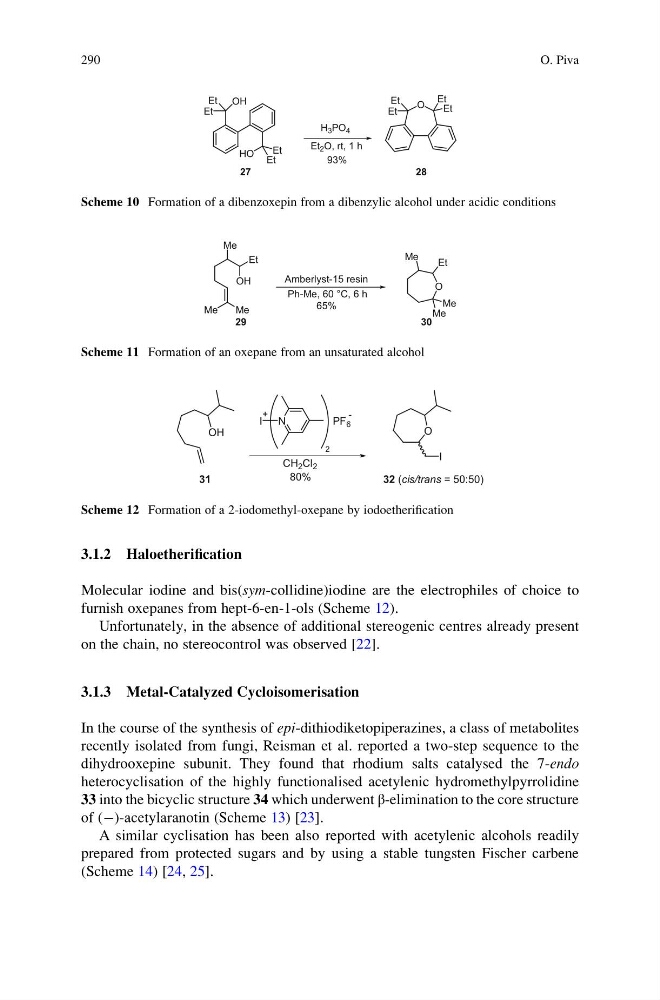
Molecular iodine and bis(sym-collidine)iodine are the electrophiles of choice to
furnish oxepanes from hept-6-en-1-ols (Scheme 12).
Unfortunately, in the absence of additional stereogenic centres already present
on the chain, no stereocontrol was observed [22].
3.1.3 Metal-Catalyzed Cycloisomerisation
In the course of the synthesis of epi-dithiodiketopiperazines, a class of metabolites
recently isolated from fungi, Reisman et al. reported a two-step sequence to the
dihydrooxepine subunit. They found that rhodium salts catalysed the 7-endo
heterocyclisation of the highly functionalised acetylenic hydromethylpyrrolidine
33 into the bicyclic structure 34 which underwent β-elimination to the core structure
of (À)-acetylaranotin (Scheme 13) [23].
A similar cyclisation has been also reported with acetylenic alcohols readily
prepared from protected sugars and by using a stable tungsten Fischer carbene
(Scheme 14) [24, 25].
OH
Et
Et
HO Et
Et
H 3 PO 4
Et 2 O, rt, 1 h
O
Et
Et
Et
Et
27
28
93%
Scheme 10 Formation of a dibenzoxepin from a dibenzylic alcohol under acidic conditions
OH
Me
Et
Me
Me
O
Me
Et
Me
Me
Amberlyst-15 resin
Ph-Me, 60 °C, 6 h
29
30
65%
Scheme 11 Formation of an oxepane from an unsaturated alcohol
OH
O
I
N
I
P F 6
CH 2 Cl 2
32 (cis/trans = 50:50)
+
2
-
31
80%
Scheme 12 Formation of a 2-iodomethyl-oxepane by iodoetherification
290
O. Piva
Molecular iodine and bis(sym-collidine)iodine are the electrophiles of choice to
furnish oxepanes from hept-6-en-1-ols (Scheme 12).
Unfortunately, in the absence of additional stereogenic centres already present
on the chain, no stereocontrol was observed [22].
3.1.3 Metal-Catalyzed Cycloisomerisation
In the course of the synthesis of epi-dithiodiketopiperazines, a class of metabolites
recently isolated from fungi, Reisman et al. reported a two-step sequence to the
dihydrooxepine subunit. They found that rhodium salts catalysed the 7-endo
heterocyclisation of the highly functionalised acetylenic hydromethylpyrrolidine
33 into the bicyclic structure 34 which underwent β-elimination to the core structure
of (À)-acetylaranotin (Scheme 13) [23].
A similar cyclisation has been also reported with acetylenic alcohols readily
prepared from protected sugars and by using a stable tungsten Fischer carbene
(Scheme 14) [24, 25].
OH
Et
Et
HO Et
Et
H 3 PO 4
Et 2 O, rt, 1 h
O
Et
Et
Et
Et
27
28
93%
Scheme 10 Formation of a dibenzoxepin from a dibenzylic alcohol under acidic conditions
OH
Me
Et
Me
Me
O
Me
Et
Me
Me
Amberlyst-15 resin
Ph-Me, 60 °C, 6 h
29
30
65%
Scheme 11 Formation of an oxepane from an unsaturated alcohol
OH
O
I
N
I
P F 6
CH 2 Cl 2
32 (cis/trans = 50:50)
+
2
-
31
80%
Scheme 12 Formation of a 2-iodomethyl-oxepane by iodoetherification
290
O. Piva