

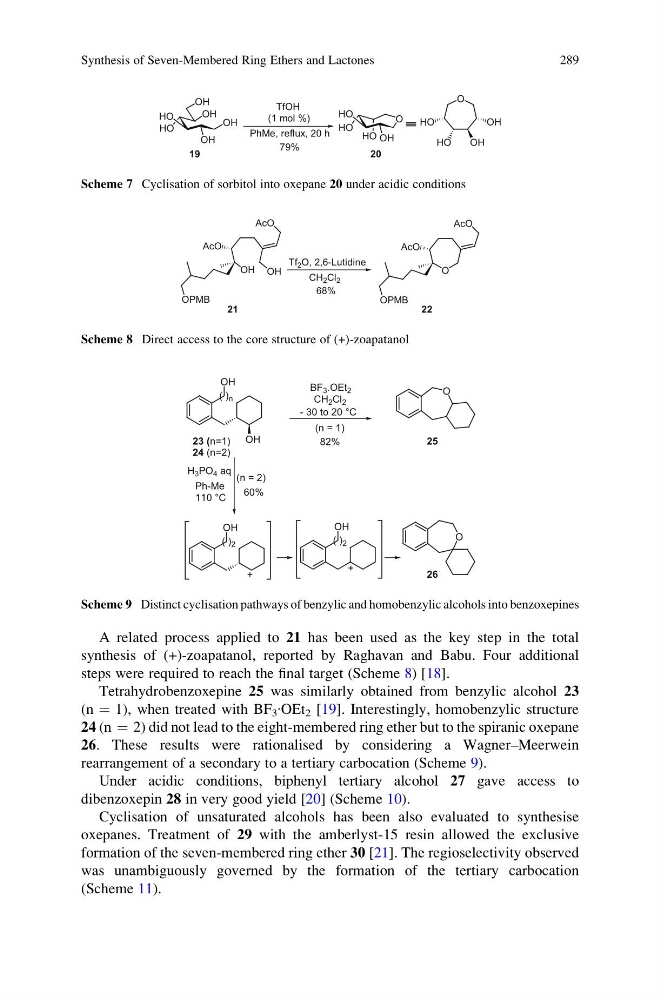
A related process applied to 21 has been used as the key step in the total
synthesis of (+)-zoapatanol, reported by Raghavan and Babu. Four additional
steps were required to reach the final target (Scheme 8) [18].
Tetrahydrobenzoxepine 25 was similarly obtained from benzylic alcohol 23
(n ¼ 1), when treated with BF 3 ∙OEt 2 [19]. Interestingly, homobenzylic structure
24 (n ¼ 2) did not lead to the eight-membered ring ether but to the spiranic oxepane
26. These results were rationalised by considering a Wagner–Meerwein
rearrangement of a secondary to a tertiary carbocation (Scheme 9).
Under acidic conditions, biphenyl tertiary alcohol 27 gave access to
dibenzoxepin 28 in very good yield [20] (Scheme 10).
Cyclisation of unsaturated alcohols has been also evaluated to synthesise
oxepanes. Treatment of 29 with the amberlyst-15 resin allowed the exclusive
formation of the seven-membered ring ether 30 [21]. The regioselectivity observed
was unambiguously governed by the formation of the tertiary carbocation
(Scheme 11).
HO
OH
OH
HO
OH
OH
HO
O
OH
HO
HO
O
OH
HO
HO
OH
TfOH
(1 mol %)
PhMe, reflux, 20 h
20
19
79%
Scheme 7 Cyclisation of sorbitol into oxepane 20 under acidic conditions
OH
AcO
OH
Tf 2 O, 2,6-Lutidine
CH 2 Cl 2
AcO
21
22
68%
OPMB
O
AcO
AcO
OPMB
Scheme 8 Direct access to the core structure of (+)-zoapatanol
OH
OH
O
25
( ) n
(n = 1)
BF 3 .OEt 2
CH 2 Cl 2
- 30 to 20 °C
(n = 2)
H 3 PO 4 aq
Ph-Me
110 °C
OH
( ) 2
OH
( ) 2
+
+
O
26
23 (n=1)
24 (n=2)
60%
82%
Scheme 9 Distinct cyclisation pathways of benzylic and homobenzylic alcohols into benzoxepines
Synthesis of Seven-Membered Ring Ethers and Lactones
289
synthesis of (+)-zoapatanol, reported by Raghavan and Babu. Four additional
steps were required to reach the final target (Scheme 8) [18].
Tetrahydrobenzoxepine 25 was similarly obtained from benzylic alcohol 23
(n ¼ 1), when treated with BF 3 ∙OEt 2 [19]. Interestingly, homobenzylic structure
24 (n ¼ 2) did not lead to the eight-membered ring ether but to the spiranic oxepane
26. These results were rationalised by considering a Wagner–Meerwein
rearrangement of a secondary to a tertiary carbocation (Scheme 9).
Under acidic conditions, biphenyl tertiary alcohol 27 gave access to
dibenzoxepin 28 in very good yield [20] (Scheme 10).
Cyclisation of unsaturated alcohols has been also evaluated to synthesise
oxepanes. Treatment of 29 with the amberlyst-15 resin allowed the exclusive
formation of the seven-membered ring ether 30 [21]. The regioselectivity observed
was unambiguously governed by the formation of the tertiary carbocation
(Scheme 11).
HO
OH
OH
HO
OH
OH
HO
O
OH
HO
HO
O
OH
HO
HO
OH
TfOH
(1 mol %)
PhMe, reflux, 20 h
20
19
79%
Scheme 7 Cyclisation of sorbitol into oxepane 20 under acidic conditions
OH
AcO
OH
Tf 2 O, 2,6-Lutidine
CH 2 Cl 2
AcO
21
22
68%
OPMB
O
AcO
AcO
OPMB
Scheme 8 Direct access to the core structure of (+)-zoapatanol
OH
OH
O
25
( ) n
(n = 1)
BF 3 .OEt 2
CH 2 Cl 2
- 30 to 20 °C
(n = 2)
H 3 PO 4 aq
Ph-Me
110 °C
OH
( ) 2
OH
( ) 2
+
+
O
26
23 (n=1)
24 (n=2)
60%
82%
Scheme 9 Distinct cyclisation pathways of benzylic and homobenzylic alcohols into benzoxepines
Synthesis of Seven-Membered Ring Ethers and Lactones
289