

2.3 Ring Expansion of 2-Halomethyl Cyclic Ethers
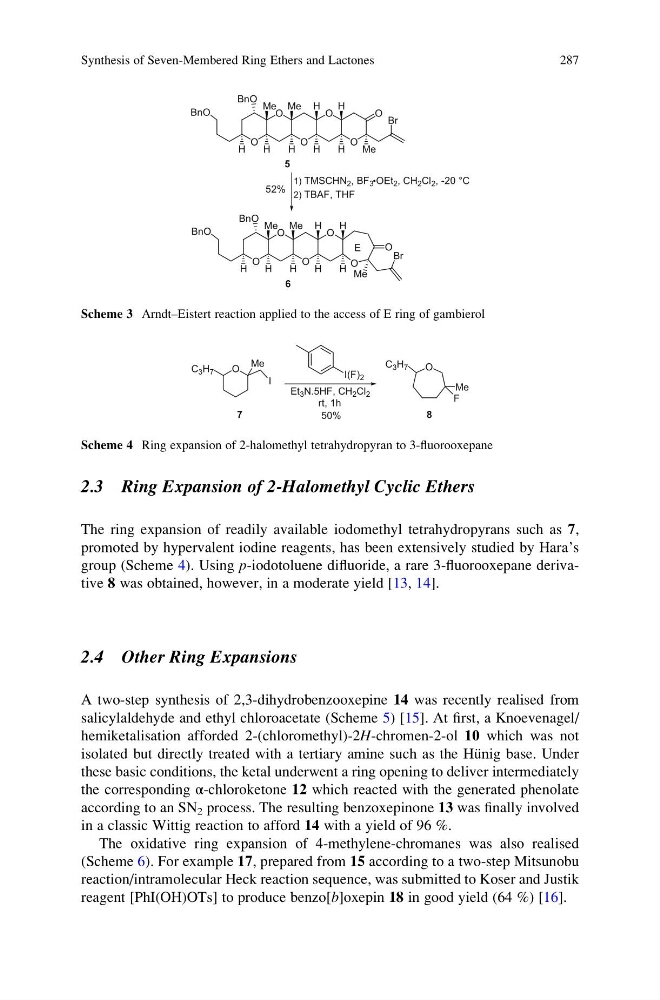
The ring expansion of readily available iodomethyl tetrahydropyrans such as 7,
promoted by hypervalent iodine reagents, has been extensively studied by Hara’s
group (Scheme 4). Using p-iodotoluene difluoride, a rare 3-fluorooxepane derivative 8 was obtained, however, in a moderate yield [13, 14].
2.4 Other Ring Expansions
A two-step synthesis of 2,3-dihydrobenzooxepine 14 was recently realised from
salicylaldehyde and ethyl chloroacetate (Scheme 5) [15]. At first, a Knoevenagel/
hemiketalisation afforded 2-(chloromethyl)-2H-chromen-2-ol 10 which was not
isolated but directly treated with a tertiary amine such as the Hu ¨nig base. Under
these basic conditions, the ketal underwent a ring opening to deliver intermediately
the corresponding α-chloroketone 12 which reacted with the generated phenolate
according to an SN 2 process. The resulting benzoxepinone 13 was finally involved
in a classic Wittig reaction to afford 14 with a yield of 96 %.
The oxidative ring expansion of 4-methylene-chromanes was also realised
(Scheme 6). For example 17, prepared from 15 according to a two-step Mitsunobu
reaction/intramolecular Heck reaction sequence, was submitted to Koser and Justik
reagent [PhI(OH)OTs] to produce benzo[b]oxepin 18 in good yield (64 %) [16].
O
O
O
O
O
O
Br
Me
Me
BnO
BnO
Me H
H
H
H
H
H
H
O
O
O
O
Me
BnO
BnO
Me H
H
H
H
H
H
H
O
Br
O
Me
E
6
1) TMSCHN 2 , BF 3 OEt 2 , CH 2 Cl 2 , -20 °C
2) TBAF, THF
5
52%
Scheme 3 Arndt–Eistert reaction applied to the access of E ring of gambierol
O
C 3 H 7
Me
I
O
C 3 H 7
Me
F
8
I(F) 2
Et 3 N.5HF, CH 2 Cl 2
rt, 1h
7
50%
Scheme 4 Ring expansion of 2-halomethyl tetrahydropyran to 3-fluorooxepane
Synthesis of Seven-Membered Ring Ethers and Lactones
287
The ring expansion of readily available iodomethyl tetrahydropyrans such as 7,
promoted by hypervalent iodine reagents, has been extensively studied by Hara’s
group (Scheme 4). Using p-iodotoluene difluoride, a rare 3-fluorooxepane derivative 8 was obtained, however, in a moderate yield [13, 14].
2.4 Other Ring Expansions
A two-step synthesis of 2,3-dihydrobenzooxepine 14 was recently realised from
salicylaldehyde and ethyl chloroacetate (Scheme 5) [15]. At first, a Knoevenagel/
hemiketalisation afforded 2-(chloromethyl)-2H-chromen-2-ol 10 which was not
isolated but directly treated with a tertiary amine such as the Hu ¨nig base. Under
these basic conditions, the ketal underwent a ring opening to deliver intermediately
the corresponding α-chloroketone 12 which reacted with the generated phenolate
according to an SN 2 process. The resulting benzoxepinone 13 was finally involved
in a classic Wittig reaction to afford 14 with a yield of 96 %.
The oxidative ring expansion of 4-methylene-chromanes was also realised
(Scheme 6). For example 17, prepared from 15 according to a two-step Mitsunobu
reaction/intramolecular Heck reaction sequence, was submitted to Koser and Justik
reagent [PhI(OH)OTs] to produce benzo[b]oxepin 18 in good yield (64 %) [16].
O
O
O
O
O
O
Br
Me
Me
BnO
BnO
Me H
H
H
H
H
H
H
O
O
O
O
Me
BnO
BnO
Me H
H
H
H
H
H
H
O
Br
O
Me
E
6
1) TMSCHN 2 , BF 3 OEt 2 , CH 2 Cl 2 , -20 °C
2) TBAF, THF
5
52%
Scheme 3 Arndt–Eistert reaction applied to the access of E ring of gambierol
O
C 3 H 7
Me
I
O
C 3 H 7
Me
F
8
I(F) 2
Et 3 N.5HF, CH 2 Cl 2
rt, 1h
7
50%
Scheme 4 Ring expansion of 2-halomethyl tetrahydropyran to 3-fluorooxepane
Synthesis of Seven-Membered Ring Ethers and Lactones
287