

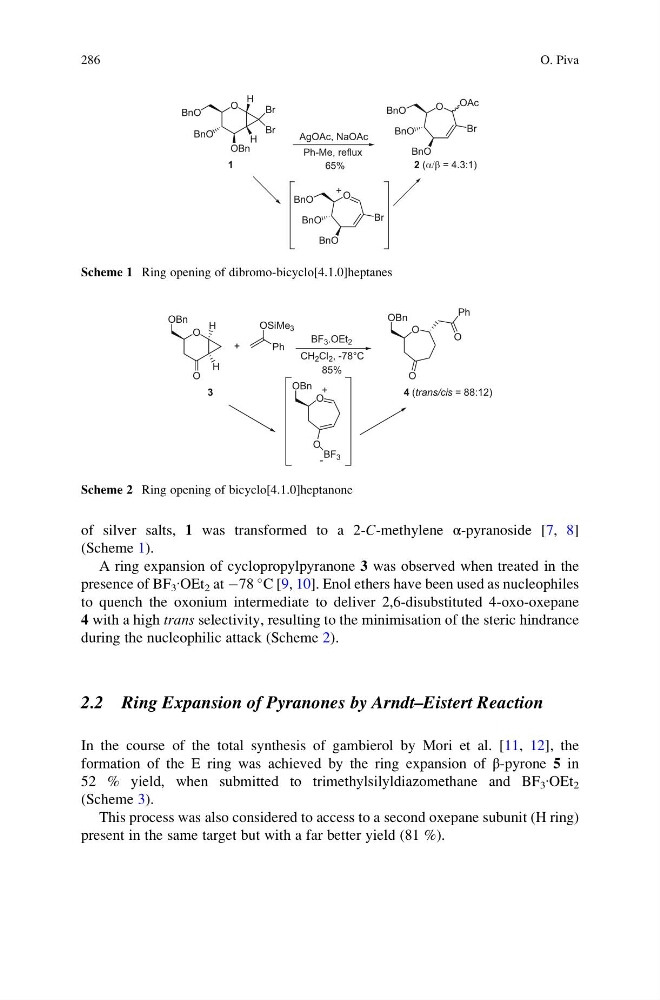
of silver salts, 1 was transformed to a 2-C-methylene α-pyranoside [7, 8]
(Scheme 1).
A ring expansion of cyclopropylpyranone 3 was observed when treated in the
presence of BF 3 ∙OEt 2 at À78
C [9, 10]. Enol ethers have been used as nucleophiles
to quench the oxonium intermediate to deliver 2,6-disubstituted 4-oxo-oxepane
4 with a high trans selectivity, resulting to the minimisation of the steric hindrance
during the nucleophilic attack (Scheme 2).
2.2 Ring Expansion of Pyranones by Arndt–Eistert Reaction
In the course of the total synthesis of gambierol by Mori et al. [11, 12], the
formation of the E ring was achieved by the ring expansion of β-pyrone 5 in
52 % yield, when submitted to trimethylsilyldiazomethane and BF 3 ∙OEt 2
(Scheme 3).
This process was also considered to access to a second oxepane subunit (H ring)
present in the same target but with a far better yield (81 %).
O
BnO
BnO
OBn
Br
Br
H
H
AgOAc, NaOAc
Ph-Me, reflux
O
BnO
BnO
BnO
Br
OAc
O
BnO
BnO
BnO
Br
+
1
2 (a/b = 4.3:1)
65%
Scheme 1 Ring opening of dibromo-bicyclo[4.1.0]heptanes
O
OBn
H
H
O
Ph
OSiMe 3
+
BF 3 .OEt 2
CH 2 Cl 2 , -78°C
O
OBn
O
Ph
O
4 (trans/cis = 88:12)
3
O
O
OBn
BF 3
+
-
85%
Scheme 2 Ring opening of bicyclo[4.1.0]heptanone
286
O. Piva
(Scheme 1).
A ring expansion of cyclopropylpyranone 3 was observed when treated in the
presence of BF 3 ∙OEt 2 at À78
C [9, 10]. Enol ethers have been used as nucleophiles
to quench the oxonium intermediate to deliver 2,6-disubstituted 4-oxo-oxepane
4 with a high trans selectivity, resulting to the minimisation of the steric hindrance
during the nucleophilic attack (Scheme 2).
2.2 Ring Expansion of Pyranones by Arndt–Eistert Reaction
In the course of the total synthesis of gambierol by Mori et al. [11, 12], the
formation of the E ring was achieved by the ring expansion of β-pyrone 5 in
52 % yield, when submitted to trimethylsilyldiazomethane and BF 3 ∙OEt 2
(Scheme 3).
This process was also considered to access to a second oxepane subunit (H ring)
present in the same target but with a far better yield (81 %).
O
BnO
BnO
OBn
Br
Br
H
H
AgOAc, NaOAc
Ph-Me, reflux
O
BnO
BnO
BnO
Br
OAc
O
BnO
BnO
BnO
Br
+
1
2 (a/b = 4.3:1)
65%
Scheme 1 Ring opening of dibromo-bicyclo[4.1.0]heptanes
O
OBn
H
H
O
Ph
OSiMe 3
+
BF 3 .OEt 2
CH 2 Cl 2 , -78°C
O
OBn
O
Ph
O
4 (trans/cis = 88:12)
3
O
O
OBn
BF 3
+
-
85%
Scheme 2 Ring opening of bicyclo[4.1.0]heptanone
286
O. Piva