

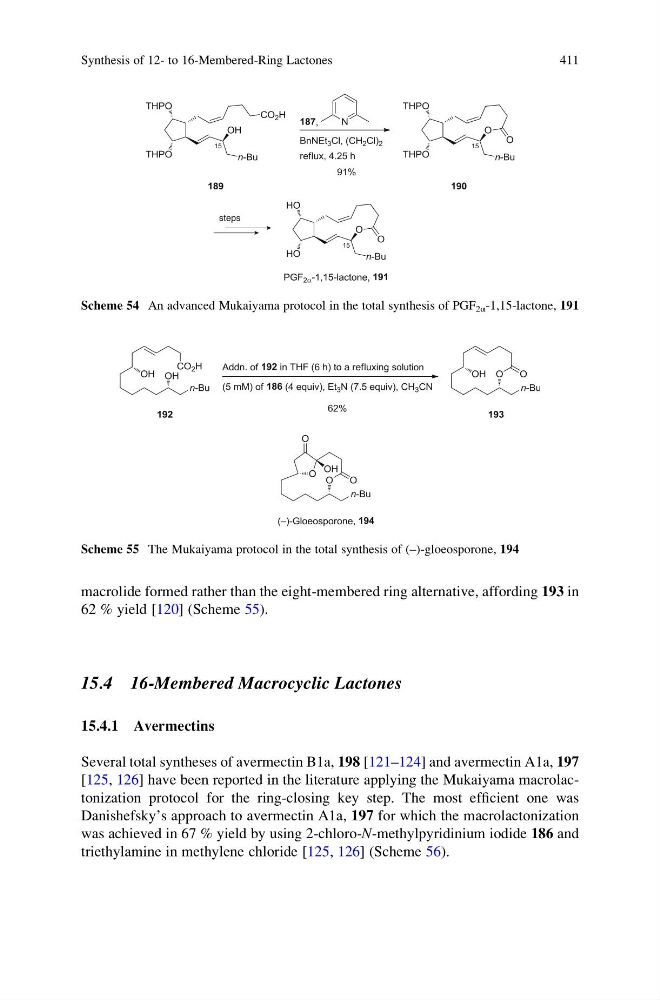
macrolide formed rather than the eight-membered ring alternative, affording 193 in
62 % yield [120] (Scheme 55).
15.4 16-Membered Macrocyclic Lactones
15.4.1 Avermectins
Several total syntheses of avermectin B1a, 198 [121–124] and avermectin A1a, 197
[125, 126] have been reported in the literature applying the Mukaiyama macrolactonization protocol for the ring-closing key step. The most efficient one was
Danishefsky’s approach to avermectin A1a, 197 for which the macrolactonization
was achieved in 67 % yield by using 2-chloro-N-methylpyridinium iodide 186 and
triethylamine in methylene chloride [125, 126] (Scheme 56).
steps
Scheme 54 An advanced Mukaiyama protocol in the total synthesis of PGF 2α -1,15-lactone, 191
Scheme 55 The Mukaiyama protocol in the total synthesis of (–)-gloeosporone, 194
Synthesis of 12- to 16-Membered-Ring Lactones
411
62 % yield [120] (Scheme 55).
15.4 16-Membered Macrocyclic Lactones
15.4.1 Avermectins
Several total syntheses of avermectin B1a, 198 [121–124] and avermectin A1a, 197
[125, 126] have been reported in the literature applying the Mukaiyama macrolactonization protocol for the ring-closing key step. The most efficient one was
Danishefsky’s approach to avermectin A1a, 197 for which the macrolactonization
was achieved in 67 % yield by using 2-chloro-N-methylpyridinium iodide 186 and
triethylamine in methylene chloride [125, 126] (Scheme 56).
steps
Scheme 54 An advanced Mukaiyama protocol in the total synthesis of PGF 2α -1,15-lactone, 191
Scheme 55 The Mukaiyama protocol in the total synthesis of (–)-gloeosporone, 194
Synthesis of 12- to 16-Membered-Ring Lactones
411