

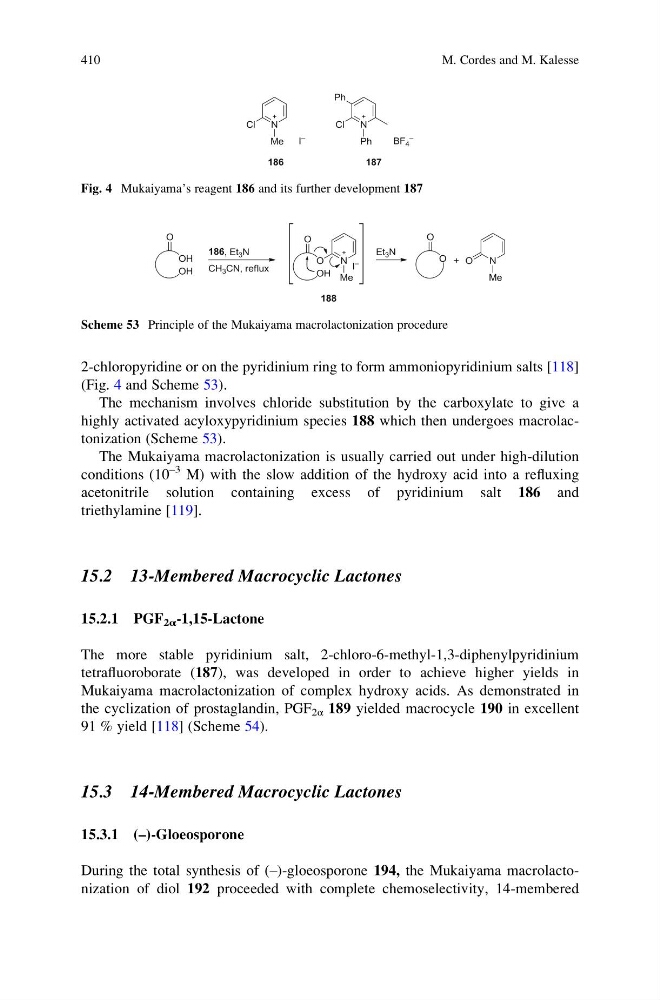
2-chloropyridine or on the pyridinium ring to form ammoniopyridinium salts [118]
(Fig. 4 and Scheme 53).
The mechanism involves chloride substitution by the carboxylate to give a
highly activated acyloxypyridinium species 188 which then undergoes macrolactonization (Scheme 53).
The Mukaiyama macrolactonization is usually carried out under high-dilution
conditions (10
–3 M) with the slow addition of the hydroxy acid into a refluxing
acetonitrile solution containing excess of pyridinium salt 186 and
triethylamine [119].
15.2 13-Membered Macrocyclic Lactones
15.2.1 PGF 2α -1,15-Lactone
The more stable pyridinium salt, 2-chloro-6-methyl-1,3-diphenylpyridinium
tetrafluoroborate (187), was developed in order to achieve higher yields in
Mukaiyama macrolactonization of complex hydroxy acids. As demonstrated in
the cyclization of prostaglandin, PGF 2α 189 yielded macrocycle 190 in excellent
91 % yield [118] (Scheme 54).
15.3 14-Membered Macrocyclic Lactones
15.3.1 (–)-Gloeosporone
During the total synthesis of (–)-gloeosporone 194, the Mukaiyama macrolactonization of diol 192 proceeded with complete chemoselectivity, 14-membered
Fig. 4 Mukaiyama’s reagent 186 and its further development 187
Scheme 53 Principle of the Mukaiyama macrolactonization procedure
410
M. Cordes and M. Kalesse
(Fig. 4 and Scheme 53).
The mechanism involves chloride substitution by the carboxylate to give a
highly activated acyloxypyridinium species 188 which then undergoes macrolactonization (Scheme 53).
The Mukaiyama macrolactonization is usually carried out under high-dilution
conditions (10
–3 M) with the slow addition of the hydroxy acid into a refluxing
acetonitrile solution containing excess of pyridinium salt 186 and
triethylamine [119].
15.2 13-Membered Macrocyclic Lactones
15.2.1 PGF 2α -1,15-Lactone
The more stable pyridinium salt, 2-chloro-6-methyl-1,3-diphenylpyridinium
tetrafluoroborate (187), was developed in order to achieve higher yields in
Mukaiyama macrolactonization of complex hydroxy acids. As demonstrated in
the cyclization of prostaglandin, PGF 2α 189 yielded macrocycle 190 in excellent
91 % yield [118] (Scheme 54).
15.3 14-Membered Macrocyclic Lactones
15.3.1 (–)-Gloeosporone
During the total synthesis of (–)-gloeosporone 194, the Mukaiyama macrolactonization of diol 192 proceeded with complete chemoselectivity, 14-membered
Fig. 4 Mukaiyama’s reagent 186 and its further development 187
Scheme 53 Principle of the Mukaiyama macrolactonization procedure
410
M. Cordes and M. Kalesse