

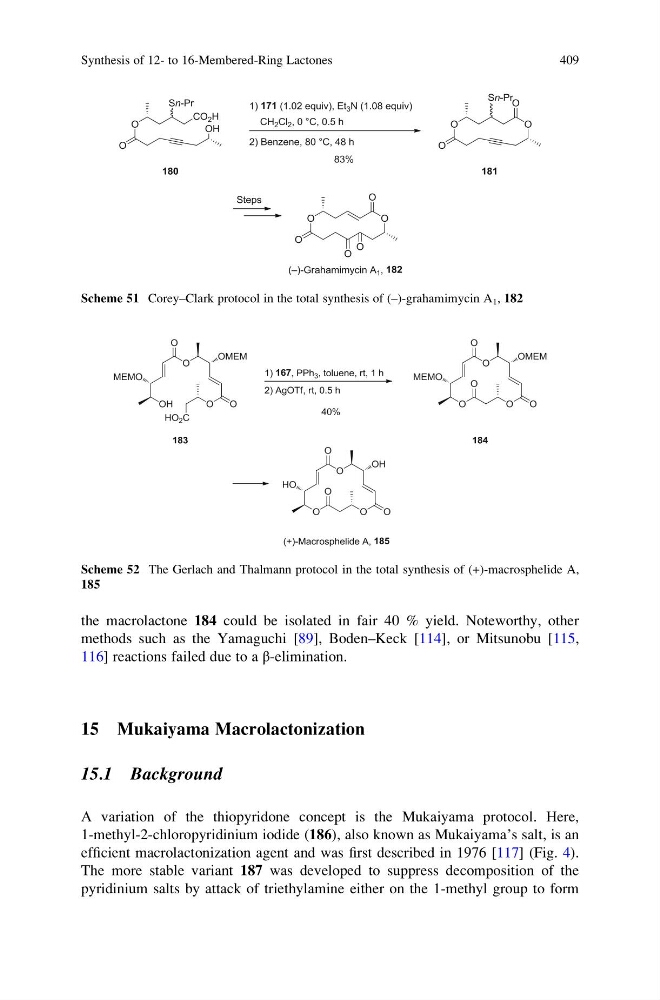
the macrolactone 184 could be isolated in fair 40 % yield. Noteworthy, other
methods such as the Yamaguchi [89], Boden–Keck [114], or Mitsunobu [115,
116] reactions failed due to a β-elimination.
15 Mukaiyama Macrolactonization
15.1 Background
A variation of the thiopyridone concept is the Mukaiyama protocol. Here,
1-methyl-2-chloropyridinium iodide (186), also known as Mukaiyama’s salt, is an
efficient macrolactonization agent and was first described in 1976 [117] (Fig. 4).
The more stable variant 187 was developed to suppress decomposition of the
pyridinium salts by attack of triethylamine either on the 1-methyl group to form
Scheme 51 Corey–Clark protocol in the total synthesis of (–)-grahamimycin A 1 , 182
Scheme 52 The Gerlach and Thalmann protocol in the total synthesis of (+)-macrosphelide A,
185
Synthesis of 12- to 16-Membered-Ring Lactones
409
methods such as the Yamaguchi [89], Boden–Keck [114], or Mitsunobu [115,
116] reactions failed due to a β-elimination.
15 Mukaiyama Macrolactonization
15.1 Background
A variation of the thiopyridone concept is the Mukaiyama protocol. Here,
1-methyl-2-chloropyridinium iodide (186), also known as Mukaiyama’s salt, is an
efficient macrolactonization agent and was first described in 1976 [117] (Fig. 4).
The more stable variant 187 was developed to suppress decomposition of the
pyridinium salts by attack of triethylamine either on the 1-methyl group to form
Scheme 51 Corey–Clark protocol in the total synthesis of (–)-grahamimycin A 1 , 182
Scheme 52 The Gerlach and Thalmann protocol in the total synthesis of (+)-macrosphelide A,
185
Synthesis of 12- to 16-Membered-Ring Lactones
409