

14.3 13-Membered Macrocyclic Lactones
14.3.1 (–)-Hybridalactone
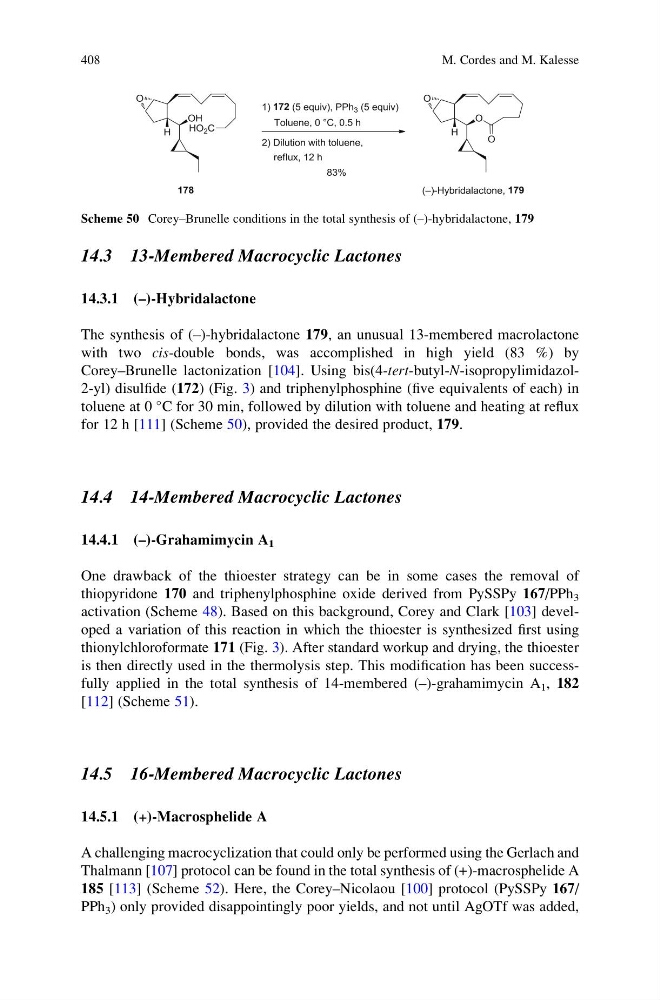
The synthesis of (–)-hybridalactone 179, an unusual 13-membered macrolactone
with two cis-double bonds, was accomplished in high yield (83 %) by
Corey–Brunelle lactonization [104]. Using bis(4-tert-butyl-N-isopropylimidazol2-yl) disulfide (172) (Fig. 3) and triphenylphosphine (five equivalents of each) in
toluene at 0
C for 30 min, followed by dilution with toluene and heating at reflux
for 12 h [111] (Scheme 50), provided the desired product, 179.
14.4 14-Membered Macrocyclic Lactones
14.4.1 (–)-Grahamimycin A 1
One drawback of the thioester strategy can be in some cases the removal of
thiopyridone 170 and triphenylphosphine oxide derived from PySSPy 167/PPh 3
activation (Scheme 48). Based on this background, Corey and Clark [103] developed a variation of this reaction in which the thioester is synthesized first using
thionylchloroformate 171 (Fig. 3). After standard workup and drying, the thioester
is then directly used in the thermolysis step. This modification has been successfully applied in the total synthesis of 14-membered (–)-grahamimycin A 1 , 182
[112] (Scheme 51).
14.5 16-Membered Macrocyclic Lactones
14.5.1 (+)-Macrosphelide A
A challenging macrocyclization that could only be performed using the Gerlach and
Thalmann [107] protocol can be found in the total synthesis of (+)-macrosphelide A
185 [113] (Scheme 52). Here, the Corey–Nicolaou [100] protocol (PySSPy 167/
PPh 3 ) only provided disappointingly poor yields, and not until AgOTf was added,
Scheme 50 Corey–Brunelle conditions in the total synthesis of (–)-hybridalactone, 179
408
M. Cordes and M. Kalesse
14.3.1 (–)-Hybridalactone
The synthesis of (–)-hybridalactone 179, an unusual 13-membered macrolactone
with two cis-double bonds, was accomplished in high yield (83 %) by
Corey–Brunelle lactonization [104]. Using bis(4-tert-butyl-N-isopropylimidazol2-yl) disulfide (172) (Fig. 3) and triphenylphosphine (five equivalents of each) in
toluene at 0
C for 30 min, followed by dilution with toluene and heating at reflux
for 12 h [111] (Scheme 50), provided the desired product, 179.
14.4 14-Membered Macrocyclic Lactones
14.4.1 (–)-Grahamimycin A 1
One drawback of the thioester strategy can be in some cases the removal of
thiopyridone 170 and triphenylphosphine oxide derived from PySSPy 167/PPh 3
activation (Scheme 48). Based on this background, Corey and Clark [103] developed a variation of this reaction in which the thioester is synthesized first using
thionylchloroformate 171 (Fig. 3). After standard workup and drying, the thioester
is then directly used in the thermolysis step. This modification has been successfully applied in the total synthesis of 14-membered (–)-grahamimycin A 1 , 182
[112] (Scheme 51).
14.5 16-Membered Macrocyclic Lactones
14.5.1 (+)-Macrosphelide A
A challenging macrocyclization that could only be performed using the Gerlach and
Thalmann [107] protocol can be found in the total synthesis of (+)-macrosphelide A
185 [113] (Scheme 52). Here, the Corey–Nicolaou [100] protocol (PySSPy 167/
PPh 3 ) only provided disappointingly poor yields, and not until AgOTf was added,
Scheme 50 Corey–Brunelle conditions in the total synthesis of (–)-hybridalactone, 179
408
M. Cordes and M. Kalesse