

11.2 16-Membered Macrocyclic Lactones
11.2.1 (+)-Macrosphelide B
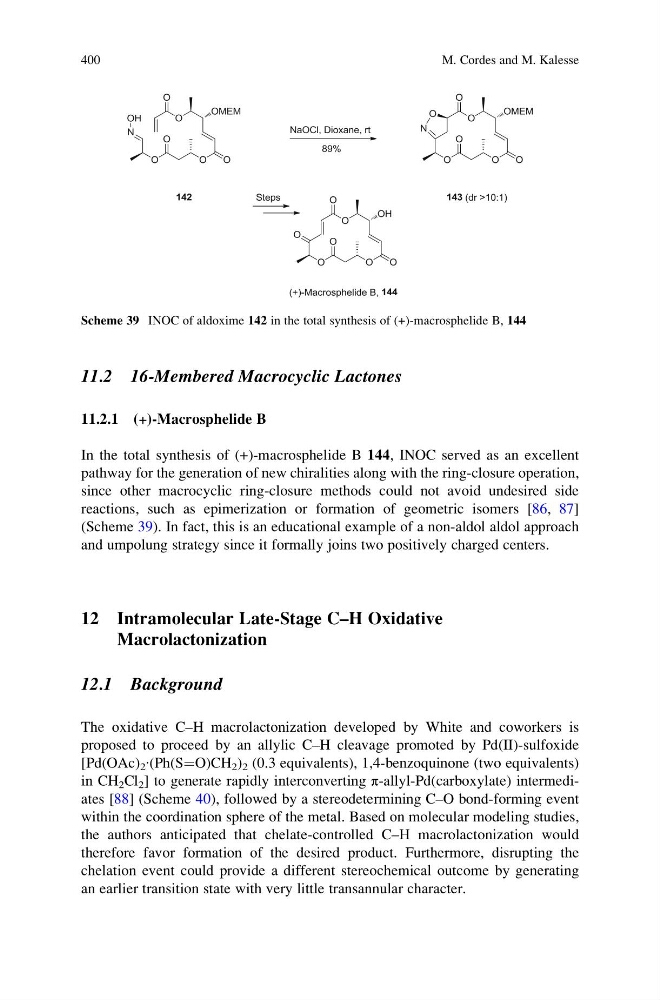
In the total synthesis of (+)-macrosphelide B 144, INOC served as an excellent
pathway for the generation of new chiralities along with the ring-closure operation,
since other macrocyclic ring-closure methods could not avoid undesired side
reactions, such as epimerization or formation of geometric isomers [86, 87]
(Scheme 39). In fact, this is an educational example of a non-aldol aldol approach
and umpolung strategy since it formally joins two positively charged centers.
12 Intramolecular Late-Stage C–H Oxidative
Macrolactonization
12.1 Background
The oxidative C–H macrolactonization developed by White and coworkers is
proposed to proceed by an allylic C–H cleavage promoted by Pd(II)-sulfoxide
[Pd(OAc) 2 ∙(Ph(S¼O)CH 2 ) 2 (0.3 equivalents), 1,4-benzoquinone (two equivalents)
in CH 2 Cl 2 ] to generate rapidly interconverting π-allyl-Pd(carboxylate) intermediates [88] (Scheme 40), followed by a stereodetermining C–O bond-forming event
within the coordination sphere of the metal. Based on molecular modeling studies,
the authors anticipated that chelate-controlled C–H macrolactonization would
therefore favor formation of the desired product. Furthermore, disrupting the
chelation event could provide a different stereochemical outcome by generating
an earlier transition state with very little transannular character.
Scheme 39 INOC of aldoxime 142 in the total synthesis of (+)-macrosphelide B, 144
400
M. Cordes and M. Kalesse
11.2.1 (+)-Macrosphelide B
In the total synthesis of (+)-macrosphelide B 144, INOC served as an excellent
pathway for the generation of new chiralities along with the ring-closure operation,
since other macrocyclic ring-closure methods could not avoid undesired side
reactions, such as epimerization or formation of geometric isomers [86, 87]
(Scheme 39). In fact, this is an educational example of a non-aldol aldol approach
and umpolung strategy since it formally joins two positively charged centers.
12 Intramolecular Late-Stage C–H Oxidative
Macrolactonization
12.1 Background
The oxidative C–H macrolactonization developed by White and coworkers is
proposed to proceed by an allylic C–H cleavage promoted by Pd(II)-sulfoxide
[Pd(OAc) 2 ∙(Ph(S¼O)CH 2 ) 2 (0.3 equivalents), 1,4-benzoquinone (two equivalents)
in CH 2 Cl 2 ] to generate rapidly interconverting π-allyl-Pd(carboxylate) intermediates [88] (Scheme 40), followed by a stereodetermining C–O bond-forming event
within the coordination sphere of the metal. Based on molecular modeling studies,
the authors anticipated that chelate-controlled C–H macrolactonization would
therefore favor formation of the desired product. Furthermore, disrupting the
chelation event could provide a different stereochemical outcome by generating
an earlier transition state with very little transannular character.
Scheme 39 INOC of aldoxime 142 in the total synthesis of (+)-macrosphelide B, 144
400
M. Cordes and M. Kalesse