

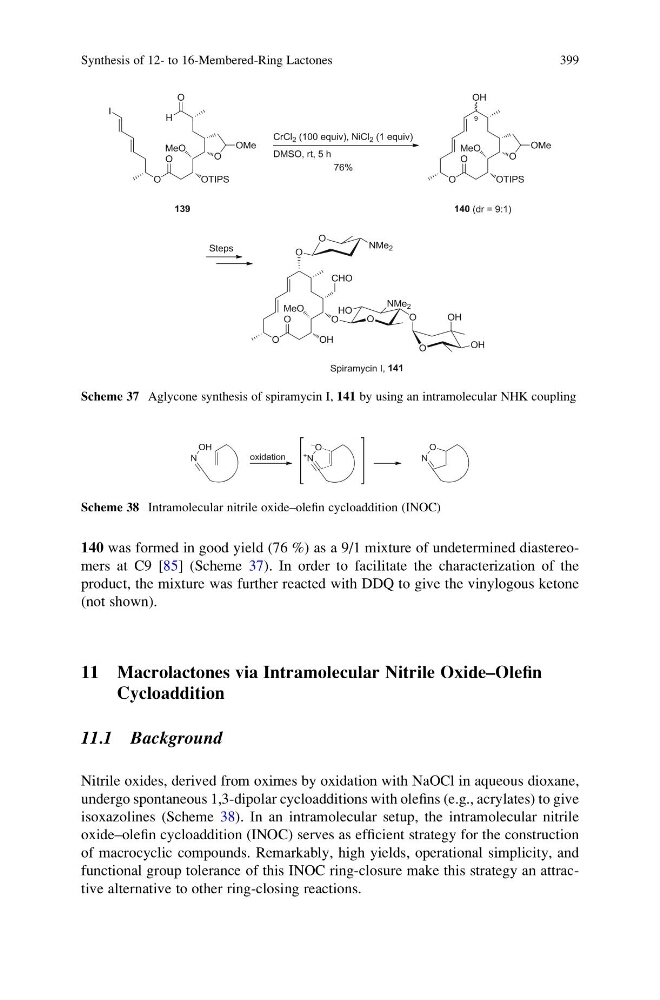
140 was formed in good yield (76 %) as a 9/1 mixture of undetermined diastereomers at C9 [85] (Scheme 37). In order to facilitate the characterization of the
product, the mixture was further reacted with DDQ to give the vinylogous ketone
(not shown).
11 Macrolactones via Intramolecular Nitrile Oxide–Olefin
Cycloaddition
11.1 Background
Nitrile oxides, derived from oximes by oxidation with NaOCl in aqueous dioxane,
undergo spontaneous 1,3-dipolar cycloadditions with olefins (e.g., acrylates) to give
isoxazolines (Scheme 38). In an intramolecular setup, the intramolecular nitrile
oxide–olefin cycloaddition (INOC) serves as efficient strategy for the construction
of macrocyclic compounds. Remarkably, high yields, operational simplicity, and
functional group tolerance of this INOC ring-closure make this strategy an attractive alternative to other ring-closing reactions.
Scheme 37 Aglycone synthesis of spiramycin I, 141 by using an intramolecular NHK coupling
Scheme 38 Intramolecular nitrile oxide–olefin cycloaddition (INOC)
Synthesis of 12- to 16-Membered-Ring Lactones
399
product, the mixture was further reacted with DDQ to give the vinylogous ketone
(not shown).
11 Macrolactones via Intramolecular Nitrile Oxide–Olefin
Cycloaddition
11.1 Background
Nitrile oxides, derived from oximes by oxidation with NaOCl in aqueous dioxane,
undergo spontaneous 1,3-dipolar cycloadditions with olefins (e.g., acrylates) to give
isoxazolines (Scheme 38). In an intramolecular setup, the intramolecular nitrile
oxide–olefin cycloaddition (INOC) serves as efficient strategy for the construction
of macrocyclic compounds. Remarkably, high yields, operational simplicity, and
functional group tolerance of this INOC ring-closure make this strategy an attractive alternative to other ring-closing reactions.
Scheme 37 Aglycone synthesis of spiramycin I, 141 by using an intramolecular NHK coupling
Scheme 38 Intramolecular nitrile oxide–olefin cycloaddition (INOC)
Synthesis of 12- to 16-Membered-Ring Lactones
399