

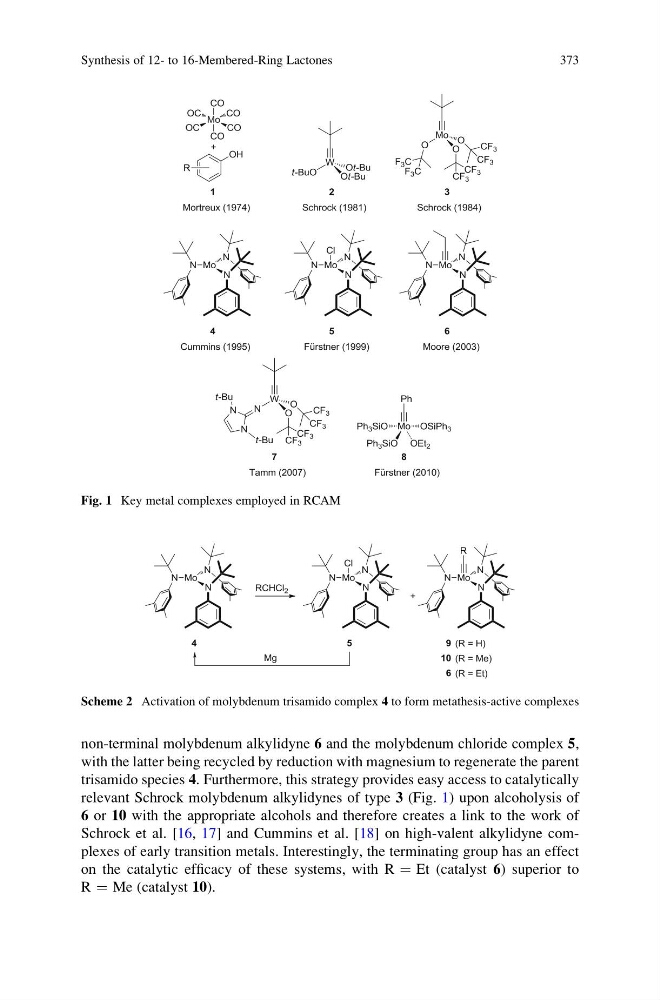
non-terminal molybdenum alkylidyne 6 and the molybdenum chloride complex 5,
with the latter being recycled by reduction with magnesium to regenerate the parent
trisamido species 4. Furthermore, this strategy provides easy access to catalytically
relevant Schrock molybdenum alkylidynes of type 3 (Fig. 1) upon alcoholysis of
6 or 10 with the appropriate alcohols and therefore creates a link to the work of
Schrock et al. [16, 17] and Cummins et al. [18] on high-valent alkylidyne complexes of early transition metals. Interestingly, the terminating group has an effect
on the catalytic efficacy of these systems, with R ¼ Et (catalyst 6) superior to
R ¼ Me (catalyst 10).
Fig. 1 Key metal complexes employed in RCAM
Scheme 2 Activation of molybdenum trisamido complex 4 to form metathesis-active complexes
Synthesis of 12- to 16-Membered-Ring Lactones
373
with the latter being recycled by reduction with magnesium to regenerate the parent
trisamido species 4. Furthermore, this strategy provides easy access to catalytically
relevant Schrock molybdenum alkylidynes of type 3 (Fig. 1) upon alcoholysis of
6 or 10 with the appropriate alcohols and therefore creates a link to the work of
Schrock et al. [16, 17] and Cummins et al. [18] on high-valent alkylidyne complexes of early transition metals. Interestingly, the terminating group has an effect
on the catalytic efficacy of these systems, with R ¼ Et (catalyst 6) superior to
R ¼ Me (catalyst 10).
Fig. 1 Key metal complexes employed in RCAM
Scheme 2 Activation of molybdenum trisamido complex 4 to form metathesis-active complexes
Synthesis of 12- to 16-Membered-Ring Lactones
373