

2 Ring-Closing Alkyne Metathesis
2.1 Background (RCAM)
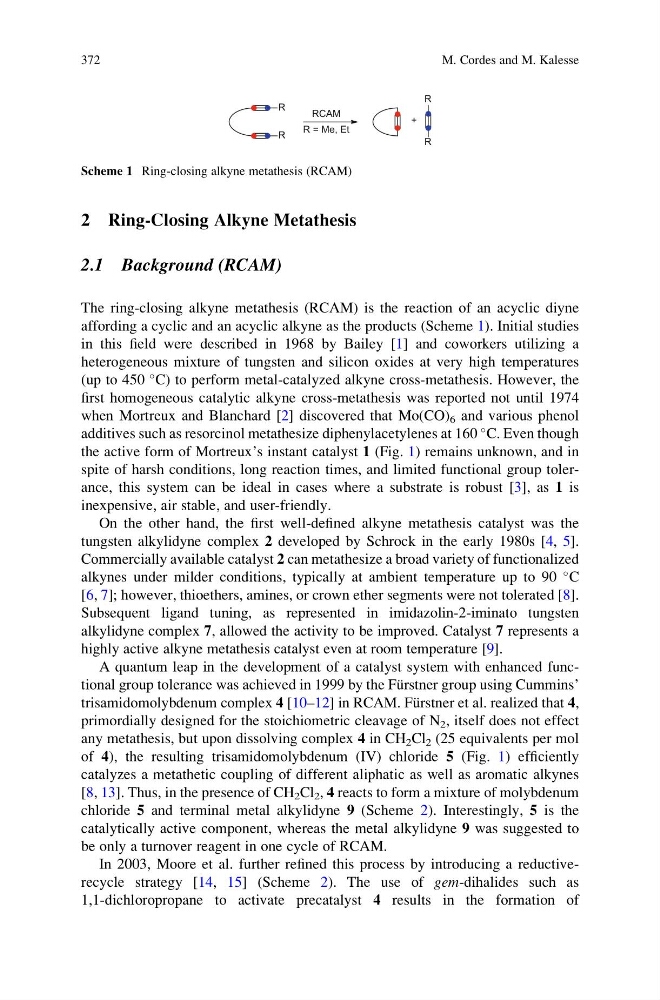
The ring-closing alkyne metathesis (RCAM) is the reaction of an acyclic diyne
affording a cyclic and an acyclic alkyne as the products (Scheme 1). Initial studies
in this field were described in 1968 by Bailey [1] and coworkers utilizing a
heterogeneous mixture of tungsten and silicon oxides at very high temperatures
(up to 450
C) to perform metal-catalyzed alkyne cross-metathesis. However, the
first homogeneous catalytic alkyne cross-metathesis was reported not until 1974
when Mortreux and Blanchard [2] discovered that Mo(CO) 6 and various phenol
additives such as resorcinol metathesize diphenylacetylenes at 160
C. Even though
the active form of Mortreux’s instant catalyst 1 (Fig. 1) remains unknown, and in
spite of harsh conditions, long reaction times, and limited functional group tolerance, this system can be ideal in cases where a substrate is robust [3], as 1 is
inexpensive, air stable, and user-friendly.
On the other hand, the first well-defined alkyne metathesis catalyst was the
tungsten alkylidyne complex 2 developed by Schrock in the early 1980s [4, 5].
Commercially available catalyst 2 can metathesize a broad variety of functionalized
alkynes under milder conditions, typically at ambient temperature up to 90
C
[6, 7]; however, thioethers, amines, or crown ether segments were not tolerated [8].
Subsequent ligand tuning, as represented in imidazolin-2-iminato tungsten
alkylidyne complex 7, allowed the activity to be improved. Catalyst 7 represents a
highly active alkyne metathesis catalyst even at room temperature [9].
A quantum leap in the development of a catalyst system with enhanced functional group tolerance was achieved in 1999 by the Fu ¨rstner group using Cummins’
trisamidomolybdenum complex 4 [10–12] in RCAM. Fu ¨rstner et al. realized that 4,
primordially designed for the stoichiometric cleavage of N 2 , itself does not effect
any metathesis, but upon dissolving complex 4 in CH 2 Cl 2 (25 equivalents per mol
of 4), the resulting trisamidomolybdenum (IV) chloride 5 (Fig. 1) efficiently
catalyzes a metathetic coupling of different aliphatic as well as aromatic alkynes
[8, 13]. Thus, in the presence of CH 2 Cl 2 , 4 reacts to form a mixture of molybdenum
chloride 5 and terminal metal alkylidyne 9 (Scheme 2). Interestingly, 5 is the
catalytically active component, whereas the metal alkylidyne 9 was suggested to
be only a turnover reagent in one cycle of RCAM.
In 2003, Moore et al. further refined this process by introducing a reductiverecycle strategy [14, 15] (Scheme 2). The use of gem-dihalides such as
1,1-dichloropropane to activate precatalyst 4 results in the formation of
R
R
+
R
R
RCAM
R = Me, Et
Scheme 1 Ring-closing alkyne metathesis (RCAM)
372
M. Cordes and M. Kalesse
2.1 Background (RCAM)
The ring-closing alkyne metathesis (RCAM) is the reaction of an acyclic diyne
affording a cyclic and an acyclic alkyne as the products (Scheme 1). Initial studies
in this field were described in 1968 by Bailey [1] and coworkers utilizing a
heterogeneous mixture of tungsten and silicon oxides at very high temperatures
(up to 450
C) to perform metal-catalyzed alkyne cross-metathesis. However, the
first homogeneous catalytic alkyne cross-metathesis was reported not until 1974
when Mortreux and Blanchard [2] discovered that Mo(CO) 6 and various phenol
additives such as resorcinol metathesize diphenylacetylenes at 160
C. Even though
the active form of Mortreux’s instant catalyst 1 (Fig. 1) remains unknown, and in
spite of harsh conditions, long reaction times, and limited functional group tolerance, this system can be ideal in cases where a substrate is robust [3], as 1 is
inexpensive, air stable, and user-friendly.
On the other hand, the first well-defined alkyne metathesis catalyst was the
tungsten alkylidyne complex 2 developed by Schrock in the early 1980s [4, 5].
Commercially available catalyst 2 can metathesize a broad variety of functionalized
alkynes under milder conditions, typically at ambient temperature up to 90
C
[6, 7]; however, thioethers, amines, or crown ether segments were not tolerated [8].
Subsequent ligand tuning, as represented in imidazolin-2-iminato tungsten
alkylidyne complex 7, allowed the activity to be improved. Catalyst 7 represents a
highly active alkyne metathesis catalyst even at room temperature [9].
A quantum leap in the development of a catalyst system with enhanced functional group tolerance was achieved in 1999 by the Fu ¨rstner group using Cummins’
trisamidomolybdenum complex 4 [10–12] in RCAM. Fu ¨rstner et al. realized that 4,
primordially designed for the stoichiometric cleavage of N 2 , itself does not effect
any metathesis, but upon dissolving complex 4 in CH 2 Cl 2 (25 equivalents per mol
of 4), the resulting trisamidomolybdenum (IV) chloride 5 (Fig. 1) efficiently
catalyzes a metathetic coupling of different aliphatic as well as aromatic alkynes
[8, 13]. Thus, in the presence of CH 2 Cl 2 , 4 reacts to form a mixture of molybdenum
chloride 5 and terminal metal alkylidyne 9 (Scheme 2). Interestingly, 5 is the
catalytically active component, whereas the metal alkylidyne 9 was suggested to
be only a turnover reagent in one cycle of RCAM.
In 2003, Moore et al. further refined this process by introducing a reductiverecycle strategy [14, 15] (Scheme 2). The use of gem-dihalides such as
1,1-dichloropropane to activate precatalyst 4 results in the formation of
R
R
+
R
R
RCAM
R = Me, Et
Scheme 1 Ring-closing alkyne metathesis (RCAM)
372
M. Cordes and M. Kalesse