

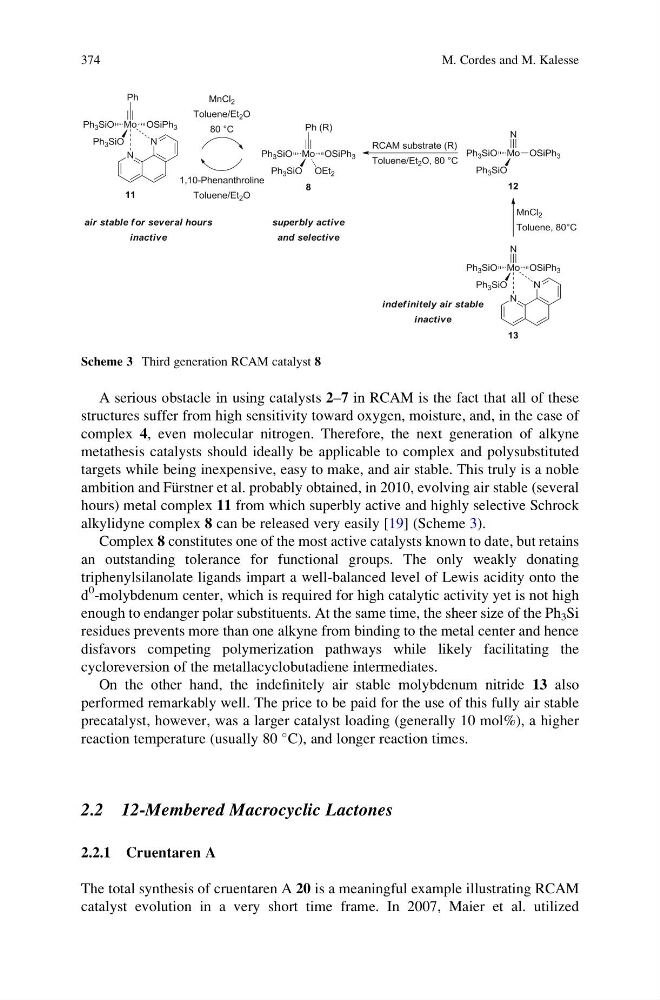
A serious obstacle in using catalysts 2–7 in RCAM is the fact that all of these
structures suffer from high sensitivity toward oxygen, moisture, and, in the case of
complex 4, even molecular nitrogen. Therefore, the next generation of alkyne
metathesis catalysts should ideally be applicable to complex and polysubstituted
targets while being inexpensive, easy to make, and air stable. This truly is a noble
ambition and Fu ¨rstner et al. probably obtained, in 2010, evolving air stable (several
hours) metal complex 11 from which superbly active and highly selective Schrock
alkylidyne complex 8 can be released very easily [19] (Scheme 3).
Complex 8 constitutes one of the most active catalysts known to date, but retains
an outstanding tolerance for functional groups. The only weakly donating
triphenylsilanolate ligands impart a well-balanced level of Lewis acidity onto the
d
0 -molybdenum center, which is required for high catalytic activity yet is not high
enough to endanger polar substituents. At the same time, the sheer size of the Ph 3 Si
residues prevents more than one alkyne from binding to the metal center and hence
disfavors competing polymerization pathways while likely facilitating the
cycloreversion of the metallacyclobutadiene intermediates.
On the other hand, the indefinitely air stable molybdenum nitride 13 also
performed remarkably well. The price to be paid for the use of this fully air stable
precatalyst, however, was a larger catalyst loading (generally 10 mol%), a higher
reaction temperature (usually 80
C), and longer reaction times.
2.2 12-Membered Macrocyclic Lactones
2.2.1 Cruentaren A
The total synthesis of cruentaren A 20 is a meaningful example illustrating RCAM
catalyst evolution in a very short time frame. In 2007, Maier et al. utilized
Scheme 3 Third generation RCAM catalyst 8
374
M. Cordes and M. Kalesse
structures suffer from high sensitivity toward oxygen, moisture, and, in the case of
complex 4, even molecular nitrogen. Therefore, the next generation of alkyne
metathesis catalysts should ideally be applicable to complex and polysubstituted
targets while being inexpensive, easy to make, and air stable. This truly is a noble
ambition and Fu ¨rstner et al. probably obtained, in 2010, evolving air stable (several
hours) metal complex 11 from which superbly active and highly selective Schrock
alkylidyne complex 8 can be released very easily [19] (Scheme 3).
Complex 8 constitutes one of the most active catalysts known to date, but retains
an outstanding tolerance for functional groups. The only weakly donating
triphenylsilanolate ligands impart a well-balanced level of Lewis acidity onto the
d
0 -molybdenum center, which is required for high catalytic activity yet is not high
enough to endanger polar substituents. At the same time, the sheer size of the Ph 3 Si
residues prevents more than one alkyne from binding to the metal center and hence
disfavors competing polymerization pathways while likely facilitating the
cycloreversion of the metallacyclobutadiene intermediates.
On the other hand, the indefinitely air stable molybdenum nitride 13 also
performed remarkably well. The price to be paid for the use of this fully air stable
precatalyst, however, was a larger catalyst loading (generally 10 mol%), a higher
reaction temperature (usually 80
C), and longer reaction times.
2.2 12-Membered Macrocyclic Lactones
2.2.1 Cruentaren A
The total synthesis of cruentaren A 20 is a meaningful example illustrating RCAM
catalyst evolution in a very short time frame. In 2007, Maier et al. utilized
Scheme 3 Third generation RCAM catalyst 8
374
M. Cordes and M. Kalesse