

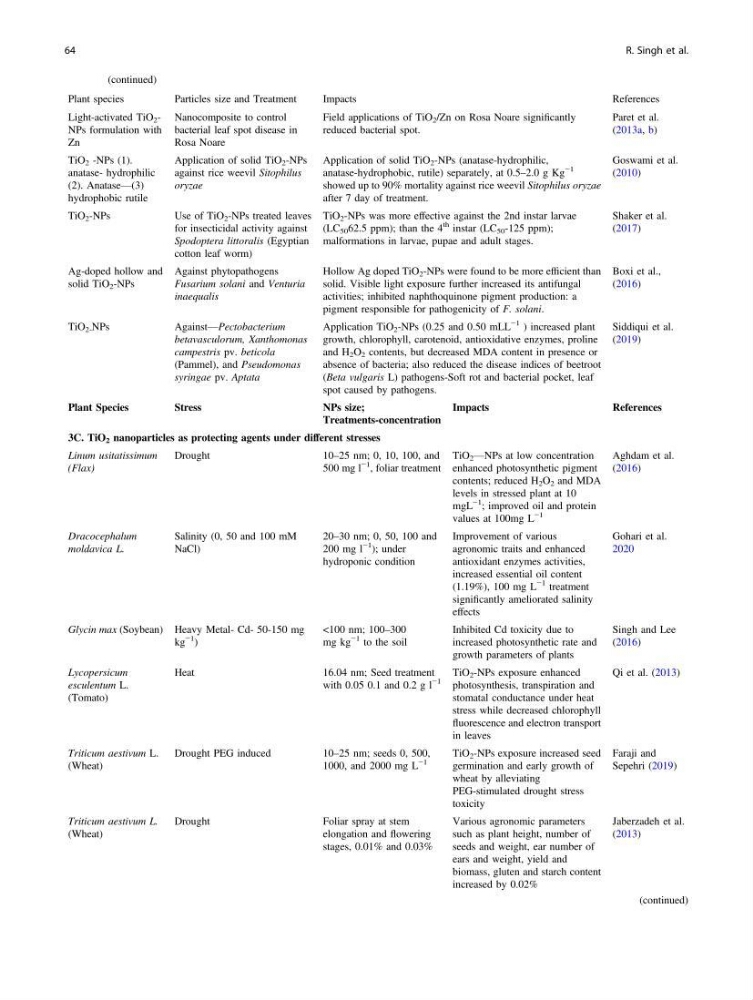
Table 3 (continued)
Plant species
Particles size and Treatment
Impacts
References
Light-activated TiO 2 -
NPs formulation with
Zn
Nanocomposite to control
bacterial leaf spot disease in
Rosa Noare
Field applications of TiO 2 /Zn on Rosa Noare significantly
reduced bacterial spot.
Paret et al.
(2013a, b)
TiO 2 -NPs (1).
anatase- hydrophilic
(2). Anatase—(3)
hydrophobic rutile
Application of solid TiO 2 -NPs
against rice weevil Sitophilus
oryzae
Application of solid TiO 2 -NPs (anatase-hydrophilic,
anatase-hydrophobic, rutile) separately, at 0.5–2.0 g Kg
−1
showed up to 90% mortality against rice weevil Sitophilus oryzae
after 7 day of treatment.
Goswami et al.
(2010)
TiO 2 -NPs
Use of TiO 2 -NPs treated leaves
for insecticidal activity against
Spodoptera littoralis (Egyptian
cotton leaf worm)
TiO 2 -NPs was more effective against the 2nd instar larvae
(LC 50 62.5 ppm); than the 4
th instar (LC 50 -125 ppm);
malformations in larvae, pupae and adult stages.
Shaker et al.
(2017)
Ag-doped hollow and
solid TiO 2 -NPs
Against phytopathogens
Fusarium solani and Venturia
inaequalis
Hollow Ag doped TiO 2 -NPs were found to be more efficient than
solid. Visible light exposure further increased its antifungal
activities; inhibited naphthoquinone pigment production: a
pigment responsible for pathogenicity of F. solani.
Boxi et al.,
(2016)
TiO 2- NPs
Against—Pectobacterium
betavasculorum, Xanthomonas
campestris pv. beticola
(Pammel), and Pseudomonas
syringae pv. Aptata
Application TiO 2 -NPs (0.25 and 0.50 mLL
−1 ) increased plant
growth, chlorophyll, carotenoid, antioxidative enzymes, proline
and H 2 O 2 contents, but decreased MDA content in presence or
absence of bacteria; also reduced the disease indices of beetroot
(Beta vulgaris L) pathogens-Soft rot and bacterial pocket, leaf
spot caused by pathogens.
Siddiqui et al.
(2019)
Plant Species
Stress
NPs size;
Treatments-concentration
Impacts
References
3C. TiO 2 nanoparticles as protecting agents under different stresses
Linum usitatissimum
(Flax)
Drought
10–25 nm; 0, 10, 100, and
500 mg l
−1
, foliar treatment
TiO 2 —NPs at low concentration
enhanced photosynthetic pigment
contents; reduced H 2 O 2 and MDA
levels in stressed plant at 10
mgL
−1
; improved oil and protein
values at 100mg L
−1
Aghdam et al.
(2016)
Dracocephalum
moldavica L.
Salinity (0, 50 and 100 mM
NaCl)
20–30 nm; 0, 50, 100 and
200 mg l
−1
); under
hydroponic condition
Improvement of various
agronomic traits and enhanced
antioxidant enzymes activities,
increased essential oil content
(1.19%), 100 mg L
−1 treatment
significantly ameliorated salinity
effects
Gohari et al.
2020
Glycin max (Soybean) Heavy Metal- Cd- 50-150 mg
kg
−1
)
<100 nm; 100–300
mg kg
−1 to the soil
Inhibited Cd toxicity due to
increased photosynthetic rate and
growth parameters of plants
Singh and Lee
(2016)
Lycopersicum
esculentum L.
(Tomato)
Heat
16.04 nm; Seed treatment
with 0.05 0.1 and 0.2 g l
−1
TiO 2 -NPs exposure enhanced
photosynthesis, transpiration and
stomatal conductance under heat
stress while decreased chlorophyll
fluorescence and electron transport
in leaves
Qi et al. (2013)
Triticum aestivum L.
(Wheat)
Drought PEG induced
10–25 nm; seeds 0, 500,
1000, and 2000 mg L
−1
TiO 2 -NPs exposure increased seed
germination and early growth of
wheat by alleviating
PEG-stimulated drought stress
toxicity
Faraji and
Sepehri (2019)
Triticum aestivum L.
(Wheat)
Drought
Foliar spray at stem
elongation and flowering
stages, 0.01% and 0.03%
Various agronomic parameters
such as plant height, number of
seeds and weight, ear number of
ears and weight, yield and
biomass, gluten and starch content
increased by 0.02%
Jaberzadeh et al.
(2013)
(continued)
64
R. Singh et al.
Plant species
Particles size and Treatment
Impacts
References
Light-activated TiO 2 -
NPs formulation with
Zn
Nanocomposite to control
bacterial leaf spot disease in
Rosa Noare
Field applications of TiO 2 /Zn on Rosa Noare significantly
reduced bacterial spot.
Paret et al.
(2013a, b)
TiO 2 -NPs (1).
anatase- hydrophilic
(2). Anatase—(3)
hydrophobic rutile
Application of solid TiO 2 -NPs
against rice weevil Sitophilus
oryzae
Application of solid TiO 2 -NPs (anatase-hydrophilic,
anatase-hydrophobic, rutile) separately, at 0.5–2.0 g Kg
−1
showed up to 90% mortality against rice weevil Sitophilus oryzae
after 7 day of treatment.
Goswami et al.
(2010)
TiO 2 -NPs
Use of TiO 2 -NPs treated leaves
for insecticidal activity against
Spodoptera littoralis (Egyptian
cotton leaf worm)
TiO 2 -NPs was more effective against the 2nd instar larvae
(LC 50 62.5 ppm); than the 4
th instar (LC 50 -125 ppm);
malformations in larvae, pupae and adult stages.
Shaker et al.
(2017)
Ag-doped hollow and
solid TiO 2 -NPs
Against phytopathogens
Fusarium solani and Venturia
inaequalis
Hollow Ag doped TiO 2 -NPs were found to be more efficient than
solid. Visible light exposure further increased its antifungal
activities; inhibited naphthoquinone pigment production: a
pigment responsible for pathogenicity of F. solani.
Boxi et al.,
(2016)
TiO 2- NPs
Against—Pectobacterium
betavasculorum, Xanthomonas
campestris pv. beticola
(Pammel), and Pseudomonas
syringae pv. Aptata
Application TiO 2 -NPs (0.25 and 0.50 mLL
−1 ) increased plant
growth, chlorophyll, carotenoid, antioxidative enzymes, proline
and H 2 O 2 contents, but decreased MDA content in presence or
absence of bacteria; also reduced the disease indices of beetroot
(Beta vulgaris L) pathogens-Soft rot and bacterial pocket, leaf
spot caused by pathogens.
Siddiqui et al.
(2019)
Plant Species
Stress
NPs size;
Treatments-concentration
Impacts
References
3C. TiO 2 nanoparticles as protecting agents under different stresses
Linum usitatissimum
(Flax)
Drought
10–25 nm; 0, 10, 100, and
500 mg l
−1
, foliar treatment
TiO 2 —NPs at low concentration
enhanced photosynthetic pigment
contents; reduced H 2 O 2 and MDA
levels in stressed plant at 10
mgL
−1
; improved oil and protein
values at 100mg L
−1
Aghdam et al.
(2016)
Dracocephalum
moldavica L.
Salinity (0, 50 and 100 mM
NaCl)
20–30 nm; 0, 50, 100 and
200 mg l
−1
); under
hydroponic condition
Improvement of various
agronomic traits and enhanced
antioxidant enzymes activities,
increased essential oil content
(1.19%), 100 mg L
−1 treatment
significantly ameliorated salinity
effects
Gohari et al.
2020
Glycin max (Soybean) Heavy Metal- Cd- 50-150 mg
kg
−1
)
<100 nm; 100–300
mg kg
−1 to the soil
Inhibited Cd toxicity due to
increased photosynthetic rate and
growth parameters of plants
Singh and Lee
(2016)
Lycopersicum
esculentum L.
(Tomato)
Heat
16.04 nm; Seed treatment
with 0.05 0.1 and 0.2 g l
−1
TiO 2 -NPs exposure enhanced
photosynthesis, transpiration and
stomatal conductance under heat
stress while decreased chlorophyll
fluorescence and electron transport
in leaves
Qi et al. (2013)
Triticum aestivum L.
(Wheat)
Drought PEG induced
10–25 nm; seeds 0, 500,
1000, and 2000 mg L
−1
TiO 2 -NPs exposure increased seed
germination and early growth of
wheat by alleviating
PEG-stimulated drought stress
toxicity
Faraji and
Sepehri (2019)
Triticum aestivum L.
(Wheat)
Drought
Foliar spray at stem
elongation and flowering
stages, 0.01% and 0.03%
Various agronomic parameters
such as plant height, number of
seeds and weight, ear number of
ears and weight, yield and
biomass, gluten and starch content
increased by 0.02%
Jaberzadeh et al.
(2013)
(continued)
64
R. Singh et al.