

Gowda 2013; Shaker et al. 2017). They can be used in two
ways: either direct application in the field, killing insects and
larvae, or can be used as nanocarriers that released commercial pesticides to enhance their efficiency. In the present
decade, nanotechnology has involved in nanopesticides,
fungicides, bactericides and so on formulations which are
found to increase the solubility of less soluble active components and control their slow release and help in developing disease-free agricultural crops (Table 3B) (Debnath et al.
2011; Gogos et al. 2012).
The application of TiO 2 was found to be effective against
Curvularia, Cercospora, Pseudomonas sp., Xanthomonas
sp., and thus, mitigate the adverse effects of leaf spot in
maize, bacterial leaf blight and blast disease in rice, spray
molds in tomato, leaf spot and brown blotch disease in
cowpea, cucumber powdery mildew and litchi downy blight
(Chao and Choi 2005; Lu et al. 2006; Owolade and
Ogunleti 2008; Choi et al. 2015). Kamran et al. (2011) reported that the nanosilver and TiO 2 -NPs have a potential to
be apply for eradication of the bacterial pathogens from the
tobacco plant. NPs remain bound to the cell wall of
pathogen and restrain the growth and development of
conidia and conidiophores of fungal which eventually may
cause death of fungal pathogen. TiO 2 -NPs significantly
inhibit the incidence of rice blast and tomato spray mold
which are reported to increase grain weight by 20% because
of the growth stimulatory effect of TiO 2 -NPs (Mahmoodzadeh et al. 2000).
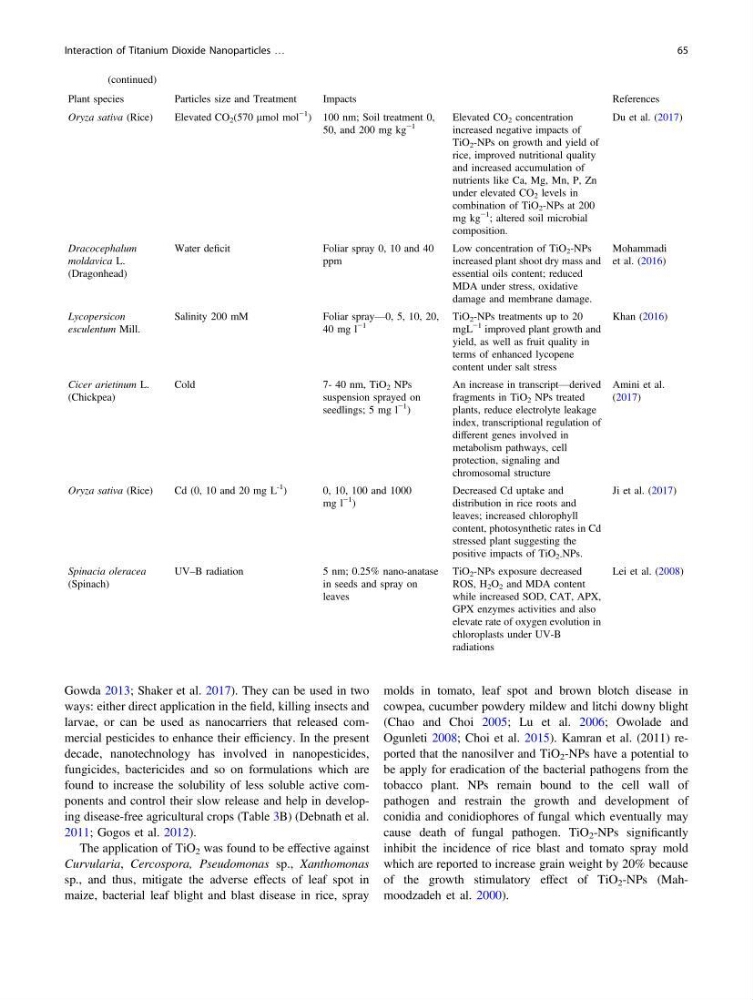
Table 3 (continued)
Plant species
Particles size and Treatment
Impacts
References
Oryza sativa (Rice)
Elevated CO 2 (570 lmol mol
−1
) 100 nm; Soil treatment 0,
50, and 200 mg kg
−1
Elevated CO 2 concentration
increased negative impacts of
TiO 2 -NPs on growth and yield of
rice, improved nutritional quality
and increased accumulation of
nutrients like Ca, Mg, Mn, P, Zn
under elevated CO 2 levels in
combination of TiO 2 -NPs at 200
mg kg
−1
; altered soil microbial
composition.
Du et al. (2017)
Dracocephalum
moldavica L.
(Dragonhead)
Water deficit
Foliar spray 0, 10 and 40
ppm
Low concentration of TiO 2 -NPs
increased plant shoot dry mass and
essential oils content; reduced
MDA under stress, oxidative
damage and membrane damage.
Mohammadi
et al. (2016)
Lycopersicon
esculentum Mill.
Salinity 200 mM
Foliar spray—0, 5, 10, 20,
40 mg l
−1
TiO 2 -NPs treatments up to 20
mgL
−1 improved plant growth and
yield, as well as fruit quality in
terms of enhanced lycopene
content under salt stress
Khan (2016)
Cicer arietinum L.
(Chickpea)
Cold
7- 40 nm, TiO 2 NPs
suspension sprayed on
seedlings; 5 mg l
−1 )
An increase in transcript—derived
fragments in TiO 2 NPs treated
plants, reduce electrolyte leakage
index, transcriptional regulation of
different genes involved in
metabolism pathways, cell
protection, signaling and
chromosomal structure
Amini et al.
(2017)
Oryza sativa (Rice)
Cd (0, 10 and 20 mg L
-1
)
0, 10, 100 and 1000
mg l
−1
)
Decreased Cd uptake and
distribution in rice roots and
leaves; increased chlorophyll
content, photosynthetic rates in Cd
stressed plant suggesting the
positive impacts of TiO 2- NPs.
Ji et al. (2017)
Spinacia oleracea
(Spinach)
UV–B radiation
5 nm; 0.25% nano-anatase
in seeds and spray on
leaves
TiO 2 -NPs exposure decreased
ROS, H 2 O 2 and MDA content
while increased SOD, CAT, APX,
GPX enzymes activities and also
elevate rate of oxygen evolution in
chloroplasts under UV-B
radiations
Lei et al. (2008)
Interaction of Titanium Dioxide Nanoparticles …
65
ways: either direct application in the field, killing insects and
larvae, or can be used as nanocarriers that released commercial pesticides to enhance their efficiency. In the present
decade, nanotechnology has involved in nanopesticides,
fungicides, bactericides and so on formulations which are
found to increase the solubility of less soluble active components and control their slow release and help in developing disease-free agricultural crops (Table 3B) (Debnath et al.
2011; Gogos et al. 2012).
The application of TiO 2 was found to be effective against
Curvularia, Cercospora, Pseudomonas sp., Xanthomonas
sp., and thus, mitigate the adverse effects of leaf spot in
maize, bacterial leaf blight and blast disease in rice, spray
molds in tomato, leaf spot and brown blotch disease in
cowpea, cucumber powdery mildew and litchi downy blight
(Chao and Choi 2005; Lu et al. 2006; Owolade and
Ogunleti 2008; Choi et al. 2015). Kamran et al. (2011) reported that the nanosilver and TiO 2 -NPs have a potential to
be apply for eradication of the bacterial pathogens from the
tobacco plant. NPs remain bound to the cell wall of
pathogen and restrain the growth and development of
conidia and conidiophores of fungal which eventually may
cause death of fungal pathogen. TiO 2 -NPs significantly
inhibit the incidence of rice blast and tomato spray mold
which are reported to increase grain weight by 20% because
of the growth stimulatory effect of TiO 2 -NPs (Mahmoodzadeh et al. 2000).
Table 3 (continued)
Plant species
Particles size and Treatment
Impacts
References
Oryza sativa (Rice)
Elevated CO 2 (570 lmol mol
−1
) 100 nm; Soil treatment 0,
50, and 200 mg kg
−1
Elevated CO 2 concentration
increased negative impacts of
TiO 2 -NPs on growth and yield of
rice, improved nutritional quality
and increased accumulation of
nutrients like Ca, Mg, Mn, P, Zn
under elevated CO 2 levels in
combination of TiO 2 -NPs at 200
mg kg
−1
; altered soil microbial
composition.
Du et al. (2017)
Dracocephalum
moldavica L.
(Dragonhead)
Water deficit
Foliar spray 0, 10 and 40
ppm
Low concentration of TiO 2 -NPs
increased plant shoot dry mass and
essential oils content; reduced
MDA under stress, oxidative
damage and membrane damage.
Mohammadi
et al. (2016)
Lycopersicon
esculentum Mill.
Salinity 200 mM
Foliar spray—0, 5, 10, 20,
40 mg l
−1
TiO 2 -NPs treatments up to 20
mgL
−1 improved plant growth and
yield, as well as fruit quality in
terms of enhanced lycopene
content under salt stress
Khan (2016)
Cicer arietinum L.
(Chickpea)
Cold
7- 40 nm, TiO 2 NPs
suspension sprayed on
seedlings; 5 mg l
−1 )
An increase in transcript—derived
fragments in TiO 2 NPs treated
plants, reduce electrolyte leakage
index, transcriptional regulation of
different genes involved in
metabolism pathways, cell
protection, signaling and
chromosomal structure
Amini et al.
(2017)
Oryza sativa (Rice)
Cd (0, 10 and 20 mg L
-1
)
0, 10, 100 and 1000
mg l
−1
)
Decreased Cd uptake and
distribution in rice roots and
leaves; increased chlorophyll
content, photosynthetic rates in Cd
stressed plant suggesting the
positive impacts of TiO 2- NPs.
Ji et al. (2017)
Spinacia oleracea
(Spinach)
UV–B radiation
5 nm; 0.25% nano-anatase
in seeds and spray on
leaves
TiO 2 -NPs exposure decreased
ROS, H 2 O 2 and MDA content
while increased SOD, CAT, APX,
GPX enzymes activities and also
elevate rate of oxygen evolution in
chloroplasts under UV-B
radiations
Lei et al. (2008)
Interaction of Titanium Dioxide Nanoparticles …
65