

1.1 Nanoparticles in Agro-ecosystems
Soil is known as the sink of NPs and portrays first site of
interactions between NPs and plants (Cornelis et al. 2014).
Plants being a primary producer play a critical role for any
ecosystem to function. As plants are first point of entry of
NPs, thus opens a potential pathway for TiO 2 -NPs in food
chain through the uptake and transportation and can be
accumulated in high trophic level consumers (Zhu et al.
2010; Rico et al. 2011). Air is another means of NPs contamination through which they primarily interact with leaf
and other aerial parts of the plant.
Over the past several years, research has been focused on
the NPs’ interaction with plants and their impact on ecology,
food chain and human health (Baan et al. 2006; Cox et al.
2016; Ali et al. 2017; Goswami et al. 2017; Ziental et al.
2020). Excessive accumulation of NPs inside the plant
system adversely affects the various physiological and
metabolic processes by regulating genes and cellular components, and consequently affects plant yield and productivity (Cornelis et al. 2014; Siddiqui et al. 2015; Tripathi
et al. 2017; Tan et al. 2018). A large number of toxicological
studies conducted on various plants reported contrasting
effects (detrimental and beneficial) of TiO 2 -NPs on plants
growth and development (Tripathi et al. 2017; Chaudhary
and Singh 2020). However, their impacts were dependent on
size, chemical structure and concentration of NPs
(Mukherjee et al. 2016) and show variation with species and
stages of plant growth (Du et al. 2011; Servin et al. 2012).
Despite of the availability of rich source of information
on the toxicity of TiO 2 -NPs in various organisms, still there
are little researches which have been performed on terrestrial
plants. Further, mechanisms by which TiO 2 -NPs exert contradictory effects on growth and development have not yet
been completely elucidated. Indeed, for monitoring environmental risks, it is very essential to know the absorption,
uptake and accumulation of TiO 2 -NPs in plants as well as
their interaction with plant cells and biomolecules which is
overviewed in this chapter. Besides, recently in the perspective of sustainable agriculture, application of TiO 2 -NPs
is considered as one of the challenging approaches to augment plant performance and productivity and to meet
emerging demand for food. However, the application of
NMs in the field of agriculture is in nascent stage, but over
the past few years few studies have been conducted with an
objective to promote commercial applications of TiO 2 -NPs
in agriculture. TiO 2 -NPs are found to be useful to improve
plants performance under different abiotic stresses (like low
temperature, heat, drought, salinity, heavy metal) and biotic
stresses (pests, pathogens infections) (Khan 2016; Singh and
Lee 2016; Gohari et al. 2020). It has been suggested that
TiO 2 -NPs’ treatment induces production of secondary
metabolites and alleviates the oxidative damage caused by
reactive oxygen species (ROS) by activation of antioxidant
defense system which ultimately improve plant performance
under stress condition. This chapter will provide an overview of the different roles and applications of TiO 2 -NPs with
their future perspectives in agriculture sector.
2 Uptake, Translocation and Accumulation
of TiO 2 Nanoparticles in Plants
Uptake and translocations of TiO 2 -NPs in plant are complex
processes that are in novice stage. Nowadays, researchers
have begun to elucidate the mechanism of their uptake and
translocation in plants. NPs are introduced to different sections of the environment with an estimate of 13.8% into soil,
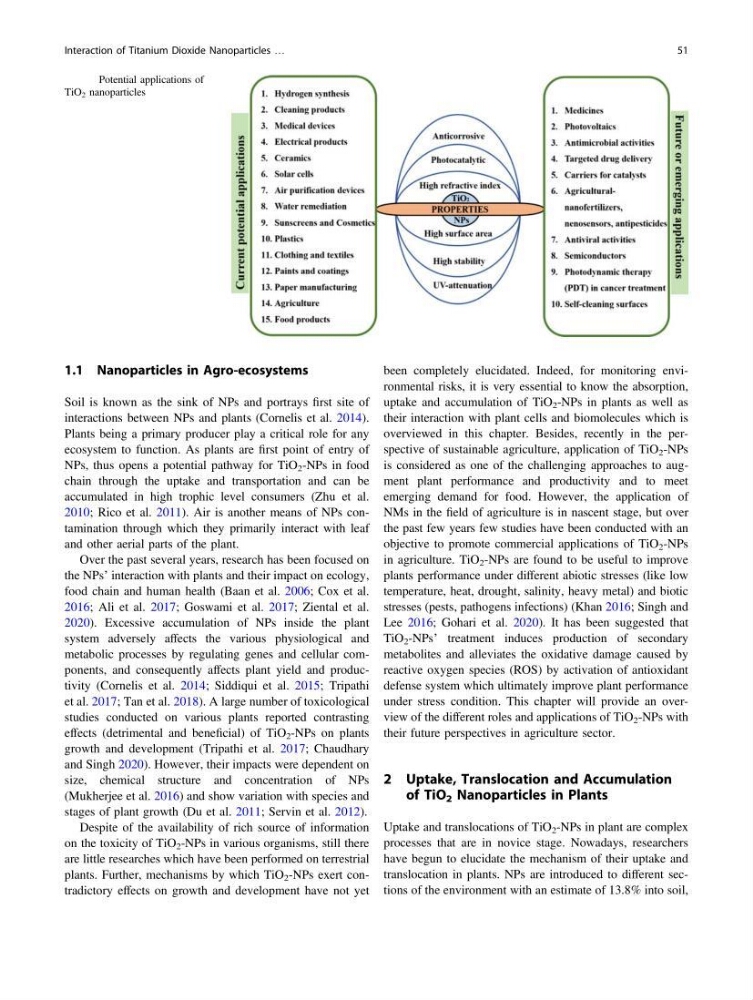
Fig. 2 Potential applications of
TiO 2 nanoparticles
Interaction of Titanium Dioxide Nanoparticles …
51
Soil is known as the sink of NPs and portrays first site of
interactions between NPs and plants (Cornelis et al. 2014).
Plants being a primary producer play a critical role for any
ecosystem to function. As plants are first point of entry of
NPs, thus opens a potential pathway for TiO 2 -NPs in food
chain through the uptake and transportation and can be
accumulated in high trophic level consumers (Zhu et al.
2010; Rico et al. 2011). Air is another means of NPs contamination through which they primarily interact with leaf
and other aerial parts of the plant.
Over the past several years, research has been focused on
the NPs’ interaction with plants and their impact on ecology,
food chain and human health (Baan et al. 2006; Cox et al.
2016; Ali et al. 2017; Goswami et al. 2017; Ziental et al.
2020). Excessive accumulation of NPs inside the plant
system adversely affects the various physiological and
metabolic processes by regulating genes and cellular components, and consequently affects plant yield and productivity (Cornelis et al. 2014; Siddiqui et al. 2015; Tripathi
et al. 2017; Tan et al. 2018). A large number of toxicological
studies conducted on various plants reported contrasting
effects (detrimental and beneficial) of TiO 2 -NPs on plants
growth and development (Tripathi et al. 2017; Chaudhary
and Singh 2020). However, their impacts were dependent on
size, chemical structure and concentration of NPs
(Mukherjee et al. 2016) and show variation with species and
stages of plant growth (Du et al. 2011; Servin et al. 2012).
Despite of the availability of rich source of information
on the toxicity of TiO 2 -NPs in various organisms, still there
are little researches which have been performed on terrestrial
plants. Further, mechanisms by which TiO 2 -NPs exert contradictory effects on growth and development have not yet
been completely elucidated. Indeed, for monitoring environmental risks, it is very essential to know the absorption,
uptake and accumulation of TiO 2 -NPs in plants as well as
their interaction with plant cells and biomolecules which is
overviewed in this chapter. Besides, recently in the perspective of sustainable agriculture, application of TiO 2 -NPs
is considered as one of the challenging approaches to augment plant performance and productivity and to meet
emerging demand for food. However, the application of
NMs in the field of agriculture is in nascent stage, but over
the past few years few studies have been conducted with an
objective to promote commercial applications of TiO 2 -NPs
in agriculture. TiO 2 -NPs are found to be useful to improve
plants performance under different abiotic stresses (like low
temperature, heat, drought, salinity, heavy metal) and biotic
stresses (pests, pathogens infections) (Khan 2016; Singh and
Lee 2016; Gohari et al. 2020). It has been suggested that
TiO 2 -NPs’ treatment induces production of secondary
metabolites and alleviates the oxidative damage caused by
reactive oxygen species (ROS) by activation of antioxidant
defense system which ultimately improve plant performance
under stress condition. This chapter will provide an overview of the different roles and applications of TiO 2 -NPs with
their future perspectives in agriculture sector.
2 Uptake, Translocation and Accumulation
of TiO 2 Nanoparticles in Plants
Uptake and translocations of TiO 2 -NPs in plant are complex
processes that are in novice stage. Nowadays, researchers
have begun to elucidate the mechanism of their uptake and
translocation in plants. NPs are introduced to different sections of the environment with an estimate of 13.8% into soil,
Fig. 2 Potential applications of
TiO 2 nanoparticles
Interaction of Titanium Dioxide Nanoparticles …
51