

18.5% into water and 2.2% in the air (Keller et al. 2013).
Soils that are final sink or main source of NPs’ pollutant
(Cornelis et al. 2014) play a significant role in transformation and modulation of TiO 2 -NPs. NPs interact with soil as
well as the other environmental components and affect their
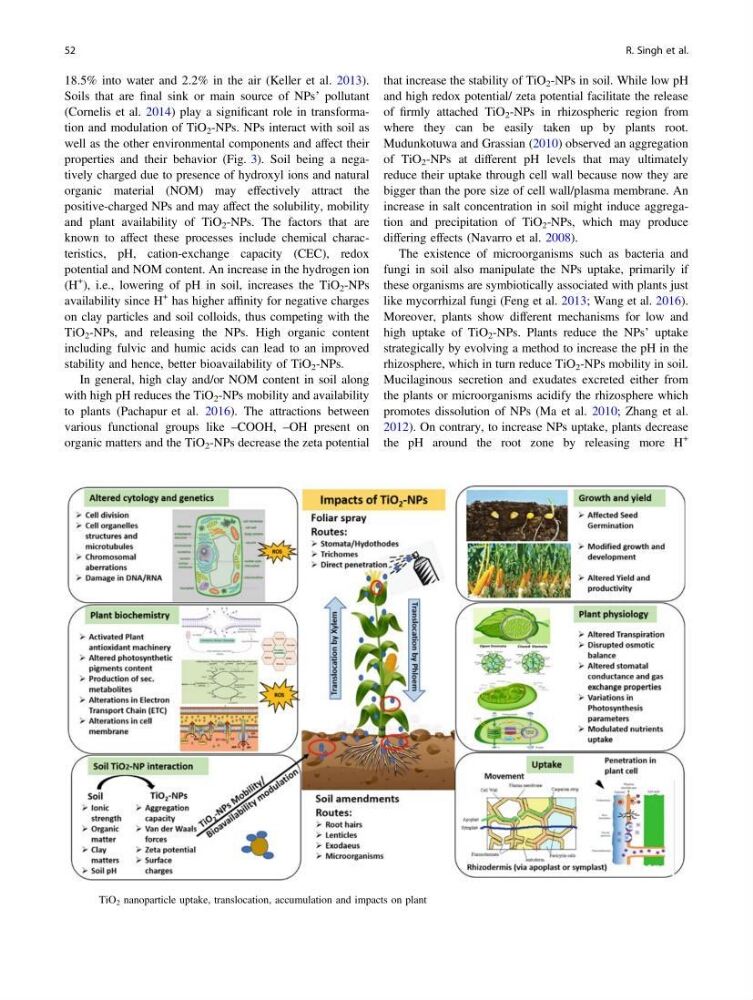
properties and their behavior (Fig. 3). Soil being a negatively charged due to presence of hydroxyl ions and natural
organic material (NOM) may effectively attract the
positive-charged NPs and may affect the solubility, mobility
and plant availability of TiO 2 -NPs. The factors that are
known to affect these processes include chemical characteristics, pH, cation-exchange capacity (CEC), redox
potential and NOM content. An increase in the hydrogen ion
(H
+ ), i.e., lowering of pH in soil, increases the TiO 2 -NPs
availability since H
+ has higher affinity for negative charges
on clay particles and soil colloids, thus competing with the
TiO 2 -NPs, and releasing the NPs. High organic content
including fulvic and humic acids can lead to an improved
stability and hence, better bioavailability of TiO 2 -NPs.
In general, high clay and/or NOM content in soil along
with high pH reduces the TiO 2 -NPs mobility and availability
to plants (Pachapur et al. 2016). The attractions between
various functional groups like –COOH, –OH present on
organic matters and the TiO 2 -NPs decrease the zeta potential
that increase the stability of TiO 2 -NPs in soil. While low pH
and high redox potential/ zeta potential facilitate the release
of firmly attached TiO 2 -NPs in rhizospheric region from
where they can be easily taken up by plants root.
Mudunkotuwa and Grassian (2010) observed an aggregation
of TiO 2 -NPs at different pH levels that may ultimately
reduce their uptake through cell wall because now they are
bigger than the pore size of cell wall/plasma membrane. An
increase in salt concentration in soil might induce aggregation and precipitation of TiO 2 -NPs, which may produce
differing effects (Navarro et al. 2008).
The existence of microorganisms such as bacteria and
fungi in soil also manipulate the NPs uptake, primarily if
these organisms are symbiotically associated with plants just
like mycorrhizal fungi (Feng et al. 2013; Wang et al. 2016).
Moreover, plants show different mechanisms for low and
high uptake of TiO 2 -NPs. Plants reduce the NPs’ uptake
strategically by evolving a method to increase the pH in the
rhizosphere, which in turn reduce TiO 2 -NPs mobility in soil.
Mucilaginous secretion and exudates excreted either from
the plants or microorganisms acidify the rhizosphere which
promotes dissolution of NPs (Ma et al. 2010; Zhang et al.
2012). On contrary, to increase NPs uptake, plants decrease
the pH around the root zone by releasing more H
+
Fig. 3 TiO 2 nanoparticle uptake, translocation, accumulation and impacts on plant
52
R. Singh et al.
Soils that are final sink or main source of NPs’ pollutant
(Cornelis et al. 2014) play a significant role in transformation and modulation of TiO 2 -NPs. NPs interact with soil as
well as the other environmental components and affect their
properties and their behavior (Fig. 3). Soil being a negatively charged due to presence of hydroxyl ions and natural
organic material (NOM) may effectively attract the
positive-charged NPs and may affect the solubility, mobility
and plant availability of TiO 2 -NPs. The factors that are
known to affect these processes include chemical characteristics, pH, cation-exchange capacity (CEC), redox
potential and NOM content. An increase in the hydrogen ion
(H
+ ), i.e., lowering of pH in soil, increases the TiO 2 -NPs
availability since H
+ has higher affinity for negative charges
on clay particles and soil colloids, thus competing with the
TiO 2 -NPs, and releasing the NPs. High organic content
including fulvic and humic acids can lead to an improved
stability and hence, better bioavailability of TiO 2 -NPs.
In general, high clay and/or NOM content in soil along
with high pH reduces the TiO 2 -NPs mobility and availability
to plants (Pachapur et al. 2016). The attractions between
various functional groups like –COOH, –OH present on
organic matters and the TiO 2 -NPs decrease the zeta potential
that increase the stability of TiO 2 -NPs in soil. While low pH
and high redox potential/ zeta potential facilitate the release
of firmly attached TiO 2 -NPs in rhizospheric region from
where they can be easily taken up by plants root.
Mudunkotuwa and Grassian (2010) observed an aggregation
of TiO 2 -NPs at different pH levels that may ultimately
reduce their uptake through cell wall because now they are
bigger than the pore size of cell wall/plasma membrane. An
increase in salt concentration in soil might induce aggregation and precipitation of TiO 2 -NPs, which may produce
differing effects (Navarro et al. 2008).
The existence of microorganisms such as bacteria and
fungi in soil also manipulate the NPs uptake, primarily if
these organisms are symbiotically associated with plants just
like mycorrhizal fungi (Feng et al. 2013; Wang et al. 2016).
Moreover, plants show different mechanisms for low and
high uptake of TiO 2 -NPs. Plants reduce the NPs’ uptake
strategically by evolving a method to increase the pH in the
rhizosphere, which in turn reduce TiO 2 -NPs mobility in soil.
Mucilaginous secretion and exudates excreted either from
the plants or microorganisms acidify the rhizosphere which
promotes dissolution of NPs (Ma et al. 2010; Zhang et al.
2012). On contrary, to increase NPs uptake, plants decrease
the pH around the root zone by releasing more H
+
Fig. 3 TiO 2 nanoparticle uptake, translocation, accumulation and impacts on plant
52
R. Singh et al.