

(Nyamukamba et al. 2018). Normally, a mixture of two
crystal forms, viz. anatase and rutile, is one of the most
commonly used and manufactured NMs. Commercial production of TiO 2 -NPs has been increased from 5000 metric
tons per year (MT yr
−1
) to more than 10,000 MT yr
−1 during
2006–2014 that is expected to increased uninterruptedly up to
approximately 2.5 million MT by 2025 (Menard et al. 2011;
Ziental et al. 2020).
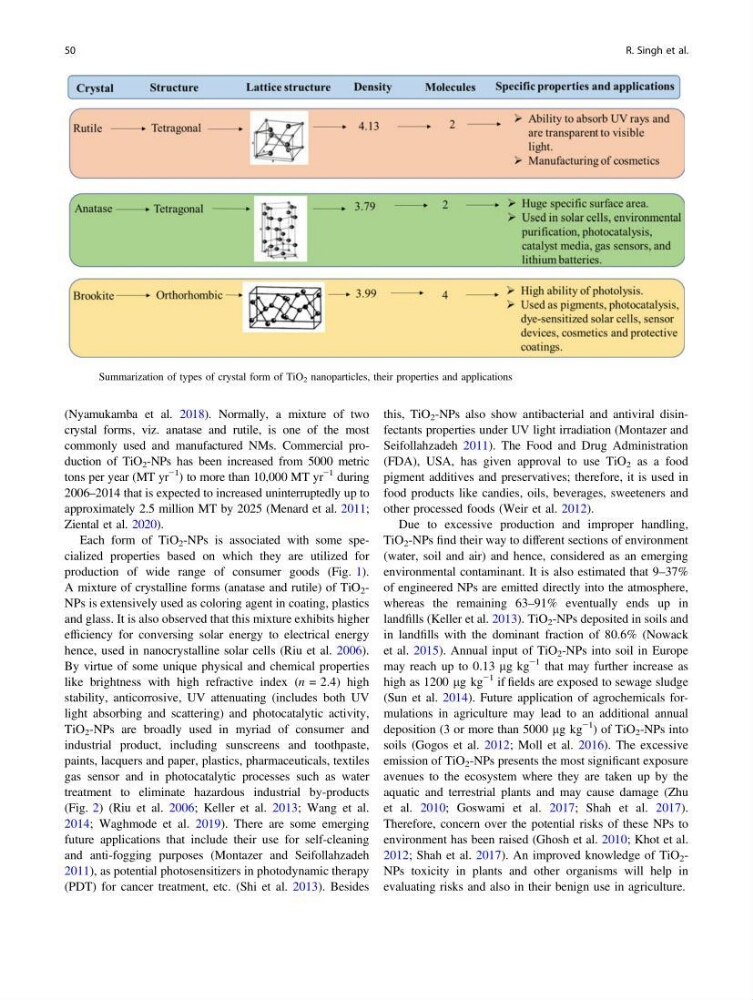
Each form of TiO 2 -NPs is associated with some specialized properties based on which they are utilized for
production of wide range of consumer goods (Fig. 1).
A mixture of crystalline forms (anatase and rutile) of TiO 2 -
NPs is extensively used as coloring agent in coating, plastics
and glass. It is also observed that this mixture exhibits higher
efficiency for conversing solar energy to electrical energy
hence, used in nanocrystalline solar cells (Riu et al. 2006).
By virtue of some unique physical and chemical properties
like brightness with high refractive index (n = 2.4) high
stability, anticorrosive, UV attenuating (includes both UV
light absorbing and scattering) and photocatalytic activity,
TiO 2 -NPs are broadly used in myriad of consumer and
industrial product, including sunscreens and toothpaste,
paints, lacquers and paper, plastics, pharmaceuticals, textiles
gas sensor and in photocatalytic processes such as water
treatment to eliminate hazardous industrial by-products
(Fig. 2) (Riu et al. 2006; Keller et al. 2013; Wang et al.
2014; Waghmode et al. 2019). There are some emerging
future applications that include their use for self-cleaning
and anti-fogging purposes (Montazer and Seifollahzadeh
2011), as potential photosensitizers in photodynamic therapy
(PDT) for cancer treatment, etc. (Shi et al. 2013). Besides
this, TiO 2 -NPs also show antibacterial and antiviral disinfectants properties under UV light irradiation (Montazer and
Seifollahzadeh 2011). The Food and Drug Administration
(FDA), USA, has given approval to use TiO 2 as a food
pigment additives and preservatives; therefore, it is used in
food products like candies, oils, beverages, sweeteners and
other processed foods (Weir et al. 2012).
Due to excessive production and improper handling,
TiO 2 -NPs find their way to different sections of environment
(water, soil and air) and hence, considered as an emerging
environmental contaminant. It is also estimated that 9–37%
of engineered NPs are emitted directly into the atmosphere,
whereas the remaining 63–91% eventually ends up in
landfills (Keller et al. 2013). TiO 2 -NPs deposited in soils and
in landfills with the dominant fraction of 80.6% (Nowack
et al. 2015). Annual input of TiO 2 -NPs into soil in Europe
may reach up to 0.13 lg kg
−1 that may further increase as
high as 1200 lg kg
−1 if fields are exposed to sewage sludge
(Sun et al. 2014). Future application of agrochemicals formulations in agriculture may lead to an additional annual
deposition (3 or more than 5000 lg kg
−1
) of TiO 2 -NPs into
soils (Gogos et al. 2012; Moll et al. 2016). The excessive
emission of TiO 2 -NPs presents the most significant exposure
avenues to the ecosystem where they are taken up by the
aquatic and terrestrial plants and may cause damage (Zhu
et al. 2010; Goswami et al. 2017; Shah et al. 2017).
Therefore, concern over the potential risks of these NPs to
environment has been raised (Ghosh et al. 2010; Khot et al.
2012; Shah et al. 2017). An improved knowledge of TiO 2 -
NPs toxicity in plants and other organisms will help in
evaluating risks and also in their benign use in agriculture.
Fig. 1 Summarization of types of crystal form of TiO 2 nanoparticles, their properties and applications
50
R. Singh et al.
crystal forms, viz. anatase and rutile, is one of the most
commonly used and manufactured NMs. Commercial production of TiO 2 -NPs has been increased from 5000 metric
tons per year (MT yr
−1
) to more than 10,000 MT yr
−1 during
2006–2014 that is expected to increased uninterruptedly up to
approximately 2.5 million MT by 2025 (Menard et al. 2011;
Ziental et al. 2020).
Each form of TiO 2 -NPs is associated with some specialized properties based on which they are utilized for
production of wide range of consumer goods (Fig. 1).
A mixture of crystalline forms (anatase and rutile) of TiO 2 -
NPs is extensively used as coloring agent in coating, plastics
and glass. It is also observed that this mixture exhibits higher
efficiency for conversing solar energy to electrical energy
hence, used in nanocrystalline solar cells (Riu et al. 2006).
By virtue of some unique physical and chemical properties
like brightness with high refractive index (n = 2.4) high
stability, anticorrosive, UV attenuating (includes both UV
light absorbing and scattering) and photocatalytic activity,
TiO 2 -NPs are broadly used in myriad of consumer and
industrial product, including sunscreens and toothpaste,
paints, lacquers and paper, plastics, pharmaceuticals, textiles
gas sensor and in photocatalytic processes such as water
treatment to eliminate hazardous industrial by-products
(Fig. 2) (Riu et al. 2006; Keller et al. 2013; Wang et al.
2014; Waghmode et al. 2019). There are some emerging
future applications that include their use for self-cleaning
and anti-fogging purposes (Montazer and Seifollahzadeh
2011), as potential photosensitizers in photodynamic therapy
(PDT) for cancer treatment, etc. (Shi et al. 2013). Besides
this, TiO 2 -NPs also show antibacterial and antiviral disinfectants properties under UV light irradiation (Montazer and
Seifollahzadeh 2011). The Food and Drug Administration
(FDA), USA, has given approval to use TiO 2 as a food
pigment additives and preservatives; therefore, it is used in
food products like candies, oils, beverages, sweeteners and
other processed foods (Weir et al. 2012).
Due to excessive production and improper handling,
TiO 2 -NPs find their way to different sections of environment
(water, soil and air) and hence, considered as an emerging
environmental contaminant. It is also estimated that 9–37%
of engineered NPs are emitted directly into the atmosphere,
whereas the remaining 63–91% eventually ends up in
landfills (Keller et al. 2013). TiO 2 -NPs deposited in soils and
in landfills with the dominant fraction of 80.6% (Nowack
et al. 2015). Annual input of TiO 2 -NPs into soil in Europe
may reach up to 0.13 lg kg
−1 that may further increase as
high as 1200 lg kg
−1 if fields are exposed to sewage sludge
(Sun et al. 2014). Future application of agrochemicals formulations in agriculture may lead to an additional annual
deposition (3 or more than 5000 lg kg
−1
) of TiO 2 -NPs into
soils (Gogos et al. 2012; Moll et al. 2016). The excessive
emission of TiO 2 -NPs presents the most significant exposure
avenues to the ecosystem where they are taken up by the
aquatic and terrestrial plants and may cause damage (Zhu
et al. 2010; Goswami et al. 2017; Shah et al. 2017).
Therefore, concern over the potential risks of these NPs to
environment has been raised (Ghosh et al. 2010; Khot et al.
2012; Shah et al. 2017). An improved knowledge of TiO 2 -
NPs toxicity in plants and other organisms will help in
evaluating risks and also in their benign use in agriculture.
Fig. 1 Summarization of types of crystal form of TiO 2 nanoparticles, their properties and applications
50
R. Singh et al.