

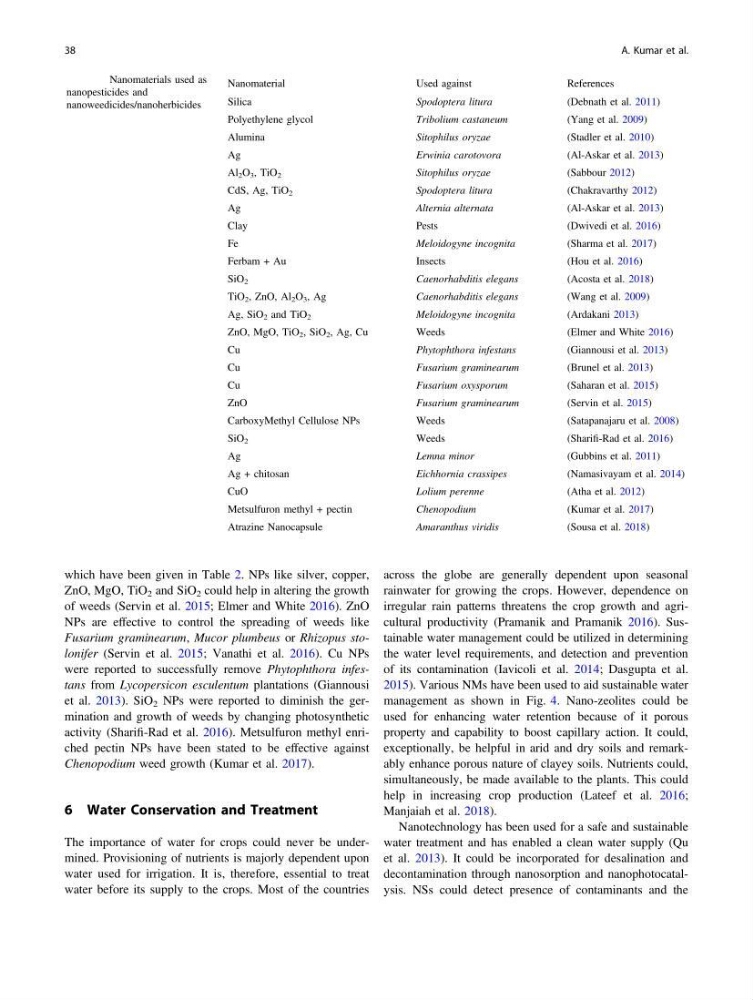
which have been given in Table 2. NPs like silver, copper,
ZnO, MgO, TiO 2 and SiO 2 could help in altering the growth
of weeds (Servin et al. 2015; Elmer and White 2016). ZnO
NPs are effective to control the spreading of weeds like
Fusarium graminearum, Mucor plumbeus or Rhizopus stolonifer (Servin et al. 2015; Vanathi et al. 2016). Cu NPs
were reported to successfully remove Phytophthora infestans from Lycopersicon esculentum plantations (Giannousi
et al. 2013). SiO 2 NPs were reported to diminish the germination and growth of weeds by changing photosynthetic
activity (Sharifi-Rad et al. 2016). Metsulfuron methyl enriched pectin NPs have been stated to be effective against
Chenopodium weed growth (Kumar et al. 2017).
6 Water Conservation and Treatment
The importance of water for crops could never be undermined. Provisioning of nutrients is majorly dependent upon
water used for irrigation. It is, therefore, essential to treat
water before its supply to the crops. Most of the countries
across the globe are generally dependent upon seasonal
rainwater for growing the crops. However, dependence on
irregular rain patterns threatens the crop growth and agricultural productivity (Pramanik and Pramanik 2016). Sustainable water management could be utilized in determining
the water level requirements, and detection and prevention
of its contamination (Iavicoli et al. 2014; Dasgupta et al.
2015). Various NMs have been used to aid sustainable water
management as shown in Fig. 4. Nano-zeolites could be
used for enhancing water retention because of it porous
property and capability to boost capillary action. It could,
exceptionally, be helpful in arid and dry soils and remarkably enhance porous nature of clayey soils. Nutrients could,
simultaneously, be made available to the plants. This could
help in increasing crop production (Lateef et al. 2016;
Manjaiah et al. 2018).
Nanotechnology has been used for a safe and sustainable
water treatment and has enabled a clean water supply (Qu
et al. 2013). It could be incorporated for desalination and
decontamination through nanosorption and nanophotocatalysis. NSs could detect presence of contaminants and the
Table 2 Nanomaterials used as
nanopesticides and
nanoweedicides/nanoherbicides
Nanomaterial
Used against
References
Silica
Spodoptera litura
(Debnath et al. 2011)
Polyethylene glycol
Tribolium castaneum
(Yang et al. 2009)
Alumina
Sitophilus oryzae
(Stadler et al. 2010)
Ag
Erwinia carotovora
(Al-Askar et al. 2013)
Al 2 O 3 , TiO 2
Sitophilus oryzae
(Sabbour 2012)
CdS, Ag, TiO 2
Spodoptera litura
(Chakravarthy 2012)
Ag
Alternia alternata
(Al-Askar et al. 2013)
Clay
Pests
(Dwivedi et al. 2016)
Fe
Meloidogyne incognita
(Sharma et al. 2017)
Ferbam + Au
Insects
(Hou et al. 2016)
SiO 2
Caenorhabditis elegans
(Acosta et al. 2018)
TiO 2 , ZnO, Al 2 O 3 , Ag
Caenorhabditis elegans
(Wang et al. 2009)
Ag, SiO 2 and TiO 2
Meloidogyne incognita
(Ardakani 2013)
ZnO, MgO, TiO 2 , SiO 2 , Ag, Cu
Weeds
(Elmer and White 2016)
Cu
Phytophthora infestans
(Giannousi et al. 2013)
Cu
Fusarium graminearum
(Brunel et al. 2013)
Cu
Fusarium oxysporum
(Saharan et al. 2015)
ZnO
Fusarium graminearum
(Servin et al. 2015)
CarboxyMethyl Cellulose NPs
Weeds
(Satapanajaru et al. 2008)
SiO 2
Weeds
(Sharifi-Rad et al. 2016)
Ag
Lemna minor
(Gubbins et al. 2011)
Ag + chitosan
Eichhornia crassipes
(Namasivayam et al. 2014)
CuO
Lolium perenne
(Atha et al. 2012)
Metsulfuron methyl + pectin
Chenopodium
(Kumar et al. 2017)
Atrazine Nanocapsule
Amaranthus viridis
(Sousa et al. 2018)
38
A. Kumar et al.
ZnO, MgO, TiO 2 and SiO 2 could help in altering the growth
of weeds (Servin et al. 2015; Elmer and White 2016). ZnO
NPs are effective to control the spreading of weeds like
Fusarium graminearum, Mucor plumbeus or Rhizopus stolonifer (Servin et al. 2015; Vanathi et al. 2016). Cu NPs
were reported to successfully remove Phytophthora infestans from Lycopersicon esculentum plantations (Giannousi
et al. 2013). SiO 2 NPs were reported to diminish the germination and growth of weeds by changing photosynthetic
activity (Sharifi-Rad et al. 2016). Metsulfuron methyl enriched pectin NPs have been stated to be effective against
Chenopodium weed growth (Kumar et al. 2017).
6 Water Conservation and Treatment
The importance of water for crops could never be undermined. Provisioning of nutrients is majorly dependent upon
water used for irrigation. It is, therefore, essential to treat
water before its supply to the crops. Most of the countries
across the globe are generally dependent upon seasonal
rainwater for growing the crops. However, dependence on
irregular rain patterns threatens the crop growth and agricultural productivity (Pramanik and Pramanik 2016). Sustainable water management could be utilized in determining
the water level requirements, and detection and prevention
of its contamination (Iavicoli et al. 2014; Dasgupta et al.
2015). Various NMs have been used to aid sustainable water
management as shown in Fig. 4. Nano-zeolites could be
used for enhancing water retention because of it porous
property and capability to boost capillary action. It could,
exceptionally, be helpful in arid and dry soils and remarkably enhance porous nature of clayey soils. Nutrients could,
simultaneously, be made available to the plants. This could
help in increasing crop production (Lateef et al. 2016;
Manjaiah et al. 2018).
Nanotechnology has been used for a safe and sustainable
water treatment and has enabled a clean water supply (Qu
et al. 2013). It could be incorporated for desalination and
decontamination through nanosorption and nanophotocatalysis. NSs could detect presence of contaminants and the
Table 2 Nanomaterials used as
nanopesticides and
nanoweedicides/nanoherbicides
Nanomaterial
Used against
References
Silica
Spodoptera litura
(Debnath et al. 2011)
Polyethylene glycol
Tribolium castaneum
(Yang et al. 2009)
Alumina
Sitophilus oryzae
(Stadler et al. 2010)
Ag
Erwinia carotovora
(Al-Askar et al. 2013)
Al 2 O 3 , TiO 2
Sitophilus oryzae
(Sabbour 2012)
CdS, Ag, TiO 2
Spodoptera litura
(Chakravarthy 2012)
Ag
Alternia alternata
(Al-Askar et al. 2013)
Clay
Pests
(Dwivedi et al. 2016)
Fe
Meloidogyne incognita
(Sharma et al. 2017)
Ferbam + Au
Insects
(Hou et al. 2016)
SiO 2
Caenorhabditis elegans
(Acosta et al. 2018)
TiO 2 , ZnO, Al 2 O 3 , Ag
Caenorhabditis elegans
(Wang et al. 2009)
Ag, SiO 2 and TiO 2
Meloidogyne incognita
(Ardakani 2013)
ZnO, MgO, TiO 2 , SiO 2 , Ag, Cu
Weeds
(Elmer and White 2016)
Cu
Phytophthora infestans
(Giannousi et al. 2013)
Cu
Fusarium graminearum
(Brunel et al. 2013)
Cu
Fusarium oxysporum
(Saharan et al. 2015)
ZnO
Fusarium graminearum
(Servin et al. 2015)
CarboxyMethyl Cellulose NPs
Weeds
(Satapanajaru et al. 2008)
SiO 2
Weeds
(Sharifi-Rad et al. 2016)
Ag
Lemna minor
(Gubbins et al. 2011)
Ag + chitosan
Eichhornia crassipes
(Namasivayam et al. 2014)
CuO
Lolium perenne
(Atha et al. 2012)
Metsulfuron methyl + pectin
Chenopodium
(Kumar et al. 2017)
Atrazine Nanocapsule
Amaranthus viridis
(Sousa et al. 2018)
38
A. Kumar et al.