

(Beddow et al. 2014; Michels et al. 2015). Thus, understanding the behavior and effects of these ENPs is very
topical for a scientific community. Both primary and
transformed ENPs are rich in the soil environment (Schwab
et al. 2016). The human added ENPs in soil attract special
attention because they have the potential to accumulate for a
longer time and are generally resistant to degradation.
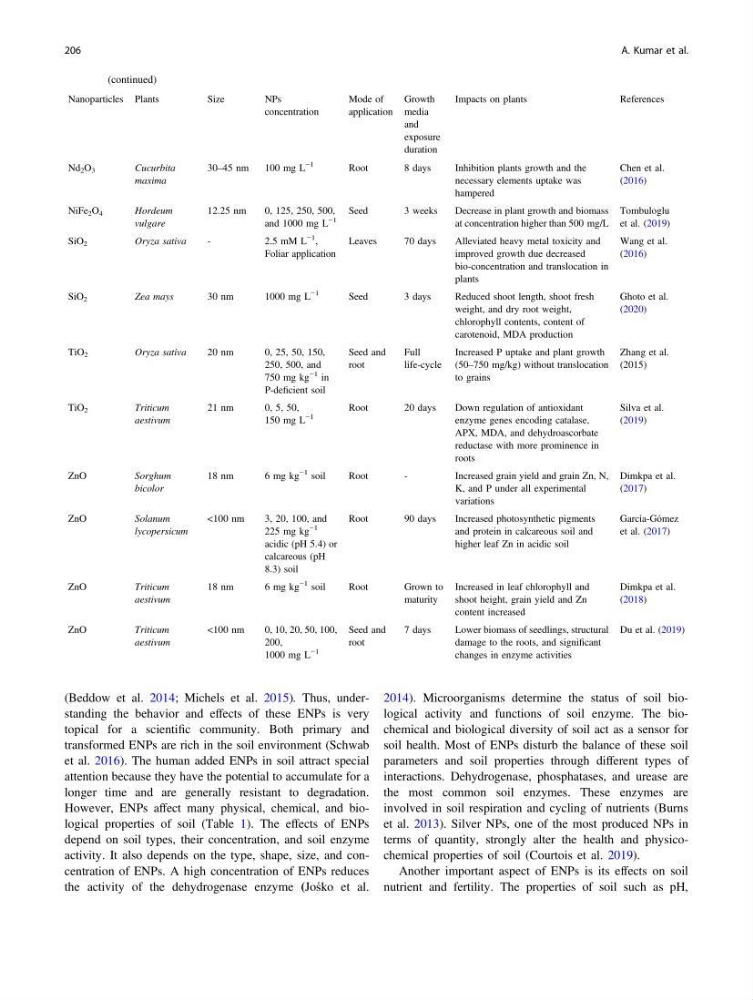
However, ENPs affect many physical, chemical, and biological properties of soil (Table 1). The effects of ENPs
depend on soil types, their concentration, and soil enzyme
activity. It also depends on the type, shape, size, and concentration of ENPs. A high concentration of ENPs reduces
the activity of the dehydrogenase enzyme (Jośko et al.
2014). Microorganisms determine the status of soil biological activity and functions of soil enzyme. The biochemical and biological diversity of soil act as a sensor for
soil health. Most of ENPs disturb the balance of these soil
parameters and soil properties through different types of
interactions. Dehydrogenase, phosphatases, and urease are
the most common soil enzymes. These enzymes are
involved in soil respiration and cycling of nutrients (Burns
et al. 2013). Silver NPs, one of the most produced NPs in
terms of quantity, strongly alter the health and physicochemical properties of soil (Courtois et al. 2019).
Another important aspect of ENPs is its effects on soil
nutrient and fertility. The properties of soil such as pH,
Table 1 (continued)
Nanoparticles Plants
Size
NPs
concentration
Mode of
application
Growth
media
and
exposure
duration
Impacts on plants
References
Nd 2 O 3
Cucurbita
maxima
30–45 nm
100 mg L
−1
Root
8 days
Inhibition plants growth and the
necessary elements uptake was
hampered
Chen et al.
(2016)
NiFe 2 O 4
Hordeum
vulgare
12.25 nm
0, 125, 250, 500,
and 1000 mg L
−1
Seed
3 weeks
Decrease in plant growth and biomass
at concentration higher than 500 mg/L
Tombuloglu
et al. (2019)
SiO 2
Oryza sativa
-
2.5 mM L
−1 ,
Foliar application
Leaves
70 days
Alleviated heavy metal toxicity and
improved growth due decreased
bio-concentration and translocation in
plants
Wang et al.
(2016)
SiO 2
Zea mays
30 nm
1000 mg L
−1
Seed
3 days
Reduced shoot length, shoot fresh
weight, and dry root weight,
chlorophyll contents, content of
carotenoid, MDA production
Ghoto et al.
(2020)
TiO 2
Oryza sativa
20 nm
0, 25, 50, 150,
250, 500, and
750 mg kg
−1 in
P-deficient soil
Seed and
root
Full
life-cycle
Increased P uptake and plant growth
(50–750 mg/kg) without translocation
to grains
Zhang et al.
(2015)
TiO 2
Triticum
aestivum
21 nm
0, 5, 50,
150 mg L
−1
Root
20 days
Down regulation of antioxidant
enzyme genes encoding catalase,
APX, MDA, and dehydroascorbate
reductase with more prominence in
roots
Silva et al.
(2019)
ZnO
Sorghum
bicolor
18 nm
6 mg kg
−1 soil
Root
-
Increased grain yield and grain Zn, N,
K, and P under all experimental
variations
Dimkpa et al.
(2017)
ZnO
Solanum
lycopersicum
<100 nm
3, 20, 100, and
225 mg kg
−1
acidic (pH 5.4) or
calcareous (pH
8.3) soil
Root
90 days
Increased photosynthetic pigments
and protein in calcareous soil and
higher leaf Zn in acidic soil
García-Gómez
et al. (2017)
ZnO
Triticum
aestivum
18 nm
6 mg kg
−1 soil
Root
Grown to
maturity
Increased in leaf chlorophyll and
shoot height, grain yield and Zn
content increased
Dimkpa et al.
(2018)
ZnO
Triticum
aestivum
<100 nm
0, 10, 20, 50, 100,
200,
1000 mg L
−1
Seed and
root
7 days
Lower biomass of seedlings, structural
damage to the roots, and significant
changes in enzyme activities
Du et al. (2019)
206
A. Kumar et al.
topical for a scientific community. Both primary and
transformed ENPs are rich in the soil environment (Schwab
et al. 2016). The human added ENPs in soil attract special
attention because they have the potential to accumulate for a
longer time and are generally resistant to degradation.
However, ENPs affect many physical, chemical, and biological properties of soil (Table 1). The effects of ENPs
depend on soil types, their concentration, and soil enzyme
activity. It also depends on the type, shape, size, and concentration of ENPs. A high concentration of ENPs reduces
the activity of the dehydrogenase enzyme (Jośko et al.
2014). Microorganisms determine the status of soil biological activity and functions of soil enzyme. The biochemical and biological diversity of soil act as a sensor for
soil health. Most of ENPs disturb the balance of these soil
parameters and soil properties through different types of
interactions. Dehydrogenase, phosphatases, and urease are
the most common soil enzymes. These enzymes are
involved in soil respiration and cycling of nutrients (Burns
et al. 2013). Silver NPs, one of the most produced NPs in
terms of quantity, strongly alter the health and physicochemical properties of soil (Courtois et al. 2019).
Another important aspect of ENPs is its effects on soil
nutrient and fertility. The properties of soil such as pH,
Table 1 (continued)
Nanoparticles Plants
Size
NPs
concentration
Mode of
application
Growth
media
and
exposure
duration
Impacts on plants
References
Nd 2 O 3
Cucurbita
maxima
30–45 nm
100 mg L
−1
Root
8 days
Inhibition plants growth and the
necessary elements uptake was
hampered
Chen et al.
(2016)
NiFe 2 O 4
Hordeum
vulgare
12.25 nm
0, 125, 250, 500,
and 1000 mg L
−1
Seed
3 weeks
Decrease in plant growth and biomass
at concentration higher than 500 mg/L
Tombuloglu
et al. (2019)
SiO 2
Oryza sativa
-
2.5 mM L
−1 ,
Foliar application
Leaves
70 days
Alleviated heavy metal toxicity and
improved growth due decreased
bio-concentration and translocation in
plants
Wang et al.
(2016)
SiO 2
Zea mays
30 nm
1000 mg L
−1
Seed
3 days
Reduced shoot length, shoot fresh
weight, and dry root weight,
chlorophyll contents, content of
carotenoid, MDA production
Ghoto et al.
(2020)
TiO 2
Oryza sativa
20 nm
0, 25, 50, 150,
250, 500, and
750 mg kg
−1 in
P-deficient soil
Seed and
root
Full
life-cycle
Increased P uptake and plant growth
(50–750 mg/kg) without translocation
to grains
Zhang et al.
(2015)
TiO 2
Triticum
aestivum
21 nm
0, 5, 50,
150 mg L
−1
Root
20 days
Down regulation of antioxidant
enzyme genes encoding catalase,
APX, MDA, and dehydroascorbate
reductase with more prominence in
roots
Silva et al.
(2019)
ZnO
Sorghum
bicolor
18 nm
6 mg kg
−1 soil
Root
-
Increased grain yield and grain Zn, N,
K, and P under all experimental
variations
Dimkpa et al.
(2017)
ZnO
Solanum
lycopersicum
<100 nm
3, 20, 100, and
225 mg kg
−1
acidic (pH 5.4) or
calcareous (pH
8.3) soil
Root
90 days
Increased photosynthetic pigments
and protein in calcareous soil and
higher leaf Zn in acidic soil
García-Gómez
et al. (2017)
ZnO
Triticum
aestivum
18 nm
6 mg kg
−1 soil
Root
Grown to
maturity
Increased in leaf chlorophyll and
shoot height, grain yield and Zn
content increased
Dimkpa et al.
(2018)
ZnO
Triticum
aestivum
<100 nm
0, 10, 20, 50, 100,
200,
1000 mg L
−1
Seed and
root
7 days
Lower biomass of seedlings, structural
damage to the roots, and significant
changes in enzyme activities
Du et al. (2019)
206
A. Kumar et al.