

in liquid state (Xie et al. 2017). The oxidation and brittleness
of sulfur are preventing sulfur coating in slow release fertilizers. Also, it is not economical to use synthetic polymers
for coating fertilizers. Hence, the best alternate available
coating is using natural polymer and it is a good water
absorber. However, the nutrient release longevity is available for less than 30 days. This duration will not meet
nitrogen supply requirements for crops. To overcome the
drawback of the bio-resources, a new technology is adopted.
In this method, natural polymers are converted into
bio-polyols that can work better. The fertilizer is coated with
polyurethane made from wheat straw. Solvents like ethylene
glycol/ethylene carbonate are used to liquefy the wheat
straw. The liquid is added with polymethylene polyphenyl
isocyanate and castor oil to get bio-based polyurethane (Lu
et al. 2015).
6.7 Zeolites in Slow/controlled Releasing
Zeolites are aluminosilicates of sodium, potassium, calcium,
and barium. Their applications lie in cation exchanges and
molecular sieves. SEM images of different zeolite particles
are shown in Fig. 12. These zeolite particles have properties
like adsorption of urease enzyme. Hence, they (except zeolite L) are useful in the preparation of urea-sensitive
biosensors (Kucherenko et al. 2015). Compared to the
conventional fertilizers, releasing of the fertilizer contents is
slow and more while applying the zeolites mixed/coated
macro or micronutrients. Zeolites reduce the nutrient loss by
controlling the release and improving uptake. Yuvaraj et al.
(2018) reported about the modification of zeolites for slow
release fertilizer application. Zeolites modified by a surfactant hexadecyltrimethylammonium bromide are treated
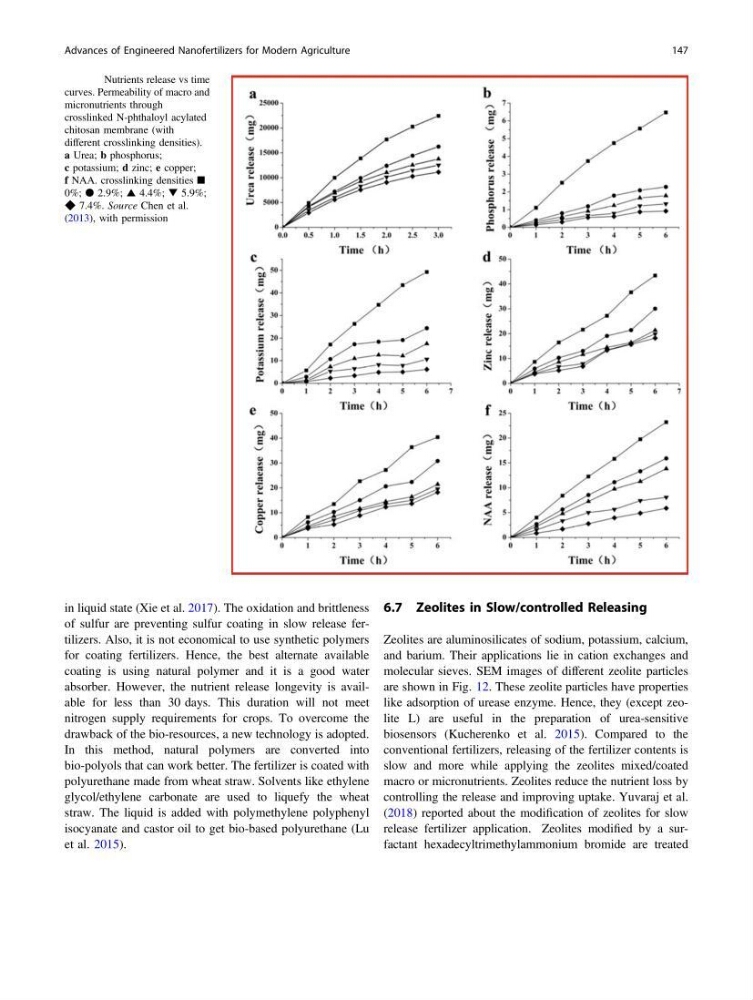
Fig. 11 Nutrients release vs time
curves. Permeability of macro and
micronutrients through
crosslinked N-phthaloyl acylated
chitosan membrane (with
different crosslinking densities).
a Urea; b phosphorus;
c potassium; d zinc; e copper;
f NAA. crosslinking densities ■
0%; ● 2.9%; ▲ 4.4%; ▼ 5.9%;
◆ 7.4%. Source Chen et al.
(2013), with permission
Advances of Engineered Nanofertilizers for Modern Agriculture
147
of sulfur are preventing sulfur coating in slow release fertilizers. Also, it is not economical to use synthetic polymers
for coating fertilizers. Hence, the best alternate available
coating is using natural polymer and it is a good water
absorber. However, the nutrient release longevity is available for less than 30 days. This duration will not meet
nitrogen supply requirements for crops. To overcome the
drawback of the bio-resources, a new technology is adopted.
In this method, natural polymers are converted into
bio-polyols that can work better. The fertilizer is coated with
polyurethane made from wheat straw. Solvents like ethylene
glycol/ethylene carbonate are used to liquefy the wheat
straw. The liquid is added with polymethylene polyphenyl
isocyanate and castor oil to get bio-based polyurethane (Lu
et al. 2015).
6.7 Zeolites in Slow/controlled Releasing
Zeolites are aluminosilicates of sodium, potassium, calcium,
and barium. Their applications lie in cation exchanges and
molecular sieves. SEM images of different zeolite particles
are shown in Fig. 12. These zeolite particles have properties
like adsorption of urease enzyme. Hence, they (except zeolite L) are useful in the preparation of urea-sensitive
biosensors (Kucherenko et al. 2015). Compared to the
conventional fertilizers, releasing of the fertilizer contents is
slow and more while applying the zeolites mixed/coated
macro or micronutrients. Zeolites reduce the nutrient loss by
controlling the release and improving uptake. Yuvaraj et al.
(2018) reported about the modification of zeolites for slow
release fertilizer application. Zeolites modified by a surfactant hexadecyltrimethylammonium bromide are treated
Fig. 11 Nutrients release vs time
curves. Permeability of macro and
micronutrients through
crosslinked N-phthaloyl acylated
chitosan membrane (with
different crosslinking densities).
a Urea; b phosphorus;
c potassium; d zinc; e copper;
f NAA. crosslinking densities ■
0%; ● 2.9%; ▲ 4.4%; ▼ 5.9%;
◆ 7.4%. Source Chen et al.
(2013), with permission
Advances of Engineered Nanofertilizers for Modern Agriculture
147