

with KH 2 PO 4 for preparation of slow release of phosphorus
fertilizer. From this fertilizer, phosphorus is released even
after 1080 h (Bansiwal et al. 2006). Zinc is utilized by plants
as a micronutrient up to 2–3%. To avoid zinc fixation in the
soil, nanozeolites are synthesized by ball milling and fortified with zinc by loading zinc sulfate. Zinc fertilizer coated
with nanozeolites releases zinc for a period of 1176 h
(Yuvaraj et al. 2018).
Phosphorus and potassium are incorporated in zeolite to
form a nanofertilizer. Release of phosphorous and potassium
from this nanofertilizer is higher than the conventional fertilizer. Also, the accumulation of phosphorous and potassium
are more in plants while applying this zeolite-based
nanofertilizer. After the application of this nanofertilizer, the
soil possesses better pH, moisture, EC, CEC, and availability
of P and K (Rajonee et al. 2017). Utilization of porous
nanomaterials (zeolites, clay, or chitosan) in fertilizer applications considerably reduces nitrogen loss by controlling the
release and improving uptake (Millan et al. 2008; Abdel-Aziz
et al. 2016; Panpatte et al. 2016). Ammonium mixed zeolites
improve the solubility of phosphate that leads to improving
the availability of phosphorus (Dwivedi et al. 2016).
7 Influences of Nanofertilizers on the Soil
and Crop Plants
It is analyzed and observed from the various literatures while
applying the nanofertilizer, it is essential to consider some
factors like concentration of nanofertilizers, biocompatibility, solubility, nutrient releasing period, control
over nutrient release, encapsulation/coating of nanofertilizer,
and size of nanomaterial. Some of the factors have influences on the agricultural output and yield of the plants. They
are enumerated below.
• Application of chemical fertilizers has drawback like soil
acidification. Slow releasing fertilizers avoid it.
• Utilization of toxic or biologically incompatible materials
causes harm to all biological organisms. Biocompatibility is an essential one. It can be achieved by
utilizing bio-synthesized nanomaterials instead of chemically synthesized nanomaterials.
• The concentration of the nanomaterial (nanofertilizer) is
more important. Applying the nanofertilizer (like carbon
nanomaterials and iron nanoparticles) up to optimum
quantity or at lower concentration yields better results.
Improvement in yields is due to the increased water uptake
and transport, seed germination, and antioxidant activities.
• Applying the nanofertilizer at higher concentration
decreases the yields. Due to aggregation at cell walls that
blocks the nutrients transfer and antioxidant activities.
• Encapsulation of microorganisms enhances the N, P, and
K availability that stimulate the plant growth.
• Sulfur-coated urea releases N slowly due to gradual
microbial, chemical, and physical degradation process.
• Urea reacted with aldehydes compounds release their N
slowly.
• Hydroxyapatite nanoparticles coating on urea reduces the
conversion of urea into ammonia and release the nitrogen
slowly.
• Hydroxyapatite nanoparticles release phosphorous and
improve the phosphorous availability to the plants without changing soil pH or soil acidification.
• Hydroxyapatite nanoparticles decrease the water
eutrophication that improves the yield.
• Hydroxyapatite nanoparticles can release both phosphorous and calcium.
• ZnO nanoparticles have solubility higher than the bulk
ZnO.
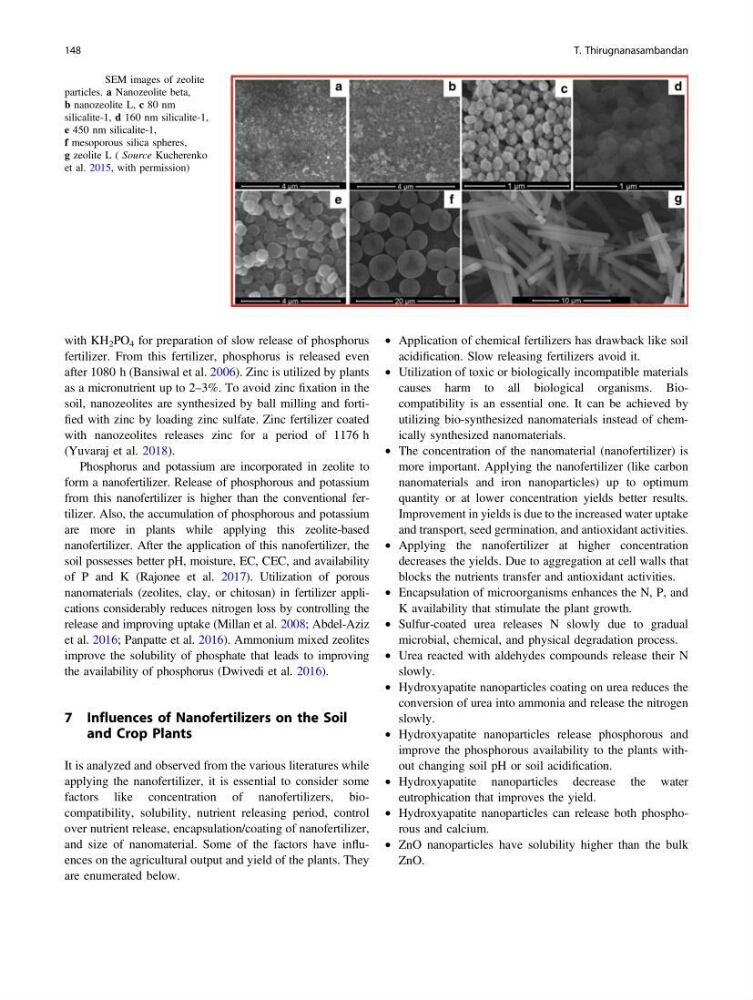
Fig. 12 SEM images of zeolite
particles. a Nanozeolite beta,
b nanozeolite L, c 80 nm
silicalite-1, d 160 nm silicalite-1,
e 450 nm silicalite-1,
f mesoporous silica spheres,
g zeolite L ( Source Kucherenko
et al. 2015, with permission)
148
T. Thirugnanasambandan
fertilizer. From this fertilizer, phosphorus is released even
after 1080 h (Bansiwal et al. 2006). Zinc is utilized by plants
as a micronutrient up to 2–3%. To avoid zinc fixation in the
soil, nanozeolites are synthesized by ball milling and fortified with zinc by loading zinc sulfate. Zinc fertilizer coated
with nanozeolites releases zinc for a period of 1176 h
(Yuvaraj et al. 2018).
Phosphorus and potassium are incorporated in zeolite to
form a nanofertilizer. Release of phosphorous and potassium
from this nanofertilizer is higher than the conventional fertilizer. Also, the accumulation of phosphorous and potassium
are more in plants while applying this zeolite-based
nanofertilizer. After the application of this nanofertilizer, the
soil possesses better pH, moisture, EC, CEC, and availability
of P and K (Rajonee et al. 2017). Utilization of porous
nanomaterials (zeolites, clay, or chitosan) in fertilizer applications considerably reduces nitrogen loss by controlling the
release and improving uptake (Millan et al. 2008; Abdel-Aziz
et al. 2016; Panpatte et al. 2016). Ammonium mixed zeolites
improve the solubility of phosphate that leads to improving
the availability of phosphorus (Dwivedi et al. 2016).
7 Influences of Nanofertilizers on the Soil
and Crop Plants
It is analyzed and observed from the various literatures while
applying the nanofertilizer, it is essential to consider some
factors like concentration of nanofertilizers, biocompatibility, solubility, nutrient releasing period, control
over nutrient release, encapsulation/coating of nanofertilizer,
and size of nanomaterial. Some of the factors have influences on the agricultural output and yield of the plants. They
are enumerated below.
• Application of chemical fertilizers has drawback like soil
acidification. Slow releasing fertilizers avoid it.
• Utilization of toxic or biologically incompatible materials
causes harm to all biological organisms. Biocompatibility is an essential one. It can be achieved by
utilizing bio-synthesized nanomaterials instead of chemically synthesized nanomaterials.
• The concentration of the nanomaterial (nanofertilizer) is
more important. Applying the nanofertilizer (like carbon
nanomaterials and iron nanoparticles) up to optimum
quantity or at lower concentration yields better results.
Improvement in yields is due to the increased water uptake
and transport, seed germination, and antioxidant activities.
• Applying the nanofertilizer at higher concentration
decreases the yields. Due to aggregation at cell walls that
blocks the nutrients transfer and antioxidant activities.
• Encapsulation of microorganisms enhances the N, P, and
K availability that stimulate the plant growth.
• Sulfur-coated urea releases N slowly due to gradual
microbial, chemical, and physical degradation process.
• Urea reacted with aldehydes compounds release their N
slowly.
• Hydroxyapatite nanoparticles coating on urea reduces the
conversion of urea into ammonia and release the nitrogen
slowly.
• Hydroxyapatite nanoparticles release phosphorous and
improve the phosphorous availability to the plants without changing soil pH or soil acidification.
• Hydroxyapatite nanoparticles decrease the water
eutrophication that improves the yield.
• Hydroxyapatite nanoparticles can release both phosphorous and calcium.
• ZnO nanoparticles have solubility higher than the bulk
ZnO.
Fig. 12 SEM images of zeolite
particles. a Nanozeolite beta,
b nanozeolite L, c 80 nm
silicalite-1, d 160 nm silicalite-1,
e 450 nm silicalite-1,
f mesoporous silica spheres,
g zeolite L ( Source Kucherenko
et al. 2015, with permission)
148
T. Thirugnanasambandan