

thermoplastic starch. Hydroxyapatite nanoparticles are dispersed in this urea matrix. These coating and dispersion lead
to produce urea-hydroxyapatite nanocomposite. This
nanocomposite controls the N-release and increases the
P-availability in soil. The interaction between hydroxyapatite and urea reduces the phosphorus immobilization that
increases the P-availability (Giroto et al. 2017).
6.5 Chitosan in Slow/controlled Releasing
Chitosan (CS) nanoparticle possesses polymeric cationic,
biodegradable, bioabsorbable, and bactericidal characteristics. Hence, it can be a best candidate in controlled release of
fertilizers. Chitosan nanoparticles are prepared by polymerizing methacrylic acid for the incorporation with NPK fertilizers. The slow release concept in fertilizers is able to save
fertilizer consumption and minimize the environmental
pollution (Corradini et al. 2010). In this way, chitosan
nanoparticles loaded with nitrogen, phosphorous, and
potassium are applied for wheat plants. Chitosan supports
for the growth of roots, shoots, and leaves of plants.
Nano-chitosan-NPK fertilizer increase harvest index, crop
index, and mobilization index of the wheat plants
(Abdel-Aziz et al. 2016). Crosslinking of chitosan with
suberoyl chloride enhances the controlled release properties
and mechanical strength of chitosan by forming a
three-dimensional network structure. Chen et al. (2013)
reported about the permeabilities of plant nutrients such as
N, P, K, Zn
2+ , and Cu
2+ and plant growth regulator
(naphthylacetic acid). N/P/K permeability is the important
parameters to evaluate the controlled release fertilizer.
Utilization of crosslinking agent (suberoyl chloride) in
crosslinking of N-phthaloyl acylated chitosan improves the
properties (such as film-forming ability, mechanical property, and hydrophobicity) of chitosan membranes. Adding
small amount of suberoyl chloride improves the properties
but the excessive crosslinking leads to poor permeability.
The macroelements (N, P, K), microelements (Zn
2+ and Cu
2+
),
and plant growth regulator (naphthylacetic acid) releasing
amount with different crosslinking densities (from 0 to 7.4%)
is shown in Fig. 11 (Chen et al. 2013).
Crosslinking decreases the permeability of macroelements, microelements, and NAA which confirms that the
crosslinked materials are suitable to use as controlled release
microelement fertilizers. The permeability is low when
crosslinking increases. Penetration of materials through
crosslinked N-phthaloyl acylated chitosan membrane is
confirmed from Fig. 11. Material releasing amount is less in
crosslinked membrane and it is high in membrane without
crosslinking. All curves exhibit the time-dependent release
pattern. Material releasing amount is high when time
increases (Chen et al. 2013).
6.6 Polyurethane in Slow/controlled Releasing
Controlled release fertilizers are made by coating fertilizers
using polymers like polyurethane. They can be synthesized
from low-cost, biodegradable, and renewable cottonseed oil.
The specialty of this coating over conventional methods is
increased surface roughness, reduced surface energy, and
superhydrophobic nature. The superhydrophobic nature
offers the non-wetting contact of water in gas state instead of
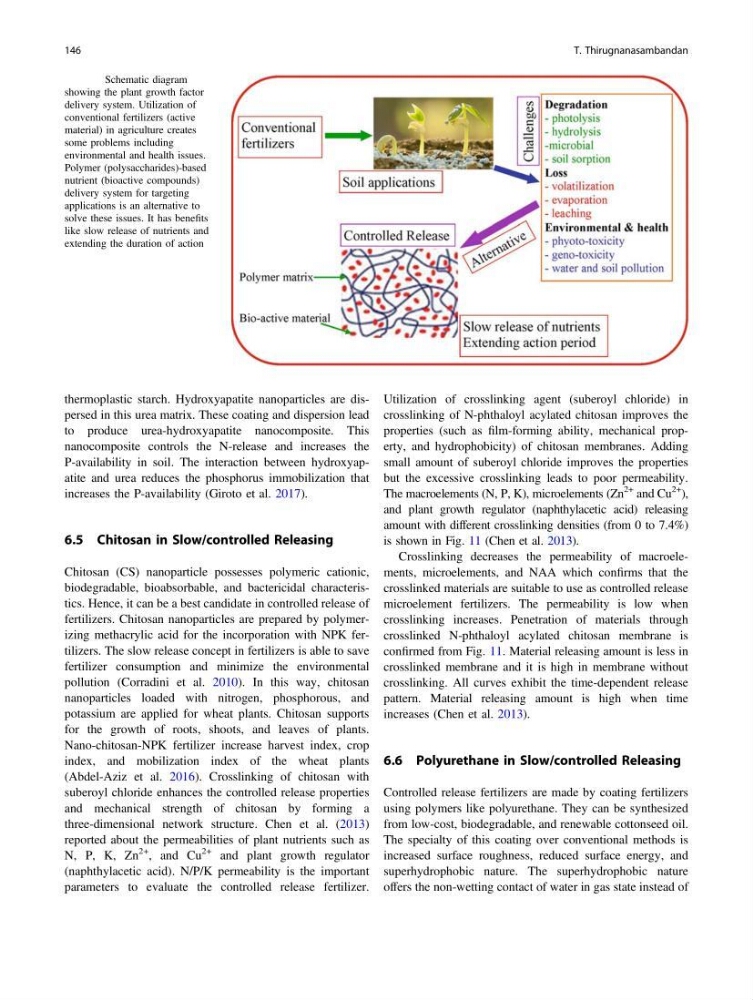
Fig. 10 Schematic diagram
showing the plant growth factor
delivery system. Utilization of
conventional fertilizers (active
material) in agriculture creates
some problems including
environmental and health issues.
Polymer (polysaccharides)-based
nutrient (bioactive compounds)
delivery system for targeting
applications is an alternative to
solve these issues. It has benefits
like slow release of nutrients and
extending the duration of action
146
T. Thirugnanasambandan
to produce urea-hydroxyapatite nanocomposite. This
nanocomposite controls the N-release and increases the
P-availability in soil. The interaction between hydroxyapatite and urea reduces the phosphorus immobilization that
increases the P-availability (Giroto et al. 2017).
6.5 Chitosan in Slow/controlled Releasing
Chitosan (CS) nanoparticle possesses polymeric cationic,
biodegradable, bioabsorbable, and bactericidal characteristics. Hence, it can be a best candidate in controlled release of
fertilizers. Chitosan nanoparticles are prepared by polymerizing methacrylic acid for the incorporation with NPK fertilizers. The slow release concept in fertilizers is able to save
fertilizer consumption and minimize the environmental
pollution (Corradini et al. 2010). In this way, chitosan
nanoparticles loaded with nitrogen, phosphorous, and
potassium are applied for wheat plants. Chitosan supports
for the growth of roots, shoots, and leaves of plants.
Nano-chitosan-NPK fertilizer increase harvest index, crop
index, and mobilization index of the wheat plants
(Abdel-Aziz et al. 2016). Crosslinking of chitosan with
suberoyl chloride enhances the controlled release properties
and mechanical strength of chitosan by forming a
three-dimensional network structure. Chen et al. (2013)
reported about the permeabilities of plant nutrients such as
N, P, K, Zn
2+ , and Cu
2+ and plant growth regulator
(naphthylacetic acid). N/P/K permeability is the important
parameters to evaluate the controlled release fertilizer.
Utilization of crosslinking agent (suberoyl chloride) in
crosslinking of N-phthaloyl acylated chitosan improves the
properties (such as film-forming ability, mechanical property, and hydrophobicity) of chitosan membranes. Adding
small amount of suberoyl chloride improves the properties
but the excessive crosslinking leads to poor permeability.
The macroelements (N, P, K), microelements (Zn
2+ and Cu
2+
),
and plant growth regulator (naphthylacetic acid) releasing
amount with different crosslinking densities (from 0 to 7.4%)
is shown in Fig. 11 (Chen et al. 2013).
Crosslinking decreases the permeability of macroelements, microelements, and NAA which confirms that the
crosslinked materials are suitable to use as controlled release
microelement fertilizers. The permeability is low when
crosslinking increases. Penetration of materials through
crosslinked N-phthaloyl acylated chitosan membrane is
confirmed from Fig. 11. Material releasing amount is less in
crosslinked membrane and it is high in membrane without
crosslinking. All curves exhibit the time-dependent release
pattern. Material releasing amount is high when time
increases (Chen et al. 2013).
6.6 Polyurethane in Slow/controlled Releasing
Controlled release fertilizers are made by coating fertilizers
using polymers like polyurethane. They can be synthesized
from low-cost, biodegradable, and renewable cottonseed oil.
The specialty of this coating over conventional methods is
increased surface roughness, reduced surface energy, and
superhydrophobic nature. The superhydrophobic nature
offers the non-wetting contact of water in gas state instead of
Fig. 10 Schematic diagram
showing the plant growth factor
delivery system. Utilization of
conventional fertilizers (active
material) in agriculture creates
some problems including
environmental and health issues.
Polymer (polysaccharides)-based
nutrient (bioactive compounds)
delivery system for targeting
applications is an alternative to
solve these issues. It has benefits
like slow release of nutrients and
extending the duration of action
146
T. Thirugnanasambandan