

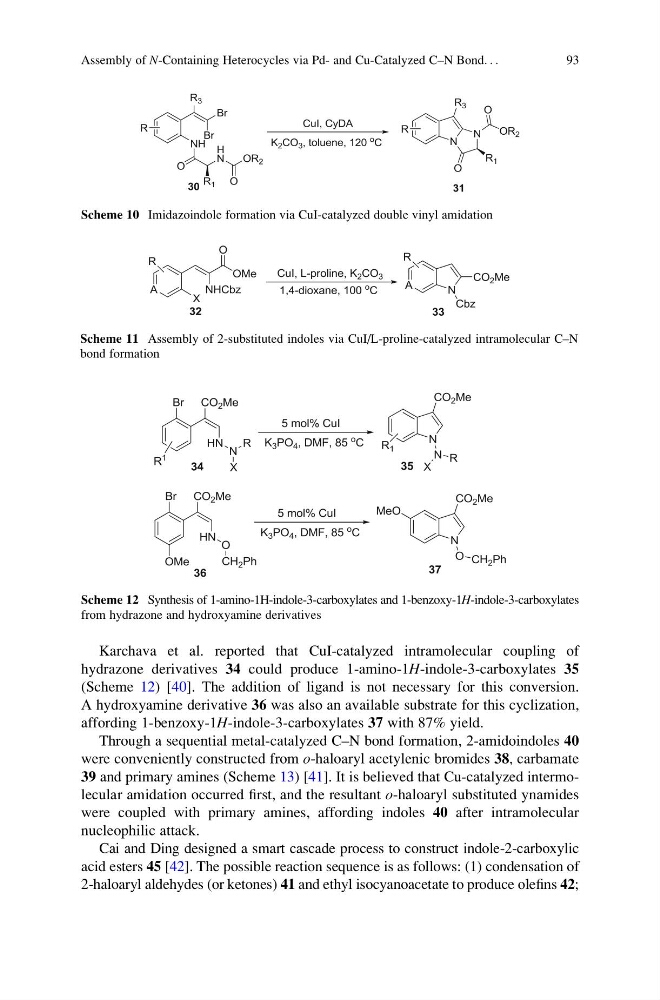
Karchava et al. reported that CuI-catalyzed intramolecular coupling of
hydrazone derivatives 34 could produce 1-amino-1H-indole-3-carboxylates 35
(Scheme 12) [40]. The addition of ligand is not necessary for this conversion.
A hydroxyamine derivative 36 was also an available substrate for this cyclization,
affording 1-benzoxy-1H-indole-3-carboxylates 37 with 87% yield.
Through a sequential metal-catalyzed C–N bond formation, 2-amidoindoles 40
were conveniently constructed from o-haloaryl acetylenic bromides 38, carbamate
39 and primary amines (Scheme 13) [41]. It is believed that Cu-catalyzed intermolecular amidation occurred first, and the resultant o-haloaryl substituted ynamides
were coupled with primary amines, affording indoles 40 after intramolecular
nucleophilic attack.
Cai and Ding designed a smart cascade process to construct indole-2-carboxylic
acid esters 45 [42]. The possible reaction sequence is as follows: (1) condensation of
2-haloaryl aldehydes (or ketones) 41 and ethyl isocyanoacetate to produce olefins 42;
Scheme 11 Assembly of 2-substituted indoles via CuI/L-proline-catalyzed intramolecular C–N
bond formation
Scheme 12 Synthesis of 1-amino-1H-indole-3-carboxylates and 1-benzoxy-1H-indole-3-carboxylates
from hydrazone and hydroxyamine derivatives
Scheme 10 Imidazoindole formation via CuI-catalyzed double vinyl amidation
Assembly of N-Containing Heterocycles via Pd- and Cu-Catalyzed C–N Bond. . .
93
hydrazone derivatives 34 could produce 1-amino-1H-indole-3-carboxylates 35
(Scheme 12) [40]. The addition of ligand is not necessary for this conversion.
A hydroxyamine derivative 36 was also an available substrate for this cyclization,
affording 1-benzoxy-1H-indole-3-carboxylates 37 with 87% yield.
Through a sequential metal-catalyzed C–N bond formation, 2-amidoindoles 40
were conveniently constructed from o-haloaryl acetylenic bromides 38, carbamate
39 and primary amines (Scheme 13) [41]. It is believed that Cu-catalyzed intermolecular amidation occurred first, and the resultant o-haloaryl substituted ynamides
were coupled with primary amines, affording indoles 40 after intramolecular
nucleophilic attack.
Cai and Ding designed a smart cascade process to construct indole-2-carboxylic
acid esters 45 [42]. The possible reaction sequence is as follows: (1) condensation of
2-haloaryl aldehydes (or ketones) 41 and ethyl isocyanoacetate to produce olefins 42;
Scheme 11 Assembly of 2-substituted indoles via CuI/L-proline-catalyzed intramolecular C–N
bond formation
Scheme 12 Synthesis of 1-amino-1H-indole-3-carboxylates and 1-benzoxy-1H-indole-3-carboxylates
from hydrazone and hydroxyamine derivatives
Scheme 10 Imidazoindole formation via CuI-catalyzed double vinyl amidation
Assembly of N-Containing Heterocycles via Pd- and Cu-Catalyzed C–N Bond. . .
93