

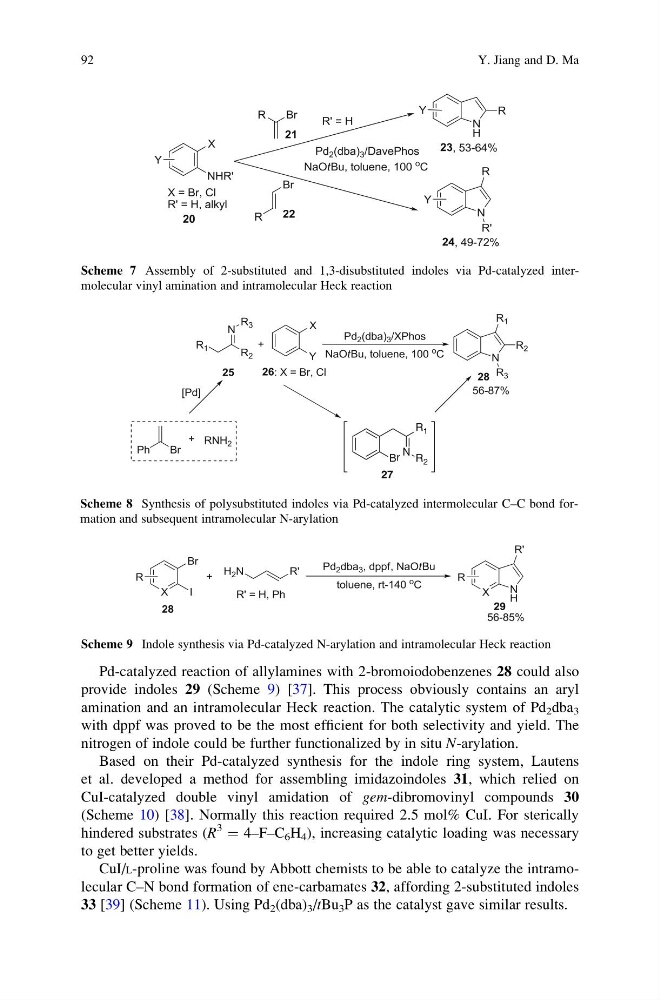
Pd-catalyzed reaction of allylamines with 2-bromoiodobenzenes 28 could also
provide indoles 29 (Scheme 9) [37]. This process obviously contains an aryl
amination and an intramolecular Heck reaction. The catalytic system of Pd 2 dba 3
with dppf was proved to be the most efficient for both selectivity and yield. The
nitrogen of indole could be further functionalized by in situ N-arylation.
Based on their Pd-catalyzed synthesis for the indole ring system, Lautens
et al. developed a method for assembling imidazoindoles 31, which relied on
CuI-catalyzed double vinyl amidation of gem-dibromovinyl compounds 30
(Scheme 10) [38]. Normally this reaction required 2.5 mol% CuI. For sterically
hindered substrates (R
3
¼ 4–F–C 6 H 4 ), increasing catalytic loading was necessary
to get better yields.
CuI/L-proline was found by Abbott chemists to be able to catalyze the intramolecular C–N bond formation of ene-carbamates 32, affording 2-substituted indoles
33 [39] (Scheme 11). Using Pd 2 (dba) 3 /tBu 3 P as the catalyst gave similar results.
Scheme 7 Assembly of 2-substituted and 1,3-disubstituted indoles via Pd-catalyzed intermolecular vinyl amination and intramolecular Heck reaction
27
R 1
N R 2
Br
Scheme 8 Synthesis of polysubstituted indoles via Pd-catalyzed intermolecular C–C bond formation and subsequent intramolecular N-arylation
Scheme 9 Indole synthesis via Pd-catalyzed N-arylation and intramolecular Heck reaction
92
Y. Jiang and D. Ma
provide indoles 29 (Scheme 9) [37]. This process obviously contains an aryl
amination and an intramolecular Heck reaction. The catalytic system of Pd 2 dba 3
with dppf was proved to be the most efficient for both selectivity and yield. The
nitrogen of indole could be further functionalized by in situ N-arylation.
Based on their Pd-catalyzed synthesis for the indole ring system, Lautens
et al. developed a method for assembling imidazoindoles 31, which relied on
CuI-catalyzed double vinyl amidation of gem-dibromovinyl compounds 30
(Scheme 10) [38]. Normally this reaction required 2.5 mol% CuI. For sterically
hindered substrates (R
3
¼ 4–F–C 6 H 4 ), increasing catalytic loading was necessary
to get better yields.
CuI/L-proline was found by Abbott chemists to be able to catalyze the intramolecular C–N bond formation of ene-carbamates 32, affording 2-substituted indoles
33 [39] (Scheme 11). Using Pd 2 (dba) 3 /tBu 3 P as the catalyst gave similar results.
Scheme 7 Assembly of 2-substituted and 1,3-disubstituted indoles via Pd-catalyzed intermolecular vinyl amination and intramolecular Heck reaction
27
R 1
N R 2
Br
Scheme 8 Synthesis of polysubstituted indoles via Pd-catalyzed intermolecular C–C bond formation and subsequent intramolecular N-arylation
Scheme 9 Indole synthesis via Pd-catalyzed N-arylation and intramolecular Heck reaction
92
Y. Jiang and D. Ma