

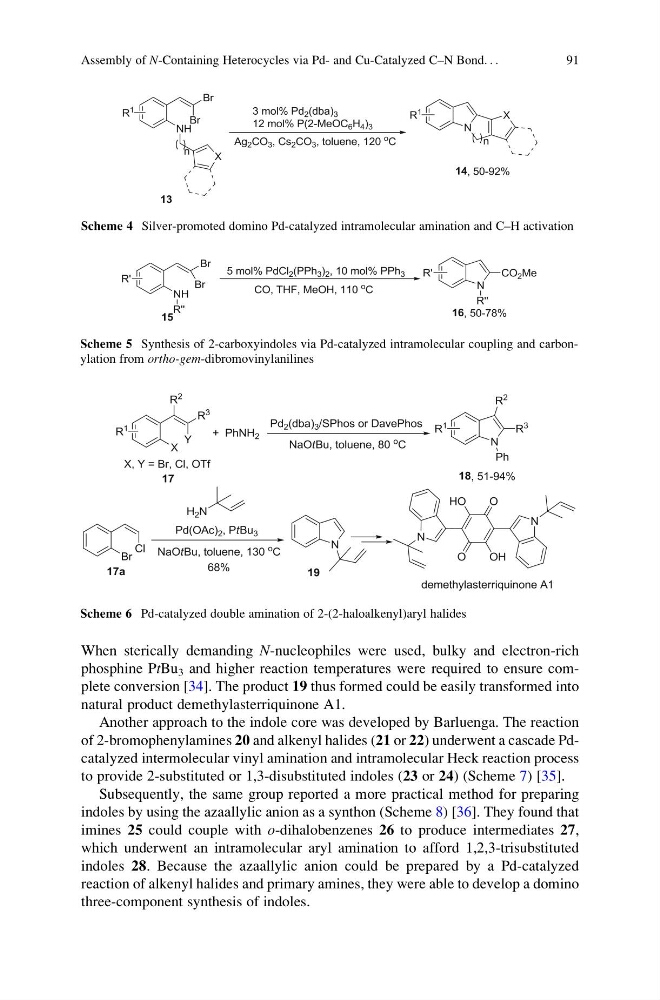
When sterically demanding N-nucleophiles were used, bulky and electron-rich
phosphine PtBu 3 and higher reaction temperatures were required to ensure complete conversion [34]. The product 19 thus formed could be easily transformed into
natural product demethylasterriquinone A1.
Another approach to the indole core was developed by Barluenga. The reaction
of 2-bromophenylamines 20 and alkenyl halides (21 or 22) underwent a cascade Pdcatalyzed intermolecular vinyl amination and intramolecular Heck reaction process
to provide 2-substituted or 1,3-disubstituted indoles (23 or 24) (Scheme 7) [35].
Subsequently, the same group reported a more practical method for preparing
indoles by using the azaallylic anion as a synthon (Scheme 8) [36]. They found that
imines 25 could couple with o-dihalobenzenes 26 to produce intermediates 27,
which underwent an intramolecular aryl amination to afford 1,2,3-trisubstituted
indoles 28. Because the azaallylic anion could be prepared by a Pd-catalyzed
reaction of alkenyl halides and primary amines, they were able to develop a domino
three-component synthesis of indoles.
Scheme 6 Pd-catalyzed double amination of 2-(2-haloalkenyl)aryl halides
Scheme 5 Synthesis of 2-carboxyindoles via Pd-catalyzed intramolecular coupling and carbonylation from ortho-gem-dibromovinylanilines
Scheme 4 Silver-promoted domino Pd-catalyzed intramolecular amination and C–H activation
Assembly of N-Containing Heterocycles via Pd- and Cu-Catalyzed C–N Bond. . .
91
phosphine PtBu 3 and higher reaction temperatures were required to ensure complete conversion [34]. The product 19 thus formed could be easily transformed into
natural product demethylasterriquinone A1.
Another approach to the indole core was developed by Barluenga. The reaction
of 2-bromophenylamines 20 and alkenyl halides (21 or 22) underwent a cascade Pdcatalyzed intermolecular vinyl amination and intramolecular Heck reaction process
to provide 2-substituted or 1,3-disubstituted indoles (23 or 24) (Scheme 7) [35].
Subsequently, the same group reported a more practical method for preparing
indoles by using the azaallylic anion as a synthon (Scheme 8) [36]. They found that
imines 25 could couple with o-dihalobenzenes 26 to produce intermediates 27,
which underwent an intramolecular aryl amination to afford 1,2,3-trisubstituted
indoles 28. Because the azaallylic anion could be prepared by a Pd-catalyzed
reaction of alkenyl halides and primary amines, they were able to develop a domino
three-component synthesis of indoles.
Scheme 6 Pd-catalyzed double amination of 2-(2-haloalkenyl)aryl halides
Scheme 5 Synthesis of 2-carboxyindoles via Pd-catalyzed intramolecular coupling and carbonylation from ortho-gem-dibromovinylanilines
Scheme 4 Silver-promoted domino Pd-catalyzed intramolecular amination and C–H activation
Assembly of N-Containing Heterocycles via Pd- and Cu-Catalyzed C–N Bond. . .
91