

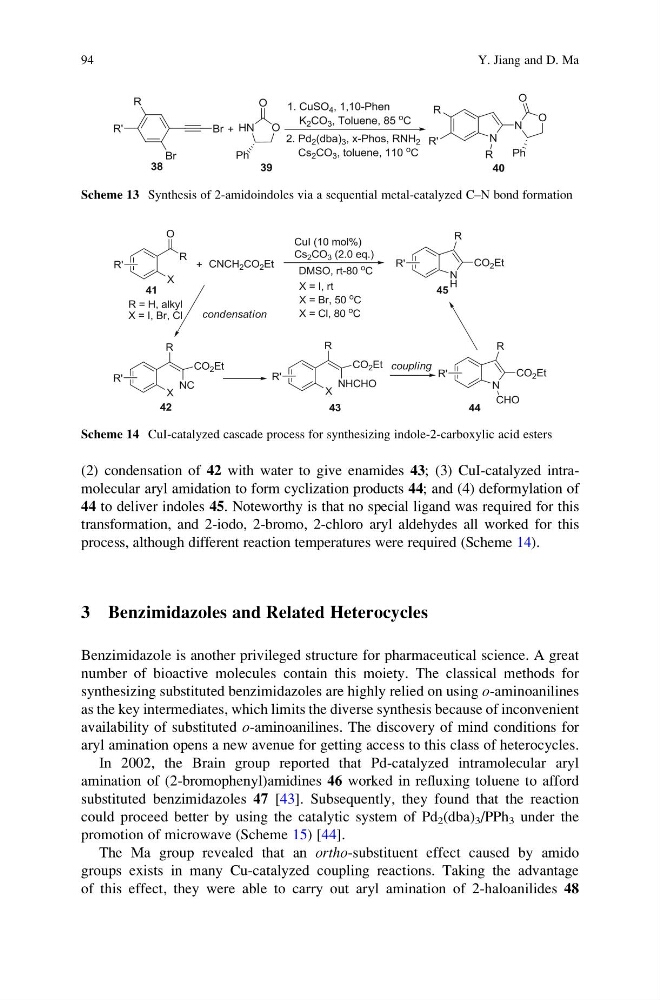
(2) condensation of 42 with water to give enamides 43; (3) CuI-catalyzed intramolecular aryl amidation to form cyclization products 44; and (4) deformylation of
44 to deliver indoles 45. Noteworthy is that no special ligand was required for this
transformation, and 2-iodo, 2-bromo, 2-chloro aryl aldehydes all worked for this
process, although different reaction temperatures were required (Scheme 14).
3 Benzimidazoles and Related Heterocycles
Benzimidazole is another privileged structure for pharmaceutical science. A great
number of bioactive molecules contain this moiety. The classical methods for
synthesizing substituted benzimidazoles are highly relied on using o-aminoanilines
as the key intermediates, which limits the diverse synthesis because of inconvenient
availability of substituted o-aminoanilines. The discovery of mind conditions for
aryl amination opens a new avenue for getting access to this class of heterocycles.
In 2002, the Brain group reported that Pd-catalyzed intramolecular aryl
amination of (2-bromophenyl)amidines 46 worked in refluxing toluene to afford
substituted benzimidazoles 47 [43]. Subsequently, they found that the reaction
could proceed better by using the catalytic system of Pd 2 (dba) 3 /PPh 3 under the
promotion of microwave (Scheme 15) [44].
The Ma group revealed that an ortho-substituent effect caused by amido
groups exists in many Cu-catalyzed coupling reactions. Taking the advantage
of this effect, they were able to carry out aryl amination of 2-haloanilides 48
Scheme 13 Synthesis of 2-amidoindoles via a sequential metal-catalyzed C–N bond formation
Scheme 14 CuI-catalyzed cascade process for synthesizing indole-2-carboxylic acid esters
94
Y. Jiang and D. Ma
44 to deliver indoles 45. Noteworthy is that no special ligand was required for this
transformation, and 2-iodo, 2-bromo, 2-chloro aryl aldehydes all worked for this
process, although different reaction temperatures were required (Scheme 14).
3 Benzimidazoles and Related Heterocycles
Benzimidazole is another privileged structure for pharmaceutical science. A great
number of bioactive molecules contain this moiety. The classical methods for
synthesizing substituted benzimidazoles are highly relied on using o-aminoanilines
as the key intermediates, which limits the diverse synthesis because of inconvenient
availability of substituted o-aminoanilines. The discovery of mind conditions for
aryl amination opens a new avenue for getting access to this class of heterocycles.
In 2002, the Brain group reported that Pd-catalyzed intramolecular aryl
amination of (2-bromophenyl)amidines 46 worked in refluxing toluene to afford
substituted benzimidazoles 47 [43]. Subsequently, they found that the reaction
could proceed better by using the catalytic system of Pd 2 (dba) 3 /PPh 3 under the
promotion of microwave (Scheme 15) [44].
The Ma group revealed that an ortho-substituent effect caused by amido
groups exists in many Cu-catalyzed coupling reactions. Taking the advantage
of this effect, they were able to carry out aryl amination of 2-haloanilides 48
Scheme 13 Synthesis of 2-amidoindoles via a sequential metal-catalyzed C–N bond formation
Scheme 14 CuI-catalyzed cascade process for synthesizing indole-2-carboxylic acid esters
94
Y. Jiang and D. Ma