

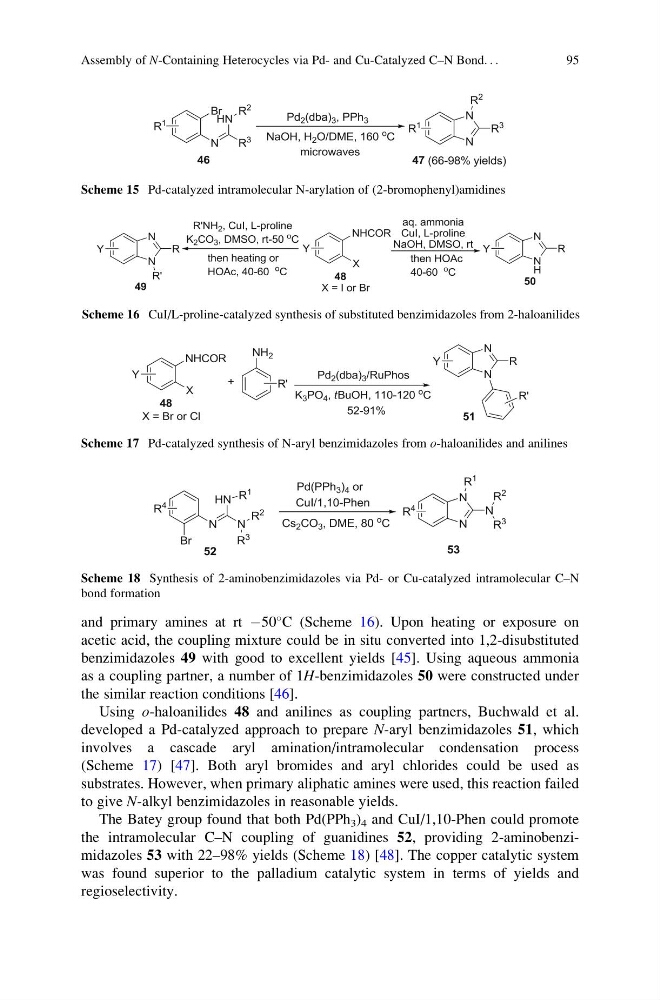
and primary amines at rt À50
C (Scheme 16). Upon heating or exposure on
acetic acid, the coupling mixture could be in situ converted into 1,2-disubstituted
benzimidazoles 49 with good to excellent yields [45]. Using aqueous ammonia
as a coupling partner, a number of 1H-benzimidazoles 50 were constructed under
the similar reaction conditions [46].
Using o-haloanilides 48 and anilines as coupling partners, Buchwald et al.
developed a Pd-catalyzed approach to prepare N-aryl benzimidazoles 51, which
involves a cascade aryl amination/intramolecular condensation process
(Scheme 17) [47]. Both aryl bromides and aryl chlorides could be used as
substrates. However, when primary aliphatic amines were used, this reaction failed
to give N-alkyl benzimidazoles in reasonable yields.
The Batey group found that both Pd(PPh 3 ) 4 and CuI/1,10-Phen could promote
the intramolecular C–N coupling of guanidines 52, providing 2-aminobenzimidazoles 53 with 22–98% yields (Scheme 18) [48]. The copper catalytic system
was found superior to the palladium catalytic system in terms of yields and
regioselectivity.
Scheme 15 Pd-catalyzed intramolecular N-arylation of (2-bromophenyl)amidines
Scheme 16 CuI/L-proline-catalyzed synthesis of substituted benzimidazoles from 2-haloanilides
Scheme 17 Pd-catalyzed synthesis of N-aryl benzimidazoles from o-haloanilides and anilines
Scheme 18 Synthesis of 2-aminobenzimidazoles via Pd- or Cu-catalyzed intramolecular C–N
bond formation
Assembly of N-Containing Heterocycles via Pd- and Cu-Catalyzed C–N Bond. . .
95
C (Scheme 16). Upon heating or exposure on
acetic acid, the coupling mixture could be in situ converted into 1,2-disubstituted
benzimidazoles 49 with good to excellent yields [45]. Using aqueous ammonia
as a coupling partner, a number of 1H-benzimidazoles 50 were constructed under
the similar reaction conditions [46].
Using o-haloanilides 48 and anilines as coupling partners, Buchwald et al.
developed a Pd-catalyzed approach to prepare N-aryl benzimidazoles 51, which
involves a cascade aryl amination/intramolecular condensation process
(Scheme 17) [47]. Both aryl bromides and aryl chlorides could be used as
substrates. However, when primary aliphatic amines were used, this reaction failed
to give N-alkyl benzimidazoles in reasonable yields.
The Batey group found that both Pd(PPh 3 ) 4 and CuI/1,10-Phen could promote
the intramolecular C–N coupling of guanidines 52, providing 2-aminobenzimidazoles 53 with 22–98% yields (Scheme 18) [48]. The copper catalytic system
was found superior to the palladium catalytic system in terms of yields and
regioselectivity.
Scheme 15 Pd-catalyzed intramolecular N-arylation of (2-bromophenyl)amidines
Scheme 16 CuI/L-proline-catalyzed synthesis of substituted benzimidazoles from 2-haloanilides
Scheme 17 Pd-catalyzed synthesis of N-aryl benzimidazoles from o-haloanilides and anilines
Scheme 18 Synthesis of 2-aminobenzimidazoles via Pd- or Cu-catalyzed intramolecular C–N
bond formation
Assembly of N-Containing Heterocycles via Pd- and Cu-Catalyzed C–N Bond. . .
95