

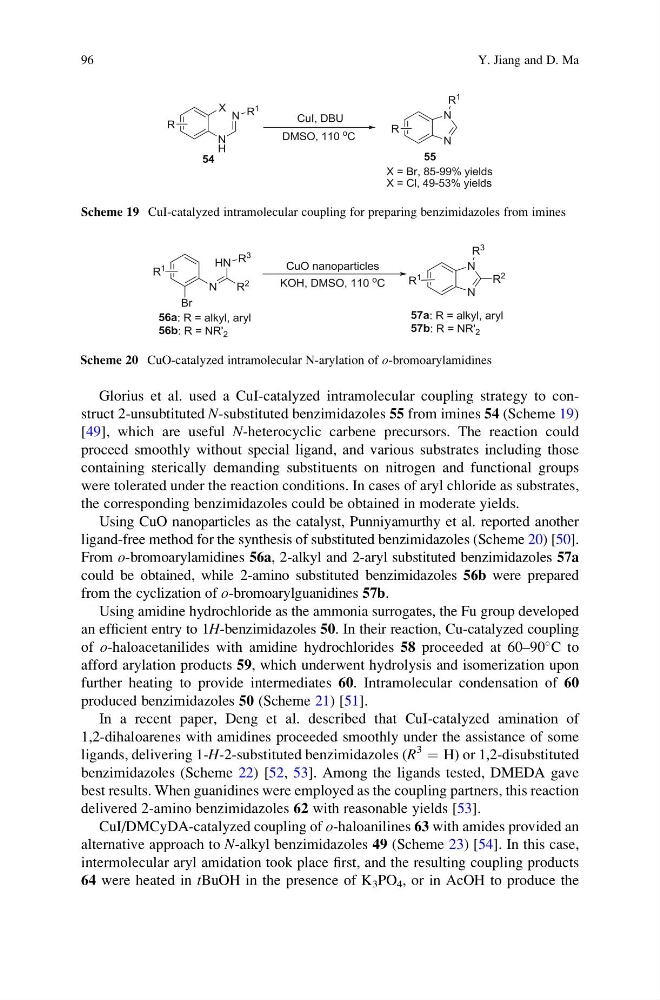
Glorius et al. used a CuI-catalyzed intramolecular coupling strategy to construct 2-unsubtituted N-substituted benzimidazoles 55 from imines 54 (Scheme 19)
[49], which are useful N-heterocyclic carbene precursors. The reaction could
proceed smoothly without special ligand, and various substrates including those
containing sterically demanding substituents on nitrogen and functional groups
were tolerated under the reaction conditions. In cases of aryl chloride as substrates,
the corresponding benzimidazoles could be obtained in moderate yields.
Using CuO nanoparticles as the catalyst, Punniyamurthy et al. reported another
ligand-free method for the synthesis of substituted benzimidazoles (Scheme 20) [50].
From o-bromoarylamidines 56a, 2-alkyl and 2-aryl substituted benzimidazoles 57a
could be obtained, while 2-amino substituted benzimidazoles 56b were prepared
from the cyclization of o-bromoarylguanidines 57b.
Using amidine hydrochloride as the ammonia surrogates, the Fu group developed
an efficient entry to 1H-benzimidazoles 50. In their reaction, Cu-catalyzed coupling
of o-haloacetanilides with amidine hydrochlorides 58 proceeded at 60–90
C to
afford arylation products 59, which underwent hydrolysis and isomerization upon
further heating to provide intermediates 60. Intramolecular condensation of 60
produced benzimidazoles 50 (Scheme 21) [51].
In a recent paper, Deng et al. described that CuI-catalyzed amination of
1,2-dihaloarenes with amidines proceeded smoothly under the assistance of some
ligands, delivering 1-H-2-substituted benzimidazoles (R
3
¼ H) or 1,2-disubstituted
benzimidazoles (Scheme 22) [52, 53]. Among the ligands tested, DMEDA gave
best results. When guanidines were employed as the coupling partners, this reaction
delivered 2-amino benzimidazoles 62 with reasonable yields [53].
CuI/DMCyDA-catalyzed coupling of o-haloanilines 63 with amides provided an
alternative approach to N-alkyl benzimidazoles 49 (Scheme 23) [54]. In this case,
intermolecular aryl amidation took place first, and the resulting coupling products
64 were heated in tBuOH in the presence of K 3 PO 4 , or in AcOH to produce the
Scheme 19 CuI-catalyzed intramolecular coupling for preparing benzimidazoles from imines
Scheme 20 CuO-catalyzed intramolecular N-arylation of o-bromoarylamidines
96
Y. Jiang and D. Ma
[49], which are useful N-heterocyclic carbene precursors. The reaction could
proceed smoothly without special ligand, and various substrates including those
containing sterically demanding substituents on nitrogen and functional groups
were tolerated under the reaction conditions. In cases of aryl chloride as substrates,
the corresponding benzimidazoles could be obtained in moderate yields.
Using CuO nanoparticles as the catalyst, Punniyamurthy et al. reported another
ligand-free method for the synthesis of substituted benzimidazoles (Scheme 20) [50].
From o-bromoarylamidines 56a, 2-alkyl and 2-aryl substituted benzimidazoles 57a
could be obtained, while 2-amino substituted benzimidazoles 56b were prepared
from the cyclization of o-bromoarylguanidines 57b.
Using amidine hydrochloride as the ammonia surrogates, the Fu group developed
an efficient entry to 1H-benzimidazoles 50. In their reaction, Cu-catalyzed coupling
of o-haloacetanilides with amidine hydrochlorides 58 proceeded at 60–90
C to
afford arylation products 59, which underwent hydrolysis and isomerization upon
further heating to provide intermediates 60. Intramolecular condensation of 60
produced benzimidazoles 50 (Scheme 21) [51].
In a recent paper, Deng et al. described that CuI-catalyzed amination of
1,2-dihaloarenes with amidines proceeded smoothly under the assistance of some
ligands, delivering 1-H-2-substituted benzimidazoles (R
3
¼ H) or 1,2-disubstituted
benzimidazoles (Scheme 22) [52, 53]. Among the ligands tested, DMEDA gave
best results. When guanidines were employed as the coupling partners, this reaction
delivered 2-amino benzimidazoles 62 with reasonable yields [53].
CuI/DMCyDA-catalyzed coupling of o-haloanilines 63 with amides provided an
alternative approach to N-alkyl benzimidazoles 49 (Scheme 23) [54]. In this case,
intermolecular aryl amidation took place first, and the resulting coupling products
64 were heated in tBuOH in the presence of K 3 PO 4 , or in AcOH to produce the
Scheme 19 CuI-catalyzed intramolecular coupling for preparing benzimidazoles from imines
Scheme 20 CuO-catalyzed intramolecular N-arylation of o-bromoarylamidines
96
Y. Jiang and D. Ma