

3.2.3 Other Nitrogen Compounds
Although the vast majority of vinylation reactions involving copper catalysts are
accomplished with amines and amides as nitrogen coupling partners, the reactivity
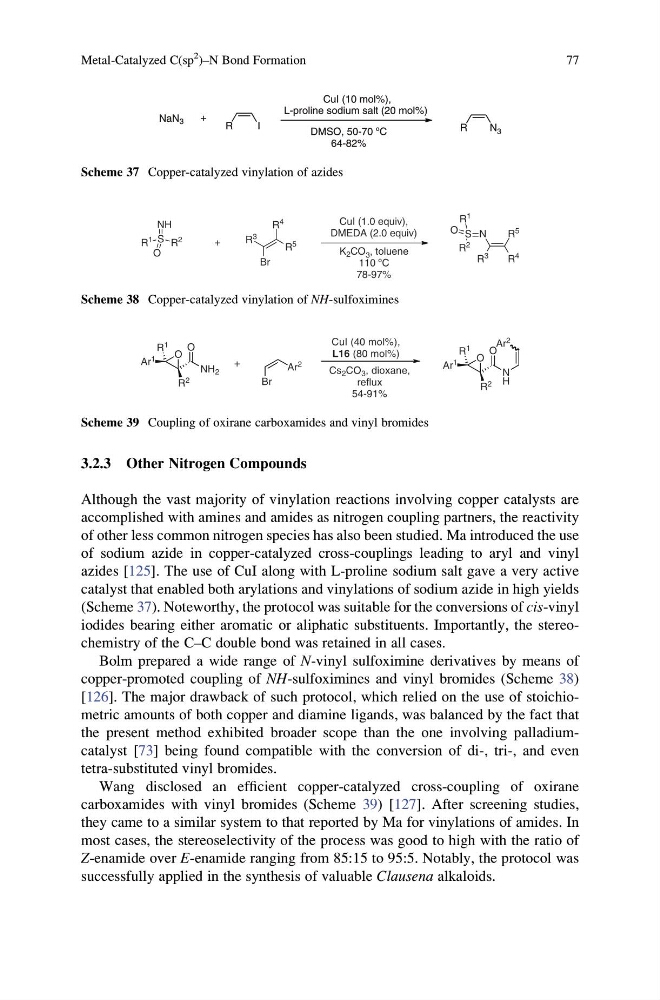
of other less common nitrogen species has also been studied. Ma introduced the use
of sodium azide in copper-catalyzed cross-couplings leading to aryl and vinyl
azides [125]. The use of CuI along with L-proline sodium salt gave a very active
catalyst that enabled both arylations and vinylations of sodium azide in high yields
(Scheme 37). Noteworthy, the protocol was suitable for the conversions of cis-vinyl
iodides bearing either aromatic or aliphatic substituents. Importantly, the stereochemistry of the C–C double bond was retained in all cases.
Bolm prepared a wide range of N-vinyl sulfoximine derivatives by means of
copper-promoted coupling of NH-sulfoximines and vinyl bromides (Scheme 38)
[126]. The major drawback of such protocol, which relied on the use of stoichiometric amounts of both copper and diamine ligands, was balanced by the fact that
the present method exhibited broader scope than the one involving palladiumcatalyst [73] being found compatible with the conversion of di-, tri-, and even
tetra-substituted vinyl bromides.
Wang disclosed an efficient copper-catalyzed cross-coupling of oxirane
carboxamides with vinyl bromides (Scheme 39) [127]. After screening studies,
they came to a similar system to that reported by Ma for vinylations of amides. In
most cases, the stereoselectivity of the process was good to high with the ratio of
Z-enamide over E-enamide ranging from 85:15 to 95:5. Notably, the protocol was
successfully applied in the synthesis of valuable Clausena alkaloids.
CuI (10 mol%),
L-proline sodium salt (20 mol%)
DMSO, 50-70 ºC
64-82%
I
R
R
N 3
NaN 3
+
Scheme 37 Copper-catalyzed vinylation of azides
+
NH
S
R
1
R
2
O
R
3
Br
R
5
R
4
CuI (1.0 equiv),
DMEDA (2.0 equiv)
K 2 CO 3 , toluene
110 ºC
78-97%
N
S
R
1
R
2
O
R
3
R
4
R
5
Scheme 38 Copper-catalyzed vinylation of NH-sulfoximines
+
Br
Ar 2
CuI (40 mol%),
L16 (80 mol%)
Cs 2 CO 3 , dioxane,
reflux
54-91%
NH 2
O
O
Ar 1
R 1
R 2
N
H
O
O
Ar 1
R 1
R 2
Ar 2
Scheme 39 Coupling of oxirane carboxamides and vinyl bromides
Metal-Catalyzed C(sp
2
)–N Bond Formation
77
Although the vast majority of vinylation reactions involving copper catalysts are
accomplished with amines and amides as nitrogen coupling partners, the reactivity
of other less common nitrogen species has also been studied. Ma introduced the use
of sodium azide in copper-catalyzed cross-couplings leading to aryl and vinyl
azides [125]. The use of CuI along with L-proline sodium salt gave a very active
catalyst that enabled both arylations and vinylations of sodium azide in high yields
(Scheme 37). Noteworthy, the protocol was suitable for the conversions of cis-vinyl
iodides bearing either aromatic or aliphatic substituents. Importantly, the stereochemistry of the C–C double bond was retained in all cases.
Bolm prepared a wide range of N-vinyl sulfoximine derivatives by means of
copper-promoted coupling of NH-sulfoximines and vinyl bromides (Scheme 38)
[126]. The major drawback of such protocol, which relied on the use of stoichiometric amounts of both copper and diamine ligands, was balanced by the fact that
the present method exhibited broader scope than the one involving palladiumcatalyst [73] being found compatible with the conversion of di-, tri-, and even
tetra-substituted vinyl bromides.
Wang disclosed an efficient copper-catalyzed cross-coupling of oxirane
carboxamides with vinyl bromides (Scheme 39) [127]. After screening studies,
they came to a similar system to that reported by Ma for vinylations of amides. In
most cases, the stereoselectivity of the process was good to high with the ratio of
Z-enamide over E-enamide ranging from 85:15 to 95:5. Notably, the protocol was
successfully applied in the synthesis of valuable Clausena alkaloids.
CuI (10 mol%),
L-proline sodium salt (20 mol%)
DMSO, 50-70 ºC
64-82%
I
R
R
N 3
NaN 3
+
Scheme 37 Copper-catalyzed vinylation of azides
+
NH
S
R
1
R
2
O
R
3
Br
R
5
R
4
CuI (1.0 equiv),
DMEDA (2.0 equiv)
K 2 CO 3 , toluene
110 ºC
78-97%
N
S
R
1
R
2
O
R
3
R
4
R
5
Scheme 38 Copper-catalyzed vinylation of NH-sulfoximines
+
Br
Ar 2
CuI (40 mol%),
L16 (80 mol%)
Cs 2 CO 3 , dioxane,
reflux
54-91%
NH 2
O
O
Ar 1
R 1
R 2
N
H
O
O
Ar 1
R 1
R 2
Ar 2
Scheme 39 Coupling of oxirane carboxamides and vinyl bromides
Metal-Catalyzed C(sp
2
)–N Bond Formation
77