

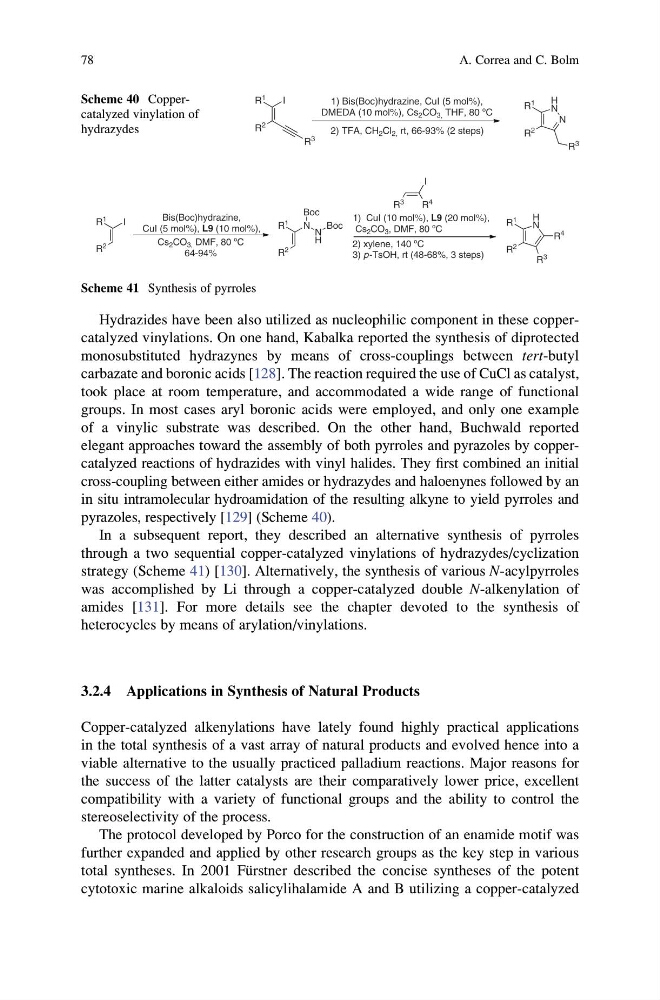
Hydrazides have been also utilized as nucleophilic component in these coppercatalyzed vinylations. On one hand, Kabalka reported the synthesis of diprotected
monosubstituted hydrazynes by means of cross-couplings between tert-butyl
carbazate and boronic acids [128]. The reaction required the use of CuCl as catalyst,
took place at room temperature, and accommodated a wide range of functional
groups. In most cases aryl boronic acids were employed, and only one example
of a vinylic substrate was described. On the other hand, Buchwald reported
elegant approaches toward the assembly of both pyrroles and pyrazoles by coppercatalyzed reactions of hydrazides with vinyl halides. They first combined an initial
cross-coupling between either amides or hydrazydes and haloenynes followed by an
in situ intramolecular hydroamidation of the resulting alkyne to yield pyrroles and
pyrazoles, respectively [129] (Scheme 40).
In a subsequent report, they described an alternative synthesis of pyrroles
through a two sequential copper-catalyzed vinylations of hydrazydes/cyclization
strategy (Scheme 41) [130]. Alternatively, the synthesis of various N-acylpyrroles
was accomplished by Li through a copper-catalyzed double N-alkenylation of
amides [131]. For more details see the chapter devoted to the synthesis of
heterocycles by means of arylation/vinylations.
3.2.4 Applications in Synthesis of Natural Products
Copper-catalyzed alkenylations have lately found highly practical applications
in the total synthesis of a vast array of natural products and evolved hence into a
viable alternative to the usually practiced palladium reactions. Major reasons for
the success of the latter catalysts are their comparatively lower price, excellent
compatibility with a variety of functional groups and the ability to control the
stereoselectivity of the process.
The protocol developed by Porco for the construction of an enamide motif was
further expanded and applied by other research groups as the key step in various
total syntheses. In 2001 Fu ¨rstner described the concise syntheses of the potent
cytotoxic marine alkaloids salicylihalamide A and B utilizing a copper-catalyzed
I
R
1
R
2
R
3
1) Bis(Boc)hydrazine, CuI (5 mol%),
DMEDA (10 mol%), Cs 2 CO 3, THF, 80 ºC
R
1
R
2
N
H
N
R
3
2) TFA, CH 2 Cl 2, rt, 66-93% (2 steps)
Scheme 40 Coppercatalyzed vinylation of
hydrazydes
I
R
1
R
2
Bis(Boc)hydrazine,
CuI (5 mol%), L9 (10 mol%),
Cs 2 CO 3, DMF, 80 ºC
64-94%
N
R
1
R
2
N
H
Boc
Boc
1) CuI (10 mol%), L9 (20 mol%),
Cs 2 CO 3 , DMF, 80 ºC
I
R
4
R
3
2) xylene, 140 ºC
3) p-TsOH, rt (48-68%, 3 steps)
R
1
R
2
H
N
R
4
R
3
Scheme 41 Synthesis of pyrroles
78
A. Correa and C. Bolm
monosubstituted hydrazynes by means of cross-couplings between tert-butyl
carbazate and boronic acids [128]. The reaction required the use of CuCl as catalyst,
took place at room temperature, and accommodated a wide range of functional
groups. In most cases aryl boronic acids were employed, and only one example
of a vinylic substrate was described. On the other hand, Buchwald reported
elegant approaches toward the assembly of both pyrroles and pyrazoles by coppercatalyzed reactions of hydrazides with vinyl halides. They first combined an initial
cross-coupling between either amides or hydrazydes and haloenynes followed by an
in situ intramolecular hydroamidation of the resulting alkyne to yield pyrroles and
pyrazoles, respectively [129] (Scheme 40).
In a subsequent report, they described an alternative synthesis of pyrroles
through a two sequential copper-catalyzed vinylations of hydrazydes/cyclization
strategy (Scheme 41) [130]. Alternatively, the synthesis of various N-acylpyrroles
was accomplished by Li through a copper-catalyzed double N-alkenylation of
amides [131]. For more details see the chapter devoted to the synthesis of
heterocycles by means of arylation/vinylations.
3.2.4 Applications in Synthesis of Natural Products
Copper-catalyzed alkenylations have lately found highly practical applications
in the total synthesis of a vast array of natural products and evolved hence into a
viable alternative to the usually practiced palladium reactions. Major reasons for
the success of the latter catalysts are their comparatively lower price, excellent
compatibility with a variety of functional groups and the ability to control the
stereoselectivity of the process.
The protocol developed by Porco for the construction of an enamide motif was
further expanded and applied by other research groups as the key step in various
total syntheses. In 2001 Fu ¨rstner described the concise syntheses of the potent
cytotoxic marine alkaloids salicylihalamide A and B utilizing a copper-catalyzed
I
R
1
R
2
R
3
1) Bis(Boc)hydrazine, CuI (5 mol%),
DMEDA (10 mol%), Cs 2 CO 3, THF, 80 ºC
R
1
R
2
N
H
N
R
3
2) TFA, CH 2 Cl 2, rt, 66-93% (2 steps)
Scheme 40 Coppercatalyzed vinylation of
hydrazydes
I
R
1
R
2
Bis(Boc)hydrazine,
CuI (5 mol%), L9 (10 mol%),
Cs 2 CO 3, DMF, 80 ºC
64-94%
N
R
1
R
2
N
H
Boc
Boc
1) CuI (10 mol%), L9 (20 mol%),
Cs 2 CO 3 , DMF, 80 ºC
I
R
4
R
3
2) xylene, 140 ºC
3) p-TsOH, rt (48-68%, 3 steps)
R
1
R
2
H
N
R
4
R
3
Scheme 41 Synthesis of pyrroles
78
A. Correa and C. Bolm