

Then, 1,10-phenanthroline, PPh 3 , and the corresponding thiol were added to the
reaction mixture once the first N-vinylation was complete.
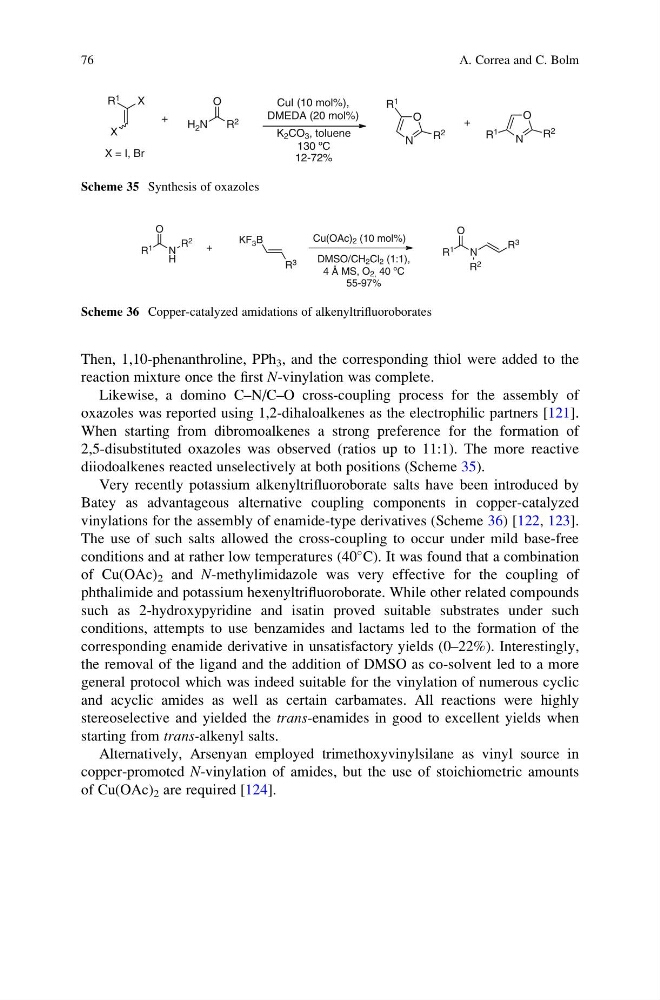
Likewise, a domino C–N/C–O cross-coupling process for the assembly of
oxazoles was reported using 1,2-dihaloalkenes as the electrophilic partners [121].
When starting from dibromoalkenes a strong preference for the formation of
2,5-disubstituted oxazoles was observed (ratios up to 11:1). The more reactive
diiodoalkenes reacted unselectively at both positions (Scheme 35).
Very recently potassium alkenyltrifluoroborate salts have been introduced by
Batey as advantageous alternative coupling components in copper-catalyzed
vinylations for the assembly of enamide-type derivatives (Scheme 36) [122, 123].
The use of such salts allowed the cross-coupling to occur under mild base-free
conditions and at rather low temperatures (40
C). It was found that a combination
of Cu(OAc) 2 and N-methylimidazole was very effective for the coupling of
phthalimide and potassium hexenyltrifluoroborate. While other related compounds
such as 2-hydroxypyridine and isatin proved suitable substrates under such
conditions, attempts to use benzamides and lactams led to the formation of the
corresponding enamide derivative in unsatisfactory yields (0–22%). Interestingly,
the removal of the ligand and the addition of DMSO as co-solvent led to a more
general protocol which was indeed suitable for the vinylation of numerous cyclic
and acyclic amides as well as certain carbamates. All reactions were highly
stereoselective and yielded the trans-enamides in good to excellent yields when
starting from trans-alkenyl salts.
Alternatively, Arsenyan employed trimethoxyvinylsilane as vinyl source in
copper-promoted N-vinylation of amides, but the use of stoichiometric amounts
of Cu(OAc) 2 are required [124].
X
R 1
X
X = I, Br
O
H 2 N
R 2
+
CuI (10 mol%),
DMEDA (20 mol%)
K 2 CO 3 , toluene
130 ºC
12-72%
O
N
R 1
R 2
O
N
R 2
R 1
+
Scheme 35 Synthesis of oxazoles
+
Cu(OAc) 2 (10 mol%)
DMSO/CH 2 Cl 2 (1:1),
4 Å MS, O 2, 40 ºC
55-97%
R 1
N
H
O
R 2
KF 3 B
R 3
R 1
N
O
R 2
R 3
Scheme 36 Copper-catalyzed amidations of alkenyltrifluoroborates
76
A. Correa and C. Bolm
reaction mixture once the first N-vinylation was complete.
Likewise, a domino C–N/C–O cross-coupling process for the assembly of
oxazoles was reported using 1,2-dihaloalkenes as the electrophilic partners [121].
When starting from dibromoalkenes a strong preference for the formation of
2,5-disubstituted oxazoles was observed (ratios up to 11:1). The more reactive
diiodoalkenes reacted unselectively at both positions (Scheme 35).
Very recently potassium alkenyltrifluoroborate salts have been introduced by
Batey as advantageous alternative coupling components in copper-catalyzed
vinylations for the assembly of enamide-type derivatives (Scheme 36) [122, 123].
The use of such salts allowed the cross-coupling to occur under mild base-free
conditions and at rather low temperatures (40
C). It was found that a combination
of Cu(OAc) 2 and N-methylimidazole was very effective for the coupling of
phthalimide and potassium hexenyltrifluoroborate. While other related compounds
such as 2-hydroxypyridine and isatin proved suitable substrates under such
conditions, attempts to use benzamides and lactams led to the formation of the
corresponding enamide derivative in unsatisfactory yields (0–22%). Interestingly,
the removal of the ligand and the addition of DMSO as co-solvent led to a more
general protocol which was indeed suitable for the vinylation of numerous cyclic
and acyclic amides as well as certain carbamates. All reactions were highly
stereoselective and yielded the trans-enamides in good to excellent yields when
starting from trans-alkenyl salts.
Alternatively, Arsenyan employed trimethoxyvinylsilane as vinyl source in
copper-promoted N-vinylation of amides, but the use of stoichiometric amounts
of Cu(OAc) 2 are required [124].
X
R 1
X
X = I, Br
O
H 2 N
R 2
+
CuI (10 mol%),
DMEDA (20 mol%)
K 2 CO 3 , toluene
130 ºC
12-72%
O
N
R 1
R 2
O
N
R 2
R 1
+
Scheme 35 Synthesis of oxazoles
+
Cu(OAc) 2 (10 mol%)
DMSO/CH 2 Cl 2 (1:1),
4 Å MS, O 2, 40 ºC
55-97%
R 1
N
H
O
R 2
KF 3 B
R 3
R 1
N
O
R 2
R 3
Scheme 36 Copper-catalyzed amidations of alkenyltrifluoroborates
76
A. Correa and C. Bolm