

1,2-diiodoethene was utilized as vinyl source in couplings with cyclic and acyclic
amides to furnish b-iodoenamides under Buchwald conditions [119].
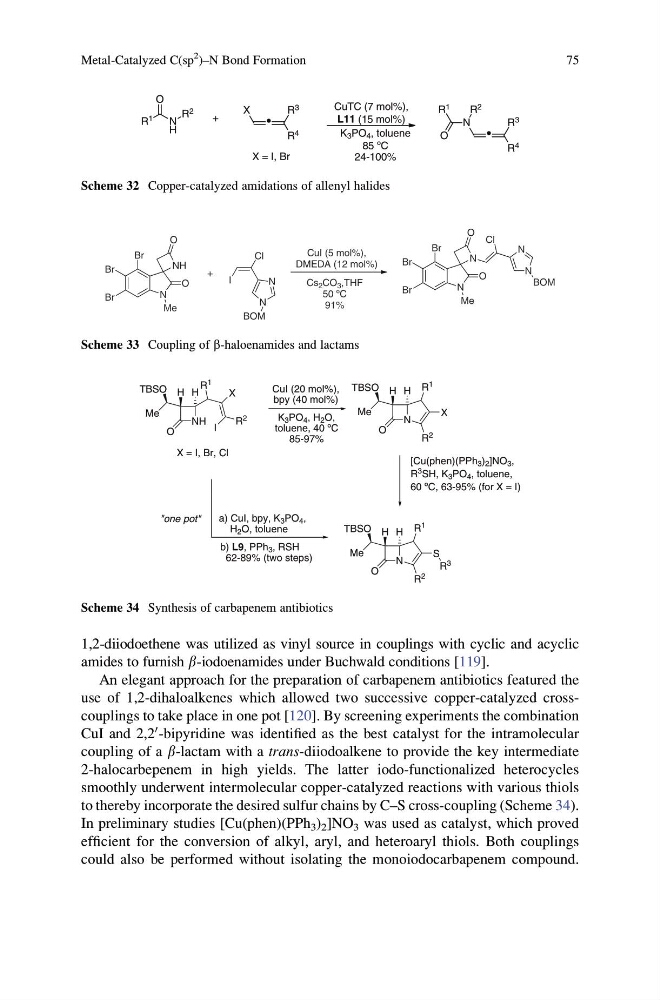
An elegant approach for the preparation of carbapenem antibiotics featured the
use of 1,2-dihaloalkenes which allowed two successive copper-catalyzed crosscouplings to take place in one pot [120]. By screening experiments the combination
CuI and 2,2
0 -bipyridine was identified as the best catalyst for the intramolecular
coupling of a b-lactam with a trans-diiodoalkene to provide the key intermediate
2-halocarbepenem in high yields. The latter iodo-functionalized heterocycles
smoothly underwent intermolecular copper-catalyzed reactions with various thiols
to thereby incorporate the desired sulfur chains by C–S cross-coupling (Scheme 34).
In preliminary studies [Cu(phen)(PPh 3 ) 2 ]NO 3 was used as catalyst, which proved
efficient for the conversion of alkyl, aryl, and heteroaryl thiols. Both couplings
could also be performed without isolating the monoiodocarbapenem compound.
+
CuTC (7 mol%),
L11 (15 mol%)
K 3 PO 4 , toluene
85 ºC
24-100%
R 1
N
H
O
R 2
X
•
R 3
R 4
X = I, Br
N
•
R 3
R 4
R 1
O
R 2
Scheme 32 Copper-catalyzed amidations of allenyl halides
+
N
NH
O
O
Me
Br
Br
Br
I
Cl
N
N
BOM
CuI (5 mol%),
DMEDA (12 mol%)
Cs 2 CO 3 ,THF
50 ºC
91%
N
N
O
O
Me
Br
Br
Br
Cl
N
N
BOM
Scheme 33 Coupling of b-haloenamides and lactams
CuI (20 mol%),
bpy (40 mol%)
K 3 PO 4 , H 2 O,
toluene, 40 ºC
85-97%
NH
O
H H
I
R
2
X
R
1
TBSO
Me
N
O
H H
TBSO
Me
R 1
X
R
2
N
O
H H
TBSO
Me
R
1
S
R
2
R
3
X = I, Br, Cl
[Cu(phen)(PPh 3 ) 2 ]NO 3 ,
R
3 SH, K 3 PO 4 , toluene,
60 ºC, 63-95% (for X = I)
"one pot"
a) CuI, bpy, K 3 PO 4 ,
H 2 O, toluene
b) L9, PPh 3 , RSH
62-89% (two steps)
Scheme 34 Synthesis of carbapenem antibiotics
Metal-Catalyzed C(sp
2
)–N Bond Formation
75
amides to furnish b-iodoenamides under Buchwald conditions [119].
An elegant approach for the preparation of carbapenem antibiotics featured the
use of 1,2-dihaloalkenes which allowed two successive copper-catalyzed crosscouplings to take place in one pot [120]. By screening experiments the combination
CuI and 2,2
0 -bipyridine was identified as the best catalyst for the intramolecular
coupling of a b-lactam with a trans-diiodoalkene to provide the key intermediate
2-halocarbepenem in high yields. The latter iodo-functionalized heterocycles
smoothly underwent intermolecular copper-catalyzed reactions with various thiols
to thereby incorporate the desired sulfur chains by C–S cross-coupling (Scheme 34).
In preliminary studies [Cu(phen)(PPh 3 ) 2 ]NO 3 was used as catalyst, which proved
efficient for the conversion of alkyl, aryl, and heteroaryl thiols. Both couplings
could also be performed without isolating the monoiodocarbapenem compound.
+
CuTC (7 mol%),
L11 (15 mol%)
K 3 PO 4 , toluene
85 ºC
24-100%
R 1
N
H
O
R 2
X
•
R 3
R 4
X = I, Br
N
•
R 3
R 4
R 1
O
R 2
Scheme 32 Copper-catalyzed amidations of allenyl halides
+
N
NH
O
O
Me
Br
Br
Br
I
Cl
N
N
BOM
CuI (5 mol%),
DMEDA (12 mol%)
Cs 2 CO 3 ,THF
50 ºC
91%
N
N
O
O
Me
Br
Br
Br
Cl
N
N
BOM
Scheme 33 Coupling of b-haloenamides and lactams
CuI (20 mol%),
bpy (40 mol%)
K 3 PO 4 , H 2 O,
toluene, 40 ºC
85-97%
NH
O
H H
I
R
2
X
R
1
TBSO
Me
N
O
H H
TBSO
Me
R 1
X
R
2
N
O
H H
TBSO
Me
R
1
S
R
2
R
3
X = I, Br, Cl
[Cu(phen)(PPh 3 ) 2 ]NO 3 ,
R
3 SH, K 3 PO 4 , toluene,
60 ºC, 63-95% (for X = I)
"one pot"
a) CuI, bpy, K 3 PO 4 ,
H 2 O, toluene
b) L9, PPh 3 , RSH
62-89% (two steps)
Scheme 34 Synthesis of carbapenem antibiotics
Metal-Catalyzed C(sp
2
)–N Bond Formation
75