

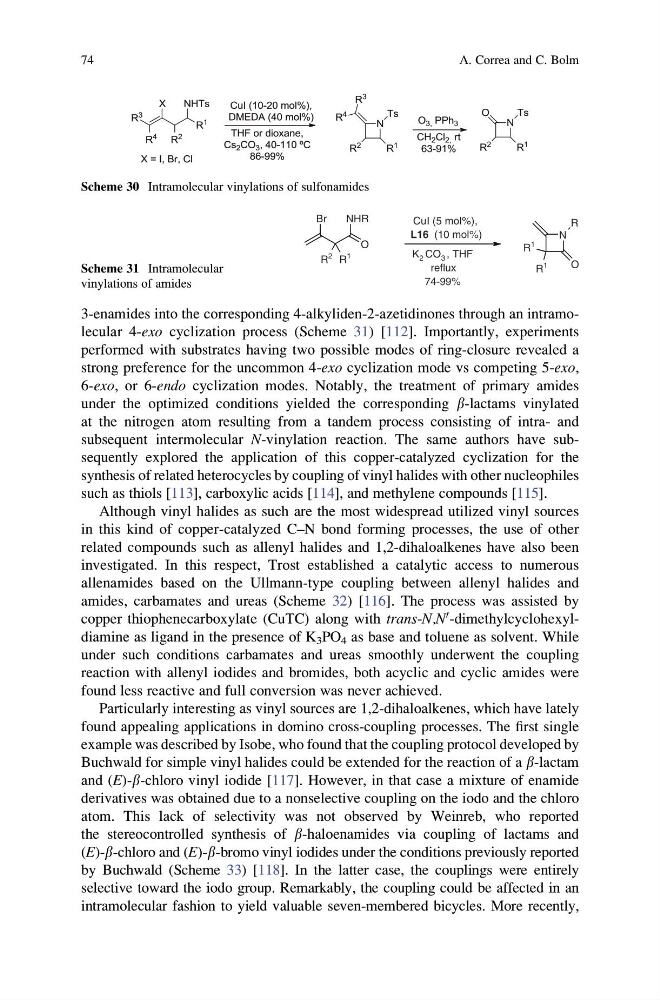
3-enamides into the corresponding 4-alkyliden-2-azetidinones through an intramolecular 4-exo cyclization process (Scheme 31) [112]. Importantly, experiments
performed with substrates having two possible modes of ring-closure revealed a
strong preference for the uncommon 4-exo cyclization mode vs competing 5-exo,
6-exo, or 6-endo cyclization modes. Notably, the treatment of primary amides
under the optimized conditions yielded the corresponding b-lactams vinylated
at the nitrogen atom resulting from a tandem process consisting of intra- and
subsequent intermolecular N-vinylation reaction. The same authors have subsequently explored the application of this copper-catalyzed cyclization for the
synthesis of related heterocycles by coupling of vinyl halides with other nucleophiles
such as thiols [113], carboxylic acids [114], and methylene compounds [115].
Although vinyl halides as such are the most widespread utilized vinyl sources
in this kind of copper-catalyzed C–N bond forming processes, the use of other
related compounds such as allenyl halides and 1,2-dihaloalkenes have also been
investigated. In this respect, Trost established a catalytic access to numerous
allenamides based on the Ullmann-type coupling between allenyl halides and
amides, carbamates and ureas (Scheme 32) [116]. The process was assisted by
copper thiophenecarboxylate (CuTC) along with trans-N,N
0 -dimethylcyclohexyldiamine as ligand in the presence of K 3 PO 4 as base and toluene as solvent. While
under such conditions carbamates and ureas smoothly underwent the coupling
reaction with allenyl iodides and bromides, both acyclic and cyclic amides were
found less reactive and full conversion was never achieved.
Particularly interesting as vinyl sources are 1,2-dihaloalkenes, which have lately
found appealing applications in domino cross-coupling processes. The first single
example was described by Isobe, who found that the coupling protocol developed by
Buchwald for simple vinyl halides could be extended for the reaction of a b-lactam
and (E)-b-chloro vinyl iodide [117]. However, in that case a mixture of enamide
derivatives was obtained due to a nonselective coupling on the iodo and the chloro
atom. This lack of selectivity was not observed by Weinreb, who reported
the stereocontrolled synthesis of b-haloenamides via coupling of lactams and
(E)-b-chloro and (E)-b-bromo vinyl iodides under the conditions previously reported
by Buchwald (Scheme 33) [118]. In the latter case, the couplings were entirely
selective toward the iodo group. Remarkably, the coupling could be affected in an
intramolecular fashion to yield valuable seven-membered bicycles. More recently,
Scheme 30 Intramolecular vinylations of sulfonamides
O
Br
NHR
R
1
CuI (5 mol%),
L16 (10 mol%)
K 2 CO 3 , THF
reflux
74-99%
N
R
O
R
2
R
1
R
1
Scheme 31 Intramolecular
vinylations of amides
74
A. Correa and C. Bolm
performed with substrates having two possible modes of ring-closure revealed a
strong preference for the uncommon 4-exo cyclization mode vs competing 5-exo,
6-exo, or 6-endo cyclization modes. Notably, the treatment of primary amides
under the optimized conditions yielded the corresponding b-lactams vinylated
at the nitrogen atom resulting from a tandem process consisting of intra- and
subsequent intermolecular N-vinylation reaction. The same authors have subsequently explored the application of this copper-catalyzed cyclization for the
synthesis of related heterocycles by coupling of vinyl halides with other nucleophiles
such as thiols [113], carboxylic acids [114], and methylene compounds [115].
Although vinyl halides as such are the most widespread utilized vinyl sources
in this kind of copper-catalyzed C–N bond forming processes, the use of other
related compounds such as allenyl halides and 1,2-dihaloalkenes have also been
investigated. In this respect, Trost established a catalytic access to numerous
allenamides based on the Ullmann-type coupling between allenyl halides and
amides, carbamates and ureas (Scheme 32) [116]. The process was assisted by
copper thiophenecarboxylate (CuTC) along with trans-N,N
0 -dimethylcyclohexyldiamine as ligand in the presence of K 3 PO 4 as base and toluene as solvent. While
under such conditions carbamates and ureas smoothly underwent the coupling
reaction with allenyl iodides and bromides, both acyclic and cyclic amides were
found less reactive and full conversion was never achieved.
Particularly interesting as vinyl sources are 1,2-dihaloalkenes, which have lately
found appealing applications in domino cross-coupling processes. The first single
example was described by Isobe, who found that the coupling protocol developed by
Buchwald for simple vinyl halides could be extended for the reaction of a b-lactam
and (E)-b-chloro vinyl iodide [117]. However, in that case a mixture of enamide
derivatives was obtained due to a nonselective coupling on the iodo and the chloro
atom. This lack of selectivity was not observed by Weinreb, who reported
the stereocontrolled synthesis of b-haloenamides via coupling of lactams and
(E)-b-chloro and (E)-b-bromo vinyl iodides under the conditions previously reported
by Buchwald (Scheme 33) [118]. In the latter case, the couplings were entirely
selective toward the iodo group. Remarkably, the coupling could be affected in an
intramolecular fashion to yield valuable seven-membered bicycles. More recently,
Scheme 30 Intramolecular vinylations of sulfonamides
O
Br
NHR
R
1
CuI (5 mol%),
L16 (10 mol%)
K 2 CO 3 , THF
reflux
74-99%
N
R
O
R
2
R
1
R
1
Scheme 31 Intramolecular
vinylations of amides
74
A. Correa and C. Bolm