

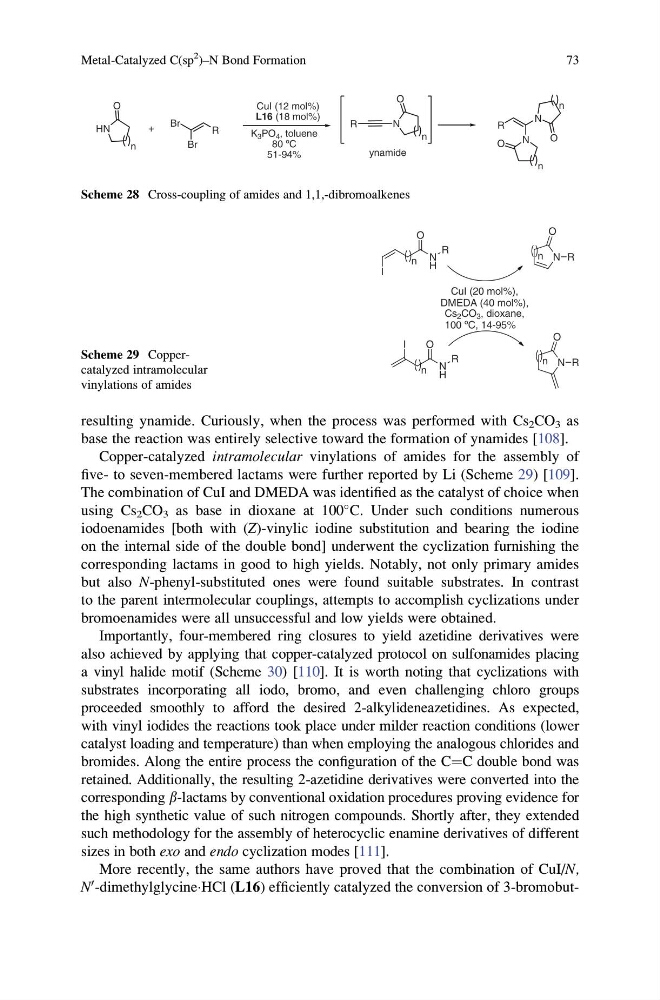
resulting ynamide. Curiously, when the process was performed with Cs 2 CO 3 as
base the reaction was entirely selective toward the formation of ynamides [108].
Copper-catalyzed intramolecular vinylations of amides for the assembly of
five- to seven-membered lactams were further reported by Li (Scheme 29) [109].
The combination of CuI and DMEDA was identified as the catalyst of choice when
using Cs 2 CO 3 as base in dioxane at 100
C. Under such conditions numerous
iodoenamides [both with (Z)-vinylic iodine substitution and bearing the iodine
on the internal side of the double bond] underwent the cyclization furnishing the
corresponding lactams in good to high yields. Notably, not only primary amides
but also N-phenyl-substituted ones were found suitable substrates. In contrast
to the parent intermolecular couplings, attempts to accomplish cyclizations under
bromoenamides were all unsuccessful and low yields were obtained.
Importantly, four-membered ring closures to yield azetidine derivatives were
also achieved by applying that copper-catalyzed protocol on sulfonamides placing
a vinyl halide motif (Scheme 30) [110]. It is worth noting that cyclizations with
substrates incorporating all iodo, bromo, and even challenging chloro groups
proceeded smoothly to afford the desired 2-alkylideneazetidines. As expected,
with vinyl iodides the reactions took place under milder reaction conditions (lower
catalyst loading and temperature) than when employing the analogous chlorides and
bromides. Along the entire process the configuration of the C¼C double bond was
retained. Additionally, the resulting 2-azetidine derivatives were converted into the
corresponding b-lactams by conventional oxidation procedures proving evidence for
the high synthetic value of such nitrogen compounds. Shortly after, they extended
such methodology for the assembly of heterocyclic enamine derivatives of different
sizes in both exo and endo cyclization modes [111].
More recently, the same authors have proved that the combination of CuI/N,
N
0 -dimethylglycine·HCl (L16) efficiently catalyzed the conversion of 3-bromobutBr
Br
R
+
CuI (12 mol%)
L16 (18 mol%)
K 3 PO 4 , toluene
80 ºC
51-94%
HN
O
n
R
N
O
n
ynamide
N
N
R
O
O
n
n
Scheme 28 Cross-coupling of amides and 1,1,-dibromoalkenes
I
N
H
O
R
n
N
H
O
R
n
I
N
O
N
O
R
R
n
n
CuI (20 mol%),
DMEDA (40 mol%),
Cs 2 CO 3 , dioxane,
100 ºC, 14-95%
Scheme 29 Coppercatalyzed intramolecular
vinylations of amides
Metal-Catalyzed C(sp
2
)–N Bond Formation
73
base the reaction was entirely selective toward the formation of ynamides [108].
Copper-catalyzed intramolecular vinylations of amides for the assembly of
five- to seven-membered lactams were further reported by Li (Scheme 29) [109].
The combination of CuI and DMEDA was identified as the catalyst of choice when
using Cs 2 CO 3 as base in dioxane at 100
C. Under such conditions numerous
iodoenamides [both with (Z)-vinylic iodine substitution and bearing the iodine
on the internal side of the double bond] underwent the cyclization furnishing the
corresponding lactams in good to high yields. Notably, not only primary amides
but also N-phenyl-substituted ones were found suitable substrates. In contrast
to the parent intermolecular couplings, attempts to accomplish cyclizations under
bromoenamides were all unsuccessful and low yields were obtained.
Importantly, four-membered ring closures to yield azetidine derivatives were
also achieved by applying that copper-catalyzed protocol on sulfonamides placing
a vinyl halide motif (Scheme 30) [110]. It is worth noting that cyclizations with
substrates incorporating all iodo, bromo, and even challenging chloro groups
proceeded smoothly to afford the desired 2-alkylideneazetidines. As expected,
with vinyl iodides the reactions took place under milder reaction conditions (lower
catalyst loading and temperature) than when employing the analogous chlorides and
bromides. Along the entire process the configuration of the C¼C double bond was
retained. Additionally, the resulting 2-azetidine derivatives were converted into the
corresponding b-lactams by conventional oxidation procedures proving evidence for
the high synthetic value of such nitrogen compounds. Shortly after, they extended
such methodology for the assembly of heterocyclic enamine derivatives of different
sizes in both exo and endo cyclization modes [111].
More recently, the same authors have proved that the combination of CuI/N,
N
0 -dimethylglycine·HCl (L16) efficiently catalyzed the conversion of 3-bromobutBr
Br
R
+
CuI (12 mol%)
L16 (18 mol%)
K 3 PO 4 , toluene
80 ºC
51-94%
HN
O
n
R
N
O
n
ynamide
N
N
R
O
O
n
n
Scheme 28 Cross-coupling of amides and 1,1,-dibromoalkenes
I
N
H
O
R
n
N
H
O
R
n
I
N
O
N
O
R
R
n
n
CuI (20 mol%),
DMEDA (40 mol%),
Cs 2 CO 3 , dioxane,
100 ºC, 14-95%
Scheme 29 Coppercatalyzed intramolecular
vinylations of amides
Metal-Catalyzed C(sp
2
)–N Bond Formation
73