

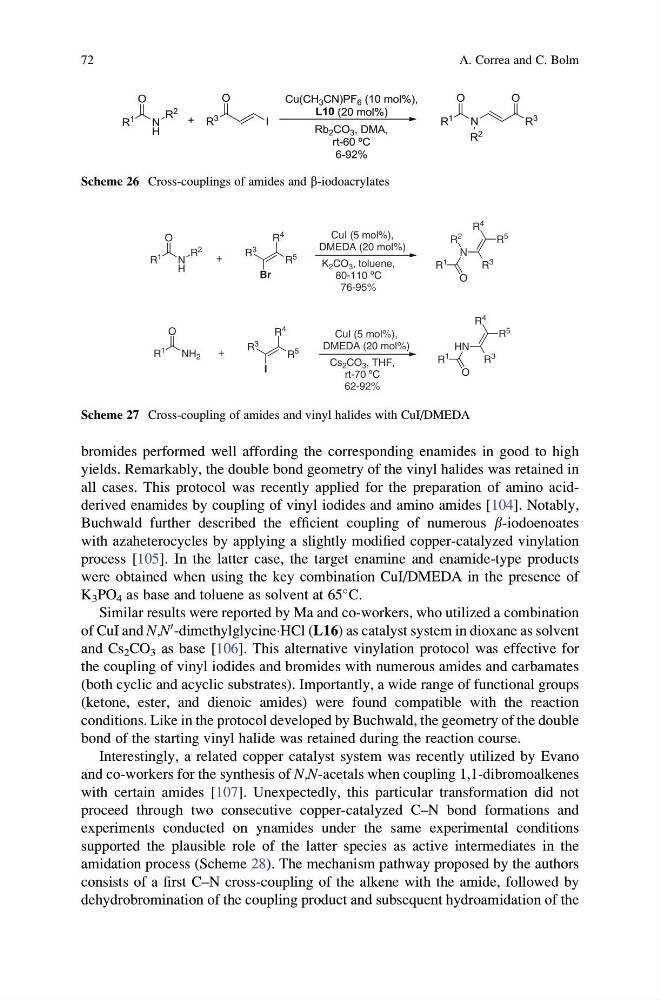
bromides performed well affording the corresponding enamides in good to high
yields. Remarkably, the double bond geometry of the vinyl halides was retained in
all cases. This protocol was recently applied for the preparation of amino acidderived enamides by coupling of vinyl iodides and amino amides [104]. Notably,
Buchwald further described the efficient coupling of numerous b-iodoenoates
with azaheterocycles by applying a slightly modified copper-catalyzed vinylation
process [105]. In the latter case, the target enamine and enamide-type products
were obtained when using the key combination CuI/DMEDA in the presence of
K 3 PO 4 as base and toluene as solvent at 65
C.
Similar results were reported by Ma and co-workers, who utilized a combination
of CuI and N,N
0 -dimethylglycine·HCl (L16) as catalyst system in dioxane as solvent
and Cs 2 CO 3 as base [106]. This alternative vinylation protocol was effective for
the coupling of vinyl iodides and bromides with numerous amides and carbamates
(both cyclic and acyclic substrates). Importantly, a wide range of functional groups
(ketone, ester, and dienoic amides) were found compatible with the reaction
conditions. Like in the protocol developed by Buchwald, the geometry of the double
bond of the starting vinyl halide was retained during the reaction course.
Interestingly, a related copper catalyst system was recently utilized by Evano
and co-workers for the synthesis of N,N-acetals when coupling 1,1-dibromoalkenes
with certain amides [107]. Unexpectedly, this particular transformation did not
proceed through two consecutive copper-catalyzed C–N bond formations and
experiments conducted on ynamides under the same experimental conditions
supported the plausible role of the latter species as active intermediates in the
amidation process (Scheme 28). The mechanism pathway proposed by the authors
consists of a first C–N cross-coupling of the alkene with the amide, followed by
dehydrobromination of the coupling product and subsequent hydroamidation of the
Scheme 26 Cross-couplings of amides and b-iodoacrylates
R
3
Br
R
5
R
4
+
CuI (5 mol%),
DMEDA (20 mol%)
K 2 CO 3 , toluene,
80-110 ºC
76-95%
N
R
2
R
5
R
4
R
3
R
1
N
H
O
R
2
O
R
1
R
3
I
R
5
R
4
+
HN
R
5
R
4
R
3
R
1
NH 2
O
O
R
1
CuI (5 mol%),
DMEDA (20 mol%)
Cs 2 CO 3 , THF,
rt-70 ºC
62-92%
Scheme 27 Cross-coupling of amides and vinyl halides with CuI/DMEDA
72
A. Correa and C. Bolm
yields. Remarkably, the double bond geometry of the vinyl halides was retained in
all cases. This protocol was recently applied for the preparation of amino acidderived enamides by coupling of vinyl iodides and amino amides [104]. Notably,
Buchwald further described the efficient coupling of numerous b-iodoenoates
with azaheterocycles by applying a slightly modified copper-catalyzed vinylation
process [105]. In the latter case, the target enamine and enamide-type products
were obtained when using the key combination CuI/DMEDA in the presence of
K 3 PO 4 as base and toluene as solvent at 65
C.
Similar results were reported by Ma and co-workers, who utilized a combination
of CuI and N,N
0 -dimethylglycine·HCl (L16) as catalyst system in dioxane as solvent
and Cs 2 CO 3 as base [106]. This alternative vinylation protocol was effective for
the coupling of vinyl iodides and bromides with numerous amides and carbamates
(both cyclic and acyclic substrates). Importantly, a wide range of functional groups
(ketone, ester, and dienoic amides) were found compatible with the reaction
conditions. Like in the protocol developed by Buchwald, the geometry of the double
bond of the starting vinyl halide was retained during the reaction course.
Interestingly, a related copper catalyst system was recently utilized by Evano
and co-workers for the synthesis of N,N-acetals when coupling 1,1-dibromoalkenes
with certain amides [107]. Unexpectedly, this particular transformation did not
proceed through two consecutive copper-catalyzed C–N bond formations and
experiments conducted on ynamides under the same experimental conditions
supported the plausible role of the latter species as active intermediates in the
amidation process (Scheme 28). The mechanism pathway proposed by the authors
consists of a first C–N cross-coupling of the alkene with the amide, followed by
dehydrobromination of the coupling product and subsequent hydroamidation of the
Scheme 26 Cross-couplings of amides and b-iodoacrylates
R
3
Br
R
5
R
4
+
CuI (5 mol%),
DMEDA (20 mol%)
K 2 CO 3 , toluene,
80-110 ºC
76-95%
N
R
2
R
5
R
4
R
3
R
1
N
H
O
R
2
O
R
1
R
3
I
R
5
R
4
+
HN
R
5
R
4
R
3
R
1
NH 2
O
O
R
1
CuI (5 mol%),
DMEDA (20 mol%)
Cs 2 CO 3 , THF,
rt-70 ºC
62-92%
Scheme 27 Cross-coupling of amides and vinyl halides with CuI/DMEDA
72
A. Correa and C. Bolm