

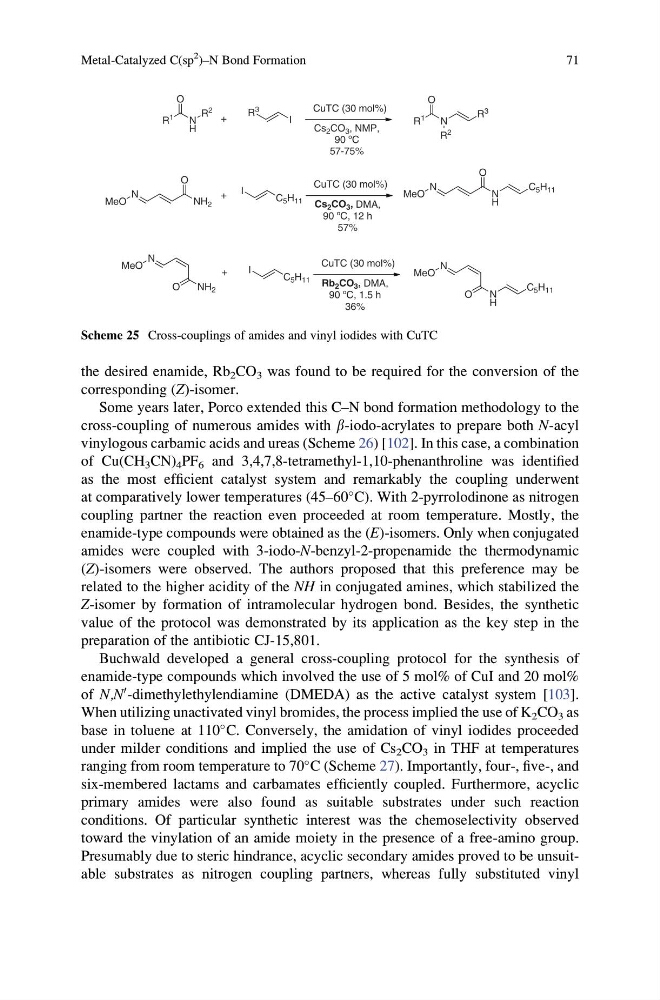
the desired enamide, Rb 2 CO 3 was found to be required for the conversion of the
corresponding (Z)-isomer.
Some years later, Porco extended this C–N bond formation methodology to the
cross-coupling of numerous amides with b-iodo-acrylates to prepare both N-acyl
vinylogous carbamic acids and ureas (Scheme 26) [102]. In this case, a combination
of Cu(CH 3 CN) 4 PF 6 and 3,4,7,8-tetramethyl-1,10-phenanthroline was identified
as the most efficient catalyst system and remarkably the coupling underwent
at comparatively lower temperatures (45–60
C). With 2-pyrrolodinone as nitrogen
coupling partner the reaction even proceeded at room temperature. Mostly, the
enamide-type compounds were obtained as the (E)-isomers. Only when conjugated
amides were coupled with 3-iodo-N-benzyl-2-propenamide the thermodynamic
(Z)-isomers were observed. The authors proposed that this preference may be
related to the higher acidity of the NH in conjugated amines, which stabilized the
Z-isomer by formation of intramolecular hydrogen bond. Besides, the synthetic
value of the protocol was demonstrated by its application as the key step in the
preparation of the antibiotic CJ-15,801.
Buchwald developed a general cross-coupling protocol for the synthesis of
enamide-type compounds which involved the use of 5 mol% of CuI and 20 mol%
of N,N
0 -dimethylethylendiamine (DMEDA) as the active catalyst system [103].
When utilizing unactivated vinyl bromides, the process implied the use of K 2 CO 3 as
base in toluene at 110
C. Conversely, the amidation of vinyl iodides proceeded
under milder conditions and implied the use of Cs 2 CO 3 in THF at temperatures
ranging from room temperature to 70
C (Scheme 27). Importantly, four-, five-, and
six-membered lactams and carbamates efficiently coupled. Furthermore, acyclic
primary amides were also found as suitable substrates under such reaction
conditions. Of particular synthetic interest was the chemoselectivity observed
toward the vinylation of an amide moiety in the presence of a free-amino group.
Presumably due to steric hindrance, acyclic secondary amides proved to be unsuitable substrates as nitrogen coupling partners, whereas fully substituted vinyl
I
+
CuTC (30 mol%)
Cs 2 CO 3 , NMP,
90 ºC
57-75%
R
1
N
H
O
R
2
R
3
R
1
N
O
R
3
R
2
MeO
N
NH 2
O
C 5 H 11
CuTC (30 mol%)
Cs 2 CO 3 , DMA,
90 ºC, 12 h
57%
I
MeO
N
N
H
O
C 5 H 11
MeO
N
NH 2
O
+
C 5 H 11
CuTC (30 mol%)
Rb 2 CO 3 , DMA,
90 ºC, 1.5 h
36%
I
MeO
N
N
H
O
C 5 H 11
+
Scheme 25 Cross-couplings of amides and vinyl iodides with CuTC
Metal-Catalyzed C(sp
2
)–N Bond Formation
71
corresponding (Z)-isomer.
Some years later, Porco extended this C–N bond formation methodology to the
cross-coupling of numerous amides with b-iodo-acrylates to prepare both N-acyl
vinylogous carbamic acids and ureas (Scheme 26) [102]. In this case, a combination
of Cu(CH 3 CN) 4 PF 6 and 3,4,7,8-tetramethyl-1,10-phenanthroline was identified
as the most efficient catalyst system and remarkably the coupling underwent
at comparatively lower temperatures (45–60
C). With 2-pyrrolodinone as nitrogen
coupling partner the reaction even proceeded at room temperature. Mostly, the
enamide-type compounds were obtained as the (E)-isomers. Only when conjugated
amides were coupled with 3-iodo-N-benzyl-2-propenamide the thermodynamic
(Z)-isomers were observed. The authors proposed that this preference may be
related to the higher acidity of the NH in conjugated amines, which stabilized the
Z-isomer by formation of intramolecular hydrogen bond. Besides, the synthetic
value of the protocol was demonstrated by its application as the key step in the
preparation of the antibiotic CJ-15,801.
Buchwald developed a general cross-coupling protocol for the synthesis of
enamide-type compounds which involved the use of 5 mol% of CuI and 20 mol%
of N,N
0 -dimethylethylendiamine (DMEDA) as the active catalyst system [103].
When utilizing unactivated vinyl bromides, the process implied the use of K 2 CO 3 as
base in toluene at 110
C. Conversely, the amidation of vinyl iodides proceeded
under milder conditions and implied the use of Cs 2 CO 3 in THF at temperatures
ranging from room temperature to 70
C (Scheme 27). Importantly, four-, five-, and
six-membered lactams and carbamates efficiently coupled. Furthermore, acyclic
primary amides were also found as suitable substrates under such reaction
conditions. Of particular synthetic interest was the chemoselectivity observed
toward the vinylation of an amide moiety in the presence of a free-amino group.
Presumably due to steric hindrance, acyclic secondary amides proved to be unsuitable substrates as nitrogen coupling partners, whereas fully substituted vinyl
I
+
CuTC (30 mol%)
Cs 2 CO 3 , NMP,
90 ºC
57-75%
R
1
N
H
O
R
2
R
3
R
1
N
O
R
3
R
2
MeO
N
NH 2
O
C 5 H 11
CuTC (30 mol%)
Cs 2 CO 3 , DMA,
90 ºC, 12 h
57%
I
MeO
N
N
H
O
C 5 H 11
MeO
N
NH 2
O
+
C 5 H 11
CuTC (30 mol%)
Rb 2 CO 3 , DMA,
90 ºC, 1.5 h
36%
I
MeO
N
N
H
O
C 5 H 11
+
Scheme 25 Cross-couplings of amides and vinyl iodides with CuTC
Metal-Catalyzed C(sp
2
)–N Bond Formation
71