

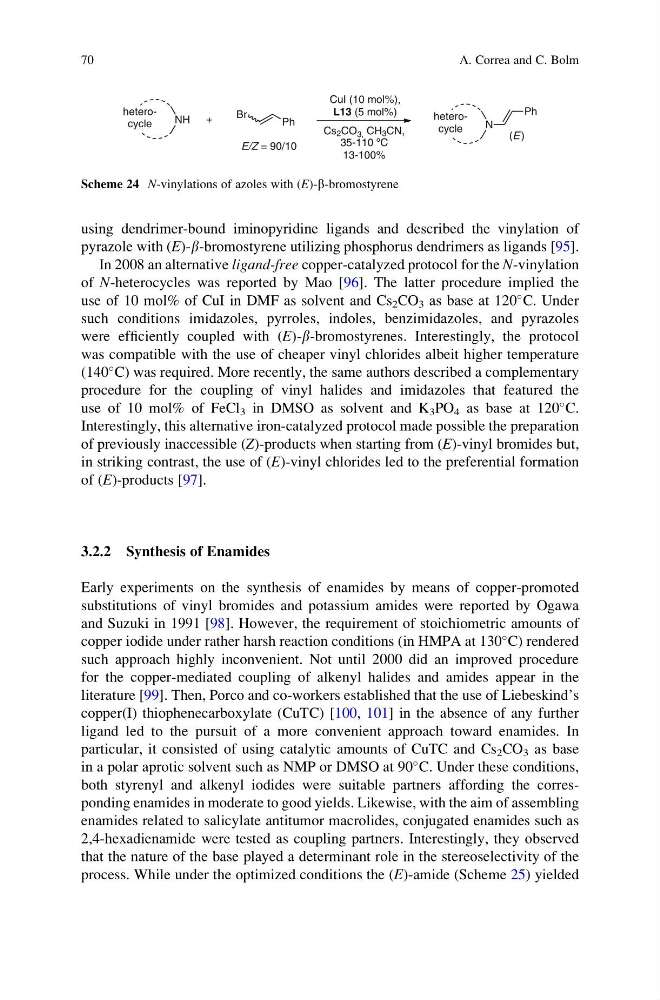
using dendrimer-bound iminopyridine ligands and described the vinylation of
pyrazole with (E)-b-bromostyrene utilizing phosphorus dendrimers as ligands [95].
In 2008 an alternative ligand-free copper-catalyzed protocol for the N-vinylation
of N-heterocycles was reported by Mao [96]. The latter procedure implied the
use of 10 mol% of CuI in DMF as solvent and Cs 2 CO 3 as base at 120
C. Under
such conditions imidazoles, pyrroles, indoles, benzimidazoles, and pyrazoles
were efficiently coupled with (E)-b-bromostyrenes. Interestingly, the protocol
was compatible with the use of cheaper vinyl chlorides albeit higher temperature
(140
C) was required. More recently, the same authors described a complementary
procedure for the coupling of vinyl halides and imidazoles that featured the
use of 10 mol% of FeCl 3 in DMSO as solvent and K 3 PO 4 as base at 120
C.
Interestingly, this alternative iron-catalyzed protocol made possible the preparation
of previously inaccessible (Z)-products when starting from (E)-vinyl bromides but,
in striking contrast, the use of (E)-vinyl chlorides led to the preferential formation
of (E)-products [97].
3.2.2 Synthesis of Enamides
Early experiments on the synthesis of enamides by means of copper-promoted
substitutions of vinyl bromides and potassium amides were reported by Ogawa
and Suzuki in 1991 [98]. However, the requirement of stoichiometric amounts of
copper iodide under rather harsh reaction conditions (in HMPA at 130
C) rendered
such approach highly inconvenient. Not until 2000 did an improved procedure
for the copper-mediated coupling of alkenyl halides and amides appear in the
literature [99]. Then, Porco and co-workers established that the use of Liebeskind’s
copper(I) thiophenecarboxylate (CuTC) [100, 101] in the absence of any further
ligand led to the pursuit of a more convenient approach toward enamides. In
particular, it consisted of using catalytic amounts of CuTC and Cs 2 CO 3 as base
in a polar aprotic solvent such as NMP or DMSO at 90
C. Under these conditions,
both styrenyl and alkenyl iodides were suitable partners affording the corresponding enamides in moderate to good yields. Likewise, with the aim of assembling
enamides related to salicylate antitumor macrolides, conjugated enamides such as
2,4-hexadienamide were tested as coupling partners. Interestingly, they observed
that the nature of the base played a determinant role in the stereoselectivity of the
process. While under the optimized conditions the (E)-amide (Scheme 25) yielded
NH
heterocycle
Ph
+
CuI (10 mol%),
L13 (5 mol%)
Cs 2 CO 3, CH 3 CN,
35-110 ºC
13-100%
N
heterocycle
Ph
Br
E/Z = 90/10
(E )
Scheme 24 N-vinylations of azoles with (E)-b-bromostyrene
70
A. Correa and C. Bolm
pyrazole with (E)-b-bromostyrene utilizing phosphorus dendrimers as ligands [95].
In 2008 an alternative ligand-free copper-catalyzed protocol for the N-vinylation
of N-heterocycles was reported by Mao [96]. The latter procedure implied the
use of 10 mol% of CuI in DMF as solvent and Cs 2 CO 3 as base at 120
C. Under
such conditions imidazoles, pyrroles, indoles, benzimidazoles, and pyrazoles
were efficiently coupled with (E)-b-bromostyrenes. Interestingly, the protocol
was compatible with the use of cheaper vinyl chlorides albeit higher temperature
(140
C) was required. More recently, the same authors described a complementary
procedure for the coupling of vinyl halides and imidazoles that featured the
use of 10 mol% of FeCl 3 in DMSO as solvent and K 3 PO 4 as base at 120
C.
Interestingly, this alternative iron-catalyzed protocol made possible the preparation
of previously inaccessible (Z)-products when starting from (E)-vinyl bromides but,
in striking contrast, the use of (E)-vinyl chlorides led to the preferential formation
of (E)-products [97].
3.2.2 Synthesis of Enamides
Early experiments on the synthesis of enamides by means of copper-promoted
substitutions of vinyl bromides and potassium amides were reported by Ogawa
and Suzuki in 1991 [98]. However, the requirement of stoichiometric amounts of
copper iodide under rather harsh reaction conditions (in HMPA at 130
C) rendered
such approach highly inconvenient. Not until 2000 did an improved procedure
for the copper-mediated coupling of alkenyl halides and amides appear in the
literature [99]. Then, Porco and co-workers established that the use of Liebeskind’s
copper(I) thiophenecarboxylate (CuTC) [100, 101] in the absence of any further
ligand led to the pursuit of a more convenient approach toward enamides. In
particular, it consisted of using catalytic amounts of CuTC and Cs 2 CO 3 as base
in a polar aprotic solvent such as NMP or DMSO at 90
C. Under these conditions,
both styrenyl and alkenyl iodides were suitable partners affording the corresponding enamides in moderate to good yields. Likewise, with the aim of assembling
enamides related to salicylate antitumor macrolides, conjugated enamides such as
2,4-hexadienamide were tested as coupling partners. Interestingly, they observed
that the nature of the base played a determinant role in the stereoselectivity of the
process. While under the optimized conditions the (E)-amide (Scheme 25) yielded
NH
heterocycle
Ph
+
CuI (10 mol%),
L13 (5 mol%)
Cs 2 CO 3, CH 3 CN,
35-110 ºC
13-100%
N
heterocycle
Ph
Br
E/Z = 90/10
(E )
Scheme 24 N-vinylations of azoles with (E)-b-bromostyrene
70
A. Correa and C. Bolm