

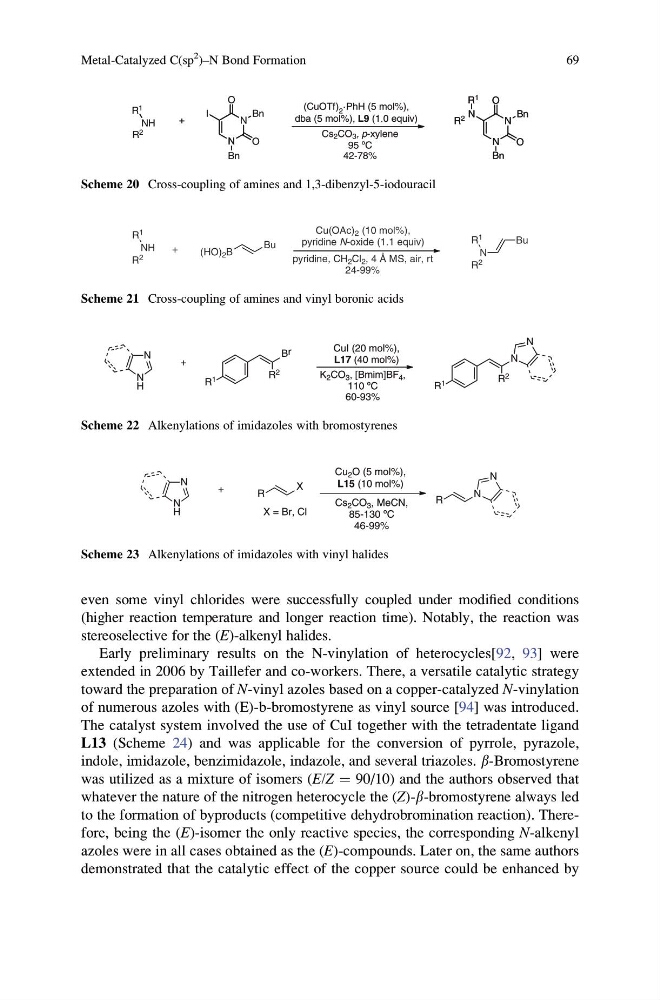
even some vinyl chlorides were successfully coupled under modified conditions
(higher reaction temperature and longer reaction time). Notably, the reaction was
stereoselective for the (E)-alkenyl halides.
Early preliminary results on the N-vinylation of heterocycles[92, 93] were
extended in 2006 by Taillefer and co-workers. There, a versatile catalytic strategy
toward the preparation of N-vinyl azoles based on a copper-catalyzed N-vinylation
of numerous azoles with (E)-b-bromostyrene as vinyl source [94] was introduced.
The catalyst system involved the use of CuI together with the tetradentate ligand
L13 (Scheme 24) and was applicable for the conversion of pyrrole, pyrazole,
indole, imidazole, benzimidazole, indazole, and several triazoles. b-Bromostyrene
was utilized as a mixture of isomers (E/Z ¼ 90/10) and the authors observed that
whatever the nature of the nitrogen heterocycle the (Z)-b-bromostyrene always led
to the formation of byproducts (competitive dehydrobromination reaction). Therefore, being the (E)-isomer the only reactive species, the corresponding N-alkenyl
azoles were in all cases obtained as the (E)-compounds. Later on, the same authors
demonstrated that the catalytic effect of the copper source could be enhanced by
(CuOTf) 2 ·PhH (5 mol%),
dba (5 mol%), L9 (1 0 equiv)
+
N
N
O
O
Bn
Bn
I
NH
R 1
R 2
N
N
O
O
Bn
Bn
N
R 2
R 1
.
Cs 2 CO 3 , p-xylene
95 ºC
42-78%
+
N
N
N
O
O
Bn
Bn
N
R 2
R 1
Scheme 20 Cross-coupling of amines and 1,3-dibenzyl-5-iodouracil
Cu(OAc) 2 (10 mol%),
pyridine N-oxide (1.1 equiv)
pyridine, CH 2 Cl 2 , 4 Å MS, air, rt
24-99%
+
NH
R 1
R 2
(HO) 2 B
Bu
N
R 1
R 2
Bu
Scheme 21 Cross-coupling of amines and vinyl boronic acids
CuI (20 mol%),
L17 (40 mol%)
K 2 CO 3 , [Bmim]BF 4 ,
110 ºC
60-93%
+
B r
R 1
R 2
N
N
H
N
R 1
R 2
N
Scheme 22 Alkenylations of imidazoles with bromostyrenes
Cu 2 O (5 mol%),
L15 (10 mol%)
Cs 2 CO 3 , MeCN,
85-130 ºC
46-99%
+
R
X
N
N
H
R
N
N
X = Br, Cl
Scheme 23 Alkenylations of imidazoles with vinyl halides
Metal-Catalyzed C(sp
2
)–N Bond Formation
69
(higher reaction temperature and longer reaction time). Notably, the reaction was
stereoselective for the (E)-alkenyl halides.
Early preliminary results on the N-vinylation of heterocycles[92, 93] were
extended in 2006 by Taillefer and co-workers. There, a versatile catalytic strategy
toward the preparation of N-vinyl azoles based on a copper-catalyzed N-vinylation
of numerous azoles with (E)-b-bromostyrene as vinyl source [94] was introduced.
The catalyst system involved the use of CuI together with the tetradentate ligand
L13 (Scheme 24) and was applicable for the conversion of pyrrole, pyrazole,
indole, imidazole, benzimidazole, indazole, and several triazoles. b-Bromostyrene
was utilized as a mixture of isomers (E/Z ¼ 90/10) and the authors observed that
whatever the nature of the nitrogen heterocycle the (Z)-b-bromostyrene always led
to the formation of byproducts (competitive dehydrobromination reaction). Therefore, being the (E)-isomer the only reactive species, the corresponding N-alkenyl
azoles were in all cases obtained as the (E)-compounds. Later on, the same authors
demonstrated that the catalytic effect of the copper source could be enhanced by
(CuOTf) 2 ·PhH (5 mol%),
dba (5 mol%), L9 (1 0 equiv)
+
N
N
O
O
Bn
Bn
I
NH
R 1
R 2
N
N
O
O
Bn
Bn
N
R 2
R 1
.
Cs 2 CO 3 , p-xylene
95 ºC
42-78%
+
N
N
N
O
O
Bn
Bn
N
R 2
R 1
Scheme 20 Cross-coupling of amines and 1,3-dibenzyl-5-iodouracil
Cu(OAc) 2 (10 mol%),
pyridine N-oxide (1.1 equiv)
pyridine, CH 2 Cl 2 , 4 Å MS, air, rt
24-99%
+
NH
R 1
R 2
(HO) 2 B
Bu
N
R 1
R 2
Bu
Scheme 21 Cross-coupling of amines and vinyl boronic acids
CuI (20 mol%),
L17 (40 mol%)
K 2 CO 3 , [Bmim]BF 4 ,
110 ºC
60-93%
+
B r
R 1
R 2
N
N
H
N
R 1
R 2
N
Scheme 22 Alkenylations of imidazoles with bromostyrenes
Cu 2 O (5 mol%),
L15 (10 mol%)
Cs 2 CO 3 , MeCN,
85-130 ºC
46-99%
+
R
X
N
N
H
R
N
N
X = Br, Cl
Scheme 23 Alkenylations of imidazoles with vinyl halides
Metal-Catalyzed C(sp
2
)–N Bond Formation
69